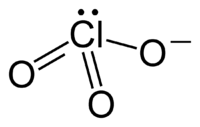
| CAS Number | 14866-68-3 |
|---|---|
| Molecular Formula | ClO3 |
| Molecular Weight | 83.450 |
| InChI Key | XTEGARKTQYYJKE-UHFFFAOYSA-M |
| LogP | -4.63 |
| Synonyms |
|
Applications:
ELSD HPLC Method for Analysis of Inorganic Ions on Chromni Column
July 17, 2026
HPLC Method for Chlorate, Nitrate, Bromate, Chloride, Sodium, Sulfate on Chromni by SIELC Technologies
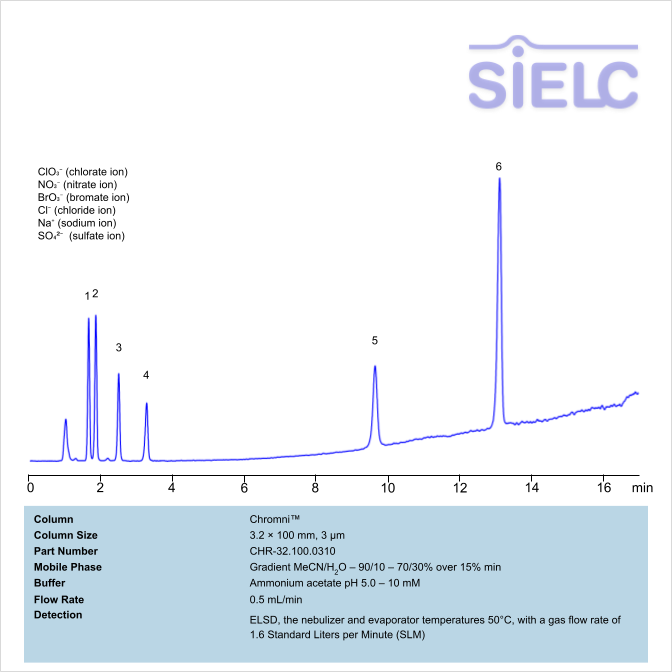
High Performance Liquid Chromatography (HPLC) Method for Analysis of Chlorate, Nitrate, Bromate, Chloride, Sodium, Sulfate.
Chlorate is a a compound with the chemical formula ClO3–. It is an oxidizer that works on Large variety of organics and other easily oxidized materials. Historically, it was used in pyrotechnics, but it faded out of use due to Chlorate’s instability. Magnesium chlorate has been found on Mars.
Nitrate, NO3–, is a compound of nitrogen and oxygen. It is essential as a nutrient in plants; therefore, it is often used in fertilizers. It is easily found in leafy greens. While it is important for cardiovascular health, too high of exposure to it can be dangerous.
Bromate is an oxyanion with the chemical formula BrO3–. It is formed in water through a reaction of ozone and bromide. It is suspected to be a human carcinogen.
Chloride is typically used to refer to a compound or molecule that contains a chlorine anion: Cl–. It is an electrolyte that is essential for bodily functions including blood pH, fluid balance, cellular functions, and more. Imbalance of chloride can indicate underlying health problems.
Sodium, which has a chemical symbol of Na, is a soft alkali metal that is highly reactive. It is found in abundance in everyday materials like table salt, sea water, and even the Earth’s crust. It is crucial for the body’s function and fluid balance.
Sulfate is an ionic chemical with the formula SO42-. In nature, it is usually found in geodes like gypsum. It is also created in atmosphere from sulfur dioxide. It is used for a variety of applications, but most notably, coloring wood and creating light-reflecting paints.
Chlorate, Nitrate, Bromate, Chloride, Sodium, Sulfate can be retained and analyzed using the Chromni stationary phase column. The analysis utilizes an isocratic method with a simple mobile phase consisting of water and acetonitrile (MeCN) with an Ammonium Acetate buffer. Detection is performed using MS.
| Column | Chromni, 3.2 x 100 mm, 3 µm, 100 A, dual ended |
| Mobile Phase | Gradient MeCN/H2O – 90/10-70/30% over 15 min |
| Buffer | Ammonium Acetate pH 5.0 – 10 mM |
| Flow Rate | 0.5 mL/min |
| Detection | ELSD |
Application Column
Chromni
Column Diameter: 3.2 mm
Column Length: 100 mm
Particle Size: 3 µm
Pore Size: 100 A
Column options: dual ended
Chlorate
Chloride
Nitrate
Sodium
Sulfate

HPLC Separation of Polar Pesticides on Newcrom B Column
November 19, 2020
HPLC Method for Glyphosate, Phosphorous acid, Fosetyl-Al, Bromide, Chlorate, Perchlorate, Bialaphos, Aminomethylphosphonic acid (AMPA), Bromate, Sodium Bromate, 3-(Methylphosphinico)propionic acid on Newcrom B by SIELC Technologies
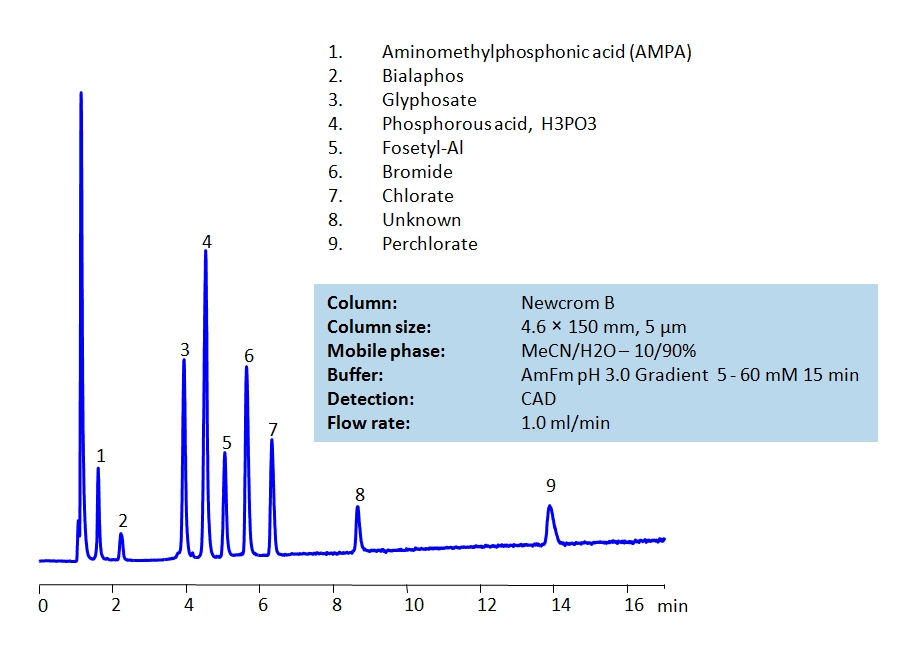
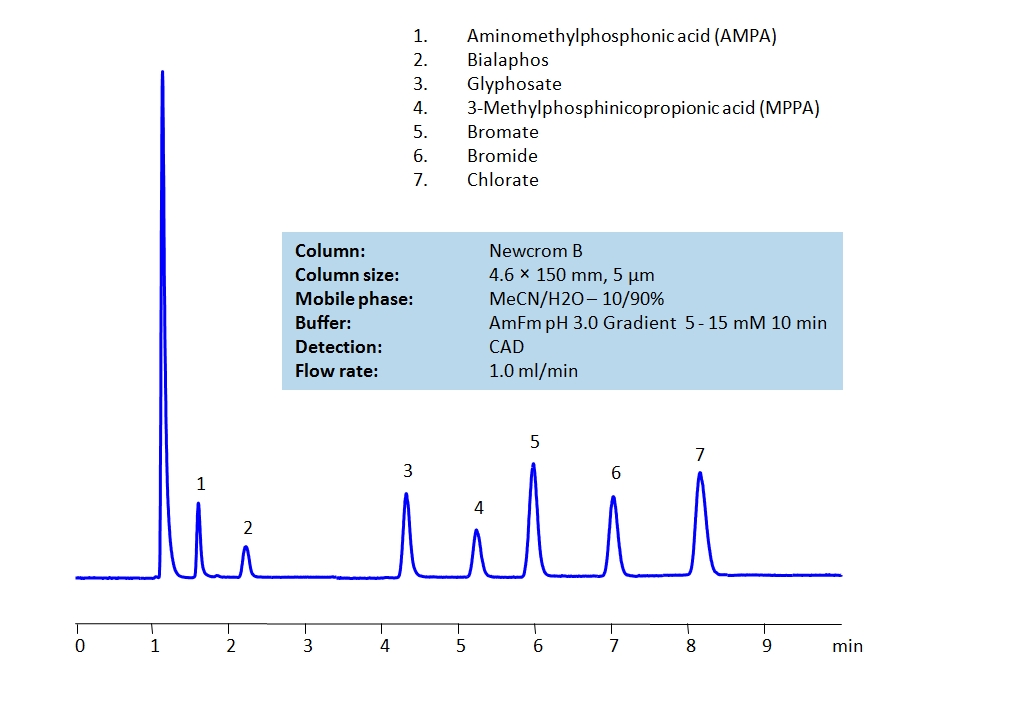
High Performance Liquid Chromatography (HPLC) Method for Analysis of Glyphosate, Phosphorous acid, Fosetyl-Al, Bromide, Chlorate, Perchlorate, Bialaphos, Aminomethylphosphonic acid (AMPA), Bromate, Sodium Bromate, 3-(Methylphosphinico)propionic acid.
Pesticide is a more generic term that includes herbicides, fungicides and insecticides in its definition. Herbicides are used to control unwanted plants, they are also known as weedkillers. Insecticides are used to kill insects. Fungicides are used to kill parasitic fungi. All are heavily used in agriculture. By using HPLC, many different pesticides can be separated and their retention characteristics controlled using the Newcrom B mixed-mode column.
| Column | Newcrom B, 4.6 x 150 mm, 5 µm, 100 A, dual ended |
| Mobile Phase | MeCN/H2O – 10/90% |
| Buffer | AmFm pH 3.0 Gradient 5 – 60 mM 15 min |
| Flow Rate | 1 ml/min |
| Detection | CAD |
| Column | Newcrom B, 4.6 x 150 mm, 5 µm, 100 A, dual ended |
| Mobile Phase | MeCN/H2O – 10/90% |
| Buffer | AmFm pH 3.0 Gradient 5 – 15 mM 10 min |
| Flow Rate | 1 ml/min |
| Detection | CAD |
| Class of Compounds | Pesticides, Herbicides, Fungicides, Insecticides |
| Analyzing Compounds | Glyphosate, Phosphorous acid, Fosetyl-Al, Bromide, Chlorate, Perchlorate, Bialaphos, Aminomethylphosphonic acid (AMPA), Bromate, Sodium Bromate, 3-(Methylphosphinico)propionic acid |
Application Column
Newcrom B
Column Diameter: 4.6 mm
Column Length: 150 mm
Particle Size: 5 µm
Pore Size: 100 A
Column options: dual ended
Aminomethylphosphonic acid (AMPA)
Bialaphos
Bromate
Bromide
Chlorate
Fosetyl-Al
Glyphosate
Perchlorate
Phosphorous acid
Sodium Bromate
Separation of Chlorate, Perchlorate, and Phosphonate Ions on Primesep D Column
June 11, 2020
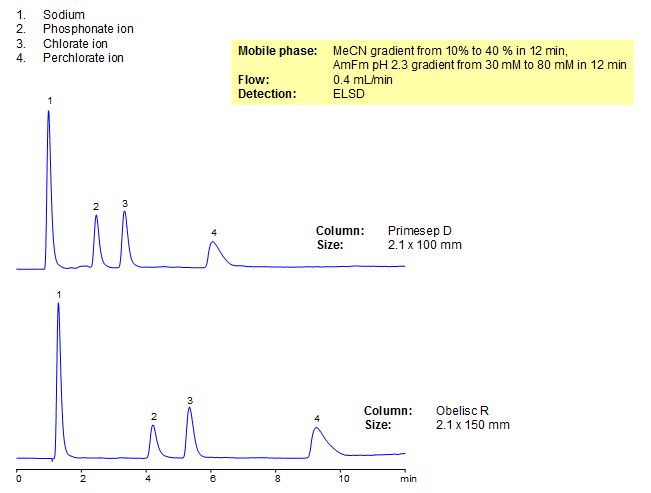
The ionic forms of Chlorate, Perchlorate, and Phosphonates are useful in many industries including medicine, paper and use in explosives. Due to their lack of UV activity, an ELSD was used to detect both the anions and cations of all three sodium salts. The ions were retained on both Primesep D and Obelisc R columns. Primesep D is a reverse phase column with embedded basic ion-pairing groups. Obelisc R is also a reverse phase column, but can be additionally tuned due to embedded ionic groups and a hydrophobic chain.
| Column | Primesep D, 2.1×100 mm, 5 µm, 100A |
| Mobile Phase | Gradient MeCN – 10-40%, 12 min |
| Buffer | Gradient AmFm pH 2.3- 30-80 mM, 12 min |
| Flow Rate | 0.4 ml/min |
| Detection | ELSD |
| Class of Compounds |
Hydrophilic, Ionizable |
| Analyzing Compounds | Chlorate, Perchlorate, Phosphonate Ions |
Application Column
Primesep D
Column Diameter: 2.1 mm
Column Length: 100 mm
Particle Size: 5 µm
Pore Size: 100 A
Column options: dual ended
Perchlorate
HPLC Determination of Chloride, Chlorate and Perchlorate on Newcrom B Column
December 10, 2019
HPLC Method for Chlorate, Perchlorate, Sodium Chlorate, Chloride on Newcrom B by SIELC Technologies
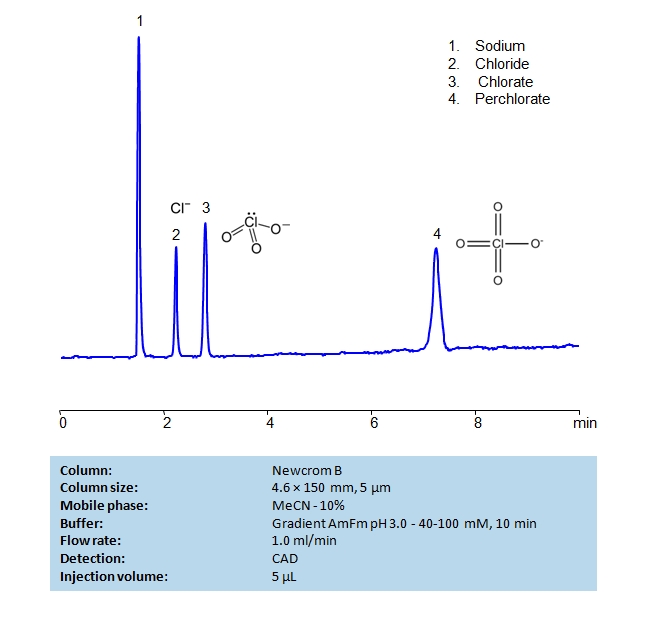
High Performance Liquid Chromatography (HPLC) Method for Analysis of Chlorate, Perchlorate, Sodium Chlorate, Chloride
Main source of contamination of environment by perchlorates are rocket fuels, car airbags, and fireworks.
EPA developed regulation of the perchlorate level in drinking water which already adapted by several states.HPLC analysis of [compound] with Newcrom B. Includes separation method, chromatogram, and mobile phase.
The most convenient, universal and very sensitive way to measure perchlorate is chromatography.
SIELC developed a simple, rugged, and selective HPLC method which allows to measure perchlorate in different matrices including drinking water.
This method allows to measure simultaneously other chloro containing ions such as chloride, and chlorate.
The method shows high selectivity and specificity.
The mobile phase is a simple mixture of water acetonitrile and ammonium formate.
The column used in the analysis has advanced surface chemistry with long chain holding a terminal positively changed functional group.
| Column | Newcrom B, 4.6 x 150 mm, 5 µm, 100 A, dual ended |
| Mobile Phase | MeCN/H2O – 10/90% |
| Buffer | Gradient AmFm pH 3.0 – 40-100 mM , 10 min |
| Flow Rate | 1.0 ml/min |
| Detection | CAD |
| Class of Compounds | Ions, Hydrophilic, Ionizable |
| Analyzing Compounds | Chlorate, Perchlorate, Sodium Chlorate, Chloride |
Application Column
Newcrom B
Column Diameter: 4.6 mm
Column Length: 150 mm
Particle Size: 5 µm
Pore Size: 100 A
Column options: dual ended
Chloride
Perchlorate
Sodium Chlorate
Separation of Chlorate, Perchlorate, and Phosphonate Ions on Obelisc R Column
July 30, 2015
HPLC Method for Chlorate, Perchlorate, Phosphonate, Sodium on Obelisc R by SIELC Technologies
High Performance Liquid Chromatography (HPLC) Method for Analysis of Chlorate, Perchlorate, Phosphonate, Sodium.
The ionic forms of Chlorate, Perchlorate, and Phosphonates are useful in many industries including medicine, paper and use in explosives. Due to their lack of UV activity, an ELSD was used to detect both the anions and cations of all three sodium salts. The ions were retained on both Primesep D and Obelisc R columns. Primesep D is a reverse phase column with embedded basic ion-pairing groups. Obelisc R is also a reverse phase column, but can be additionally tuned due to embedded ionic groups and a hydrophobic chain.
| Column | Obelisc R, 2.1 x 50 mm, 5 µm, 100 A, dual ended |
| Mobile Phase | Gradient MeCN – 10-40%, 12 min |
| Buffer | Gradient AmFm pH 2.3- 30-80 mM, 12 min |
| Flow Rate | 0.4 ml/min |
| Detection | ELSD |
| Class of Compounds |
Hydrophilic, Ionizable |
| Analyzing Compounds | Chlorate, Perchlorate, Phosphonate, Sodium |
Application Column
Obelisc R
Column Diameter: 2.1 mm
Column Length: 50 mm
Particle Size: 5 µm
Pore Size: 100 A
Column options: dual ended
Perchlorate
Phosphonate
Sodium
HPLC Analysis of Basic Drugs and Acidic Counter-Ions by Mixed-Mode Chromatography
July 16, 2009
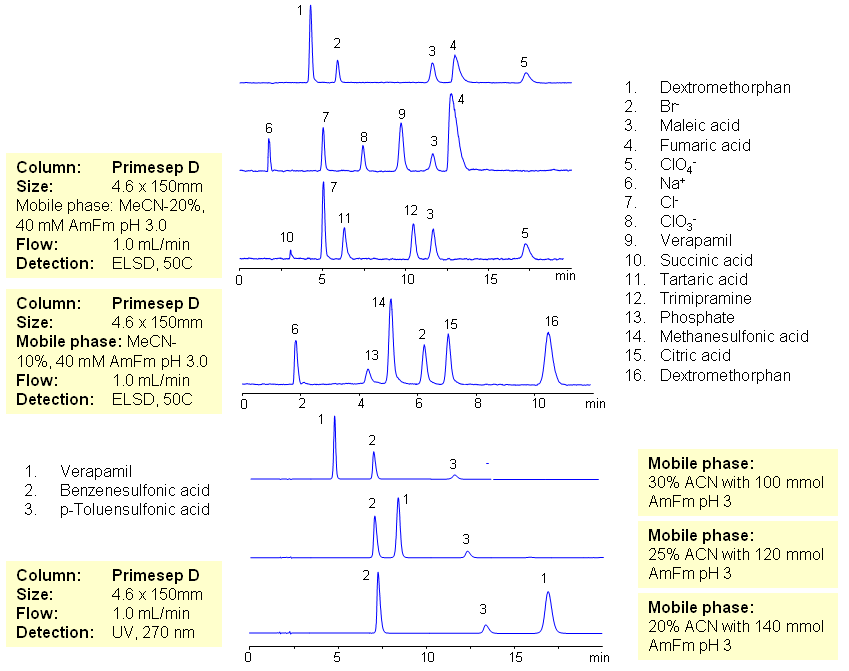
The majority of drugs in the pharmaceutical industry are administered in salt form. The presence of two counter-ions very often necessitates the use of two methods. The nature of these counterparts in drugs can be an inorganic cation and organic acid, inorganic anion and organic base, and organic cation and organic anion. Furthermore, the properties of the molecules will result in a differing stoichiometry. The task of simultaneous quantitation of counter-ions can be achieved by using mixed-mode columns. The general approach for analysis is based on properties of corresponding counter-ions. Hydrophobic basic drugs, like dextromethorphan, verapamil, trimipramine, and corresponding acidic counter-ions (chloride, chlorate, bromide, bromate, perchlorate, maleate, fumarate,tartrate, succinate, phosphate, citrate, benzosulfonate, toleuensulfonate) can be separated and quantitated in the same run on reversed-phase anion-exchange column. Basic hydrophobic drugs are retained by the reversed-phase mechanism, and counter-ions are retained by the reversed-phase and anion-exchange mechanism. Some polar counter-ions are retained only by the anion-exchange mechanism. Retention time and selectivity of HPLC separation of drugs and counter-ions can be achieved by changing the amount of acetonitrile and the amount of ions in the mobile phase. The detection technique depends on the properties of the counter-ions. In case of low or no UV activity, ELSD can be employed if the counter-ion forms a non-volatile salt with the mobile phase additive (ammonium formate). This HPLC method can be used for simultaneous quantitation of other basic drugs and counter-ions. The presence of two mechanisms of retention allows control over retention times of drug and counter-ion independently, and even allows a change of order of elution when necessary.
| Column | Primesep D , 4.6×150 mm, 5 µm, 100A |
| Mobile Phase | MeCN/H2O |
| Buffer | AmFm pH 3.0 |
| Flow Rate | 1.0 ml/min |
| Detection | ELSD, UV 270 |
| Class of Compounds | Ions, Hydrophilic, Hydrophobic, Base, Acids, Ionizable |
| Analyzing Compounds | Sodium Chloride, Sodium chloride, Sodium Chlorate, Sodium bromide, Sodium bromate, Perchloric Acid, Maleic Acid, Fumaric Acid, Tartaric Acid, Succinic Acid, Phosphoric Acid, Citric acid, Benzosulfonic acid, Dextromethorphan, Verapamil, Trimipramine |
Application Column
Primesep D
The Primesep family of mixed-mode columns offers a wide variety of stationary phases, boasting unprecedented selectivity in the separation of a broad array of chemical compounds across multiple applications. Corresponding Primesep guard columns, available with all stationary phases, do not require holders. SIELC provides a method development service available to all customers. Inquire about our specially-tailored custom LC-phases for specific separations.
Select optionsBromide
Chlorate
Chloride
Citric Acid
Dextromethorphan
Fumaric Acid
Maleic Acid
Organic Acids
Perchlorate
Phosphoric Acid
Pyrilamine
Succinic Acid
Tartaric Acid
Verapamil
p-Toluenesulfonic Acid (PTSA)
UV Detection
HPLC Separation of Chlorate and Bromate Ions
March 27, 2004
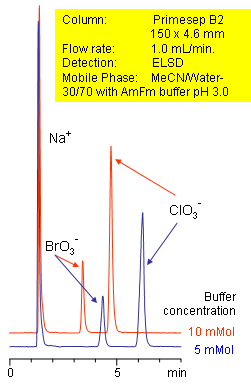
Primesep B2 separates chlorate and bromate by an ion-exchange mechanism. The anion-exchange properties of the column allow retention of hydrophilic compounds, and these properties can be adjusted by simply changing the ammonium formate buffer concentration. The HPLC separation uses a mobile phase of water, acetonitrile (MeCN, ACN) and ammonium formate with evaporative light scattering detection (ELSD).
| Column | Primesep B2, 4.6×150 mm, 5 µm, 100A |
| Mobile Phase | MeCN/H2O – 30/70% |
| Buffer | AmFm pH 3.0 |
| Flow Rate | 1.0 ml/min |
| Detection | CAD |
| Class of Compounds | Ions, Hydrophilic, Ionizable |
| Analyzing Compounds | Sodium Chlorate, Sodium Bromate |
Application Column
Primesep B2
The Primesep family of mixed-mode columns offers a wide variety of stationary phases, boasting unprecedented selectivity in the separation of a broad array of chemical compounds across multiple applications. Corresponding Primesep guard columns, available with all stationary phases, do not require holders. SIELC provides a method development service available to all customers. Inquire about our specially-tailored custom LC-phases for specific separations.
Select optionsChlorate
Sodium Bromate
Sodium Chlorate
