Chromni™ Multi-Mode HPLC Column
One Column. All Modes.
Reversed-phase, HILIC, ion-exchange, ion-exclusion, and normal-phase separations on a single stationary phase.
How Chromni™ Works
Developing an HPLC method often means screening multiple columns to find a suitable retention mechanism. Chromni™ combines hydrophobic, polar, and ionizable functionalities on one uniform stationary phase. Changing the mobile phase changes which interactions contribute most strongly to analyte retention and selectivity.
The surface chemistry is dynamic and adaptive, allowing it to shift its retention mechanism depending on mobile phase composition. Solvent composition, buffer, pH, and ionic modifiers provide ways to fine-tune the separation without switching to another stationary phase.
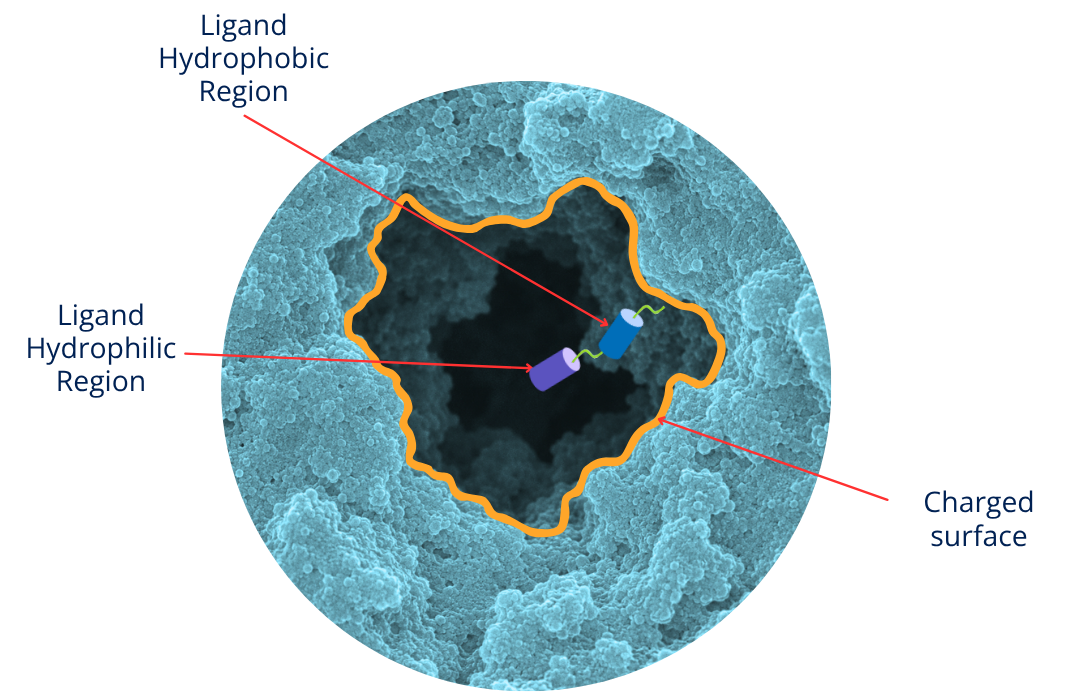
Three Types of Interaction. One Surface.
Chromni™ places complementary functionalities together on a uniform stationary phase. The mobile phase shifts their relative contribution to retention.
Hydrophobic
Supports reversed-phase retention in aqueous–organic mobile phases.
Polar
Contributes to HILIC retention under high-organic conditions and normal-phase retention in pure organic solvents.
Ionizable
Enables ionic retention behavior, including ion exchange and ion exclusion, under suitable mobile-phase conditions.
How Mobile-Phase Conditions Change Retention
A change in mobile phase can bring a different interaction to the foreground. The table below describes the intended modes, not an on/off switch for individual surface groups.
Reversed Phase
Mobile phase: Aqueous–organic
Dominant interaction: Hydrophobic retention
HILIC
Mobile phase: High-organic aqueous
Dominant interaction: Polar retention
Ion Exchange / Ion Exclusion
Mobile phase: Buffered conditions with ionic modifiers
Dominant interaction: Ionic retention or exclusion behavior
Normal Phase
Mobile phase: Pure organic solvents
Dominant interaction: Polar retention in normal-phase conditions
Chromni™ in Motion
Watch how changes in mobile-phase conditions shift the dominant retention mechanism.
What This Means for Method Development
Screen More Modes
Explore distinct retention mechanisms without changing to a different stationary phase.
Tune Selectivity
Adjust organic fraction, buffer, pH, and ionic strength to refine retention and separation.
Cover Broader Chemistry
Develop methods for polar, nonpolar, acidic, basic, and neutral compounds.
Available Chromni™ Configurations
One Column. More Possibilities.
Explore the Chromni™ product range or review the brochure to find a configuration for your method.
