Cyralis™ Chiral HPLC Columns
Four complementary polysaccharide-based stationary phases for chiral separations: cellulose- and amylose-based selectors with two distinct aromatic substituent patterns.
How Polysaccharide Selectors Separate Enantiomers
Polysaccharide stationary phases separate racemates by inducing subtle energetic differences between enantiomers and the selector as they flow through and interact with the stationary phase. Common polysaccharide selectors contain large phenyl groups that provide π-π interactions. Most selectors also contain carbamate NH groups capable of hydrogen bonding, as well as a highly stereoregular cavity formed by the stereochemistry of the polysaccharide itself. These interactions provide anchors for racemates passing through the stationary phase. Enantiomeric discrimination occurs based on how effectively each enantiomer interacts with the selector’s aromatic system, hydrogen-bonding sites, and geometric structure.
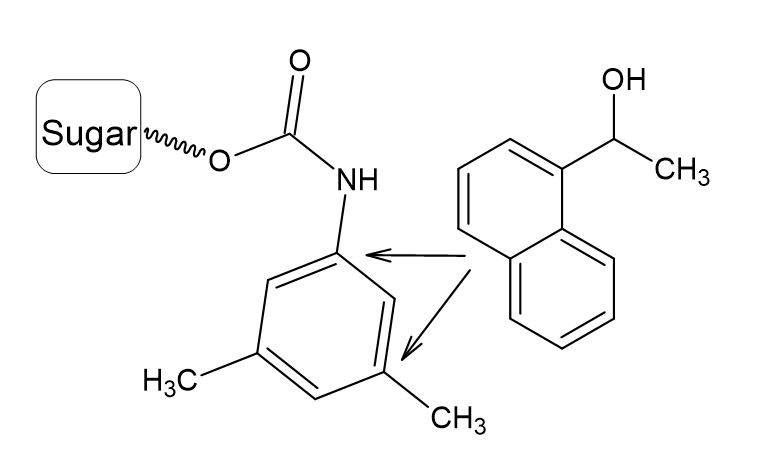
π-π Interactions
Interactions between aromatic groups of the analyte and the large phenyl groups of the selector.
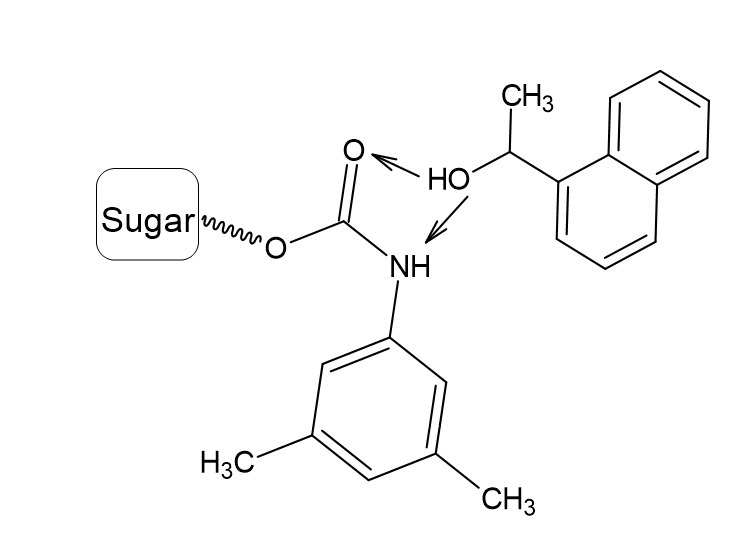
Hydrogen Bonding
Hydrogen-bonding interactions provided by the carbamate NH functionality.

Geometric Recognition
Differences in how each enantiomer fits within the highly stereoregular cavity of the polysaccharide selector.
Four Complementary Chiral Selectors
The Cyralis™ family includes cellulose- and amylose-based selectors with either 3,5-dimethylphenylcarbamate or 3-chloro-4-methylphenylcarbamate substituents. These four stationary phases provide complementary chiral selectivity.
Cyralis™ CM
Cellulose tris(3,5-dimethylphenylcarbamate) coated onto silica.
Cyralis™ CL
Cellulose tris(3-chloro-4-methylphenylcarbamate) coated onto silica.
Cyralis™ AL
Amylose tris(3-chloro-4-methylphenylcarbamate) coated onto silica.
Although it is difficult to predict which compounds will separate well on a specific selector, broad patterns have been observed. Because chiral recognition strongly depends on the three-dimensional structure of the analyte, a compound that separates well on one selector may show limited or no separation on the other three.
Complementary Chiral Selectivity Across Four Cyralis™ Columns
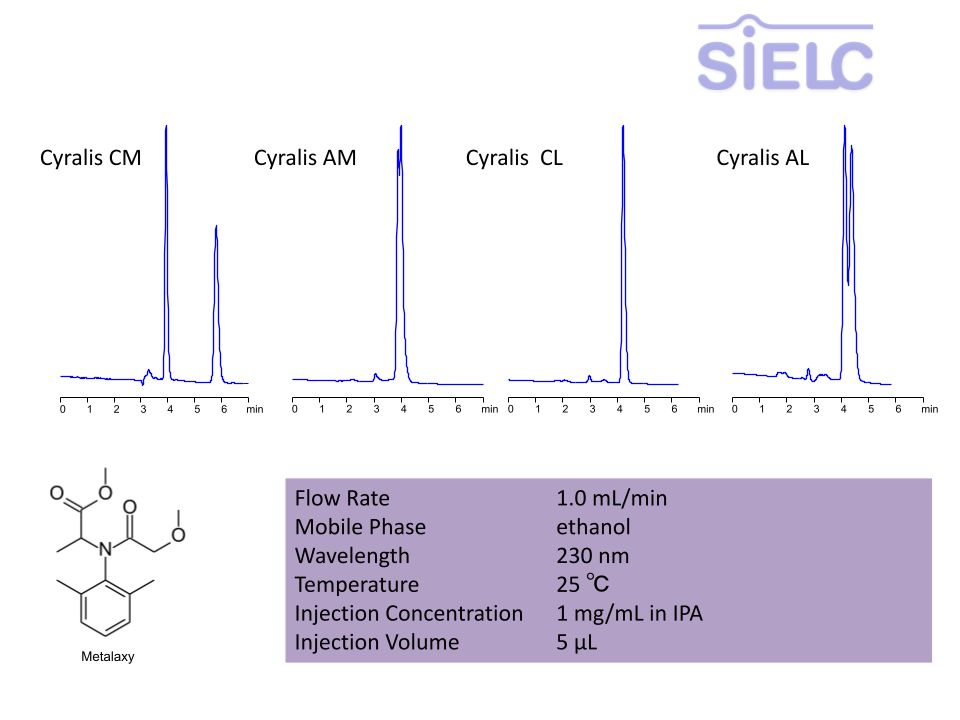
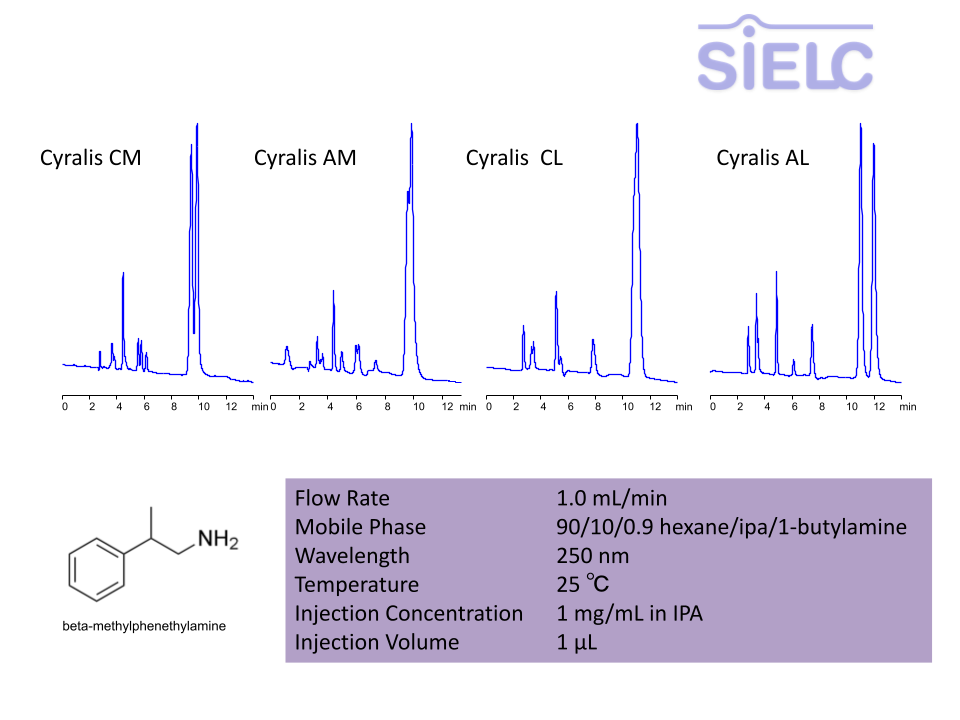
The chromatograms below demonstrate how each Cyralis™ stationary phase can provide distinct selectivity for the same racemate. A compound that resolves well on one selector may show limited or no separation on the other three.
Example 1: Separation Achieved on Cyralis™ CM
Cyralis™ CM provides effective separation for this compound.
Example 2: Separation Achieved on Cyralis™ AM
Cyralis™ AM provides effective separation for this compound.
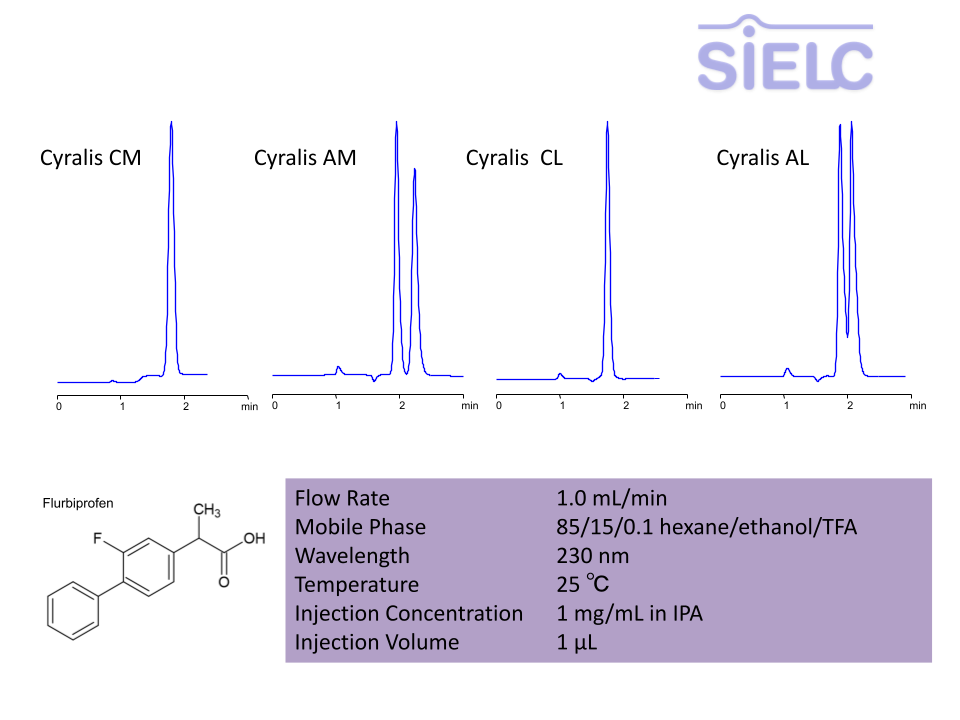
Example 3: Separation Achieved on Cyralis™ CL
Cyralis™ CL provides effective separation for this compound.
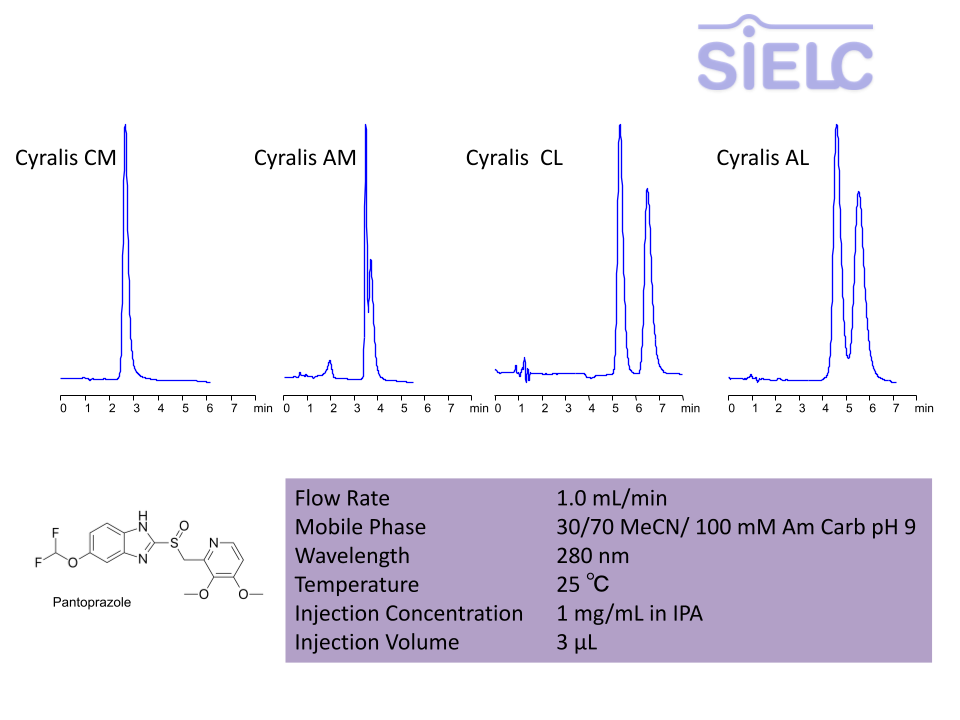
Example 4: Separation Achieved on Cyralis™ AL
Cyralis™ AL provides effective separation for this compound.
Four Complementary Stationary Phases
Cyralis™ CM
Cellulose tris(3,5-dimethylphenylcarbamate)
Suitable for chiral neutral compounds, acids, bases, and chiral salts.
Particle sizes: 3, 5 and 10 μm
Cyralis™ AM
Amylose tris(3,5-dimethylphenylcarbamate)
Suitable for chiral neutral compounds, acids, bases, and chiral salts.
Particle sizes: 3, 5 and 10 μm
Cyralis™ CL
Cellulose tris(3-chloro-4-methylphenylcarbamate)
Suitable for chiral neutral compounds, acids, bases, and chiral salts.
Particle sizes: 3, 5 and 10 μm
Cyralis™ AL
Amylose tris(3-chloro-4-methylphenylcarbamate)
Suitable for chiral neutral compounds, acids, bases, and chiral salts.
Particle sizes: 3, 5 and 10 μm
Compatible Chromatographic Modes
Choosing Among Cyralis™ Chiral Columns
Cyralis™ CM, AM, CL, and AL provide four complementary chiral selectivities. The selector backbone—cellulose or amylose—and the aromatic carbamate substituent both influence enantiomeric recognition. When the optimal stationary phase cannot be predicted from the molecular structure of the analyte, evaluating all four Cyralis™ selectors is recommended.
