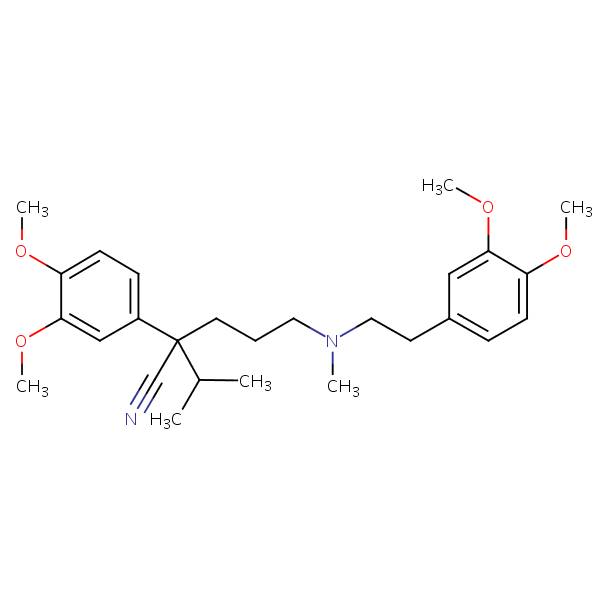
| CAS Number | 52-53-9 |
|---|---|
| Molecular Formula | C27H38N2O4 |
| Molecular Weight | 454.611 |
| InChI Key | SGTNSNPWRIOYBX-UHFFFAOYSA-N |
| LogP | 3.79 |
| Synonyms |
|
Applications:
HPLC Chiral Separation of Verapamil Enantiomers on Cyralis CM Column
June 30, 2026
HPLC Chiral Method for Analysis of Verapamil Enantiomers on Cyralis CM Column by SIELC Technologies
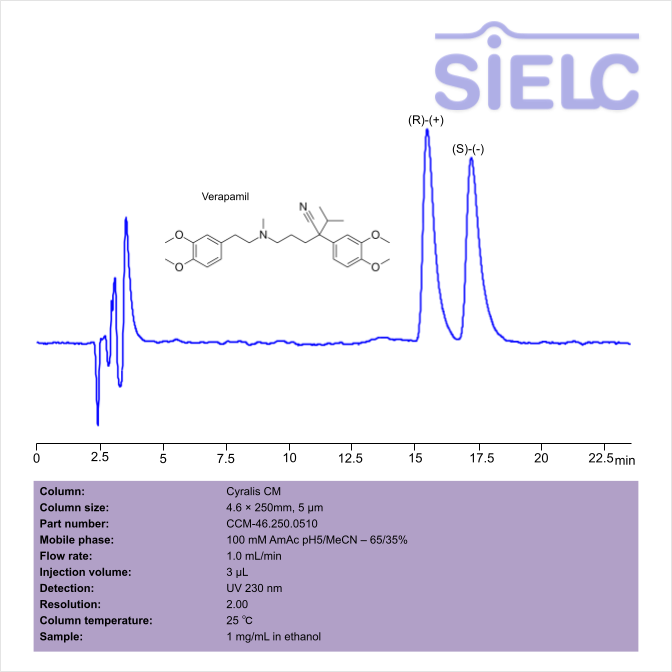
High Performance Liquid Chromatography (HPLC) Method for Analysis of Verapamil.
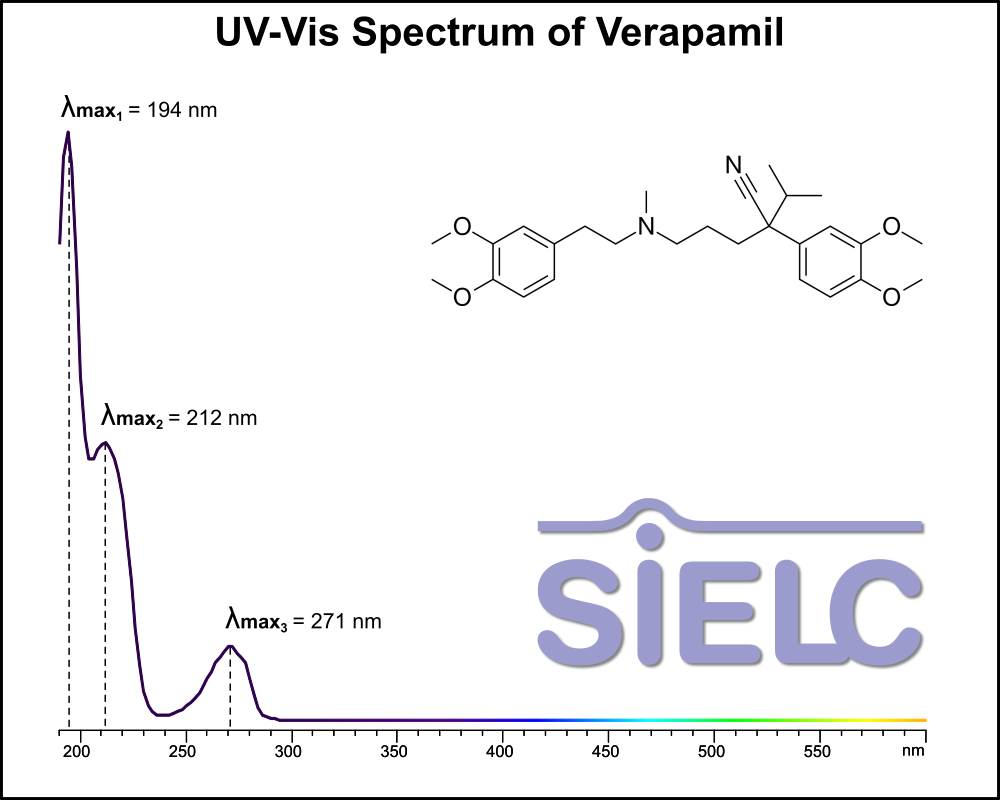
Verapamil is a medication with the chemical formula C27H28N2O4. It is a calcium channel blocker that is used primarily to treat high blood pressure, angina, and supraventricular tachycardia. On occasion, it is used to prevent migraines and cluster headaches. You can find detailed UV spectra of Verapamil and information about its various lambda maxima by visiting the following link.
This application describes a normal-phase chiral HPLC method for the separation of Verapamil enantiomers using SIELC’s Cyralis CM chiral column. Cyralis CM is a cellulose-based chiral stationary phase (CSP) designed for enantiomeric separations, optical purity testing, chiral impurity analysis, and stereoisomer characterization in pharmaceutical, chemical, agrochemical, and fine chemical applications. For best results, the sample should be prepared fresh for analysis.
Verapamil can be retained and analyzed using the Cyralis CM stationary phase column. The analysis utilizes an isocratic method with a mobile phase consisting of AmAC and MeCN. Detection is performed using UV.
Condition
| Column | Cyralis CM, 4.6 x 250 mm, 5 µm, 100 A, reversed phase |
| Mobile Phase | AmAC/MeCN |
| Flow Rate | 1.0 mL/min |
| Detection | UV 230 nm |
| Resolution | 2.00 |
Description
| Class of Compounds | Drug |
| Analyzing Compounds | Verapamil |
Application Column
Cyralis CM
Column Diameter: 4.6 mm
Column Length: 250 mm
Particle Size: 5 µm
Pore Size: 100 A
Column options: reversed phase

Uv-Vis Spectrum of Verapamil
March 13, 2026
Access the UV-Vis Spectrum SIELC Library
If you are looking for optimized HPLC method to analyze Verapamil check our HPLC Applications library
For optimal results in HPLC analysis, it is recommended to measure absorbance at a wavelength that matches the absorption maximum of the compound(s) being analyzed. The UV spectrum shown can assist in selecting an appropriate wavelength for your analysis. Please note that certain mobile phases and buffers may block wavelengths below 230 nm, rendering absorbance measurement at these wavelengths ineffective. If detection below 230 nm is required, it is recommended to use acetonitrile and water as low UV-transparent mobile phases, with phosphoric acid and its salts, sulfuric acid, and TFA as buffers.
For some compounds, the UV-Vis Spectrum is affected by the pH of the mobile phase. The spectra presented here are measured with an acidic mobile phase that has a pH of 3 or lower.
HPLC Method for Analysis of Verapamil
May 6, 2016
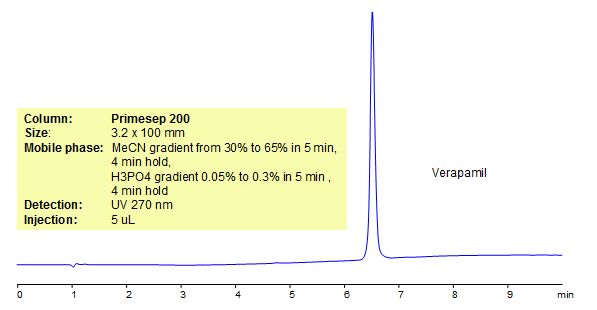
Verapamil is a phenylalkylamine calcium channel blocker that is a class IV anti-arrhythmia agent. It is used to treat high blood pressure, as well as hypertension, angina pectoris and superventricular tachyarrhythmias. The drug also helps prevent strokes, heart attacks, and kidney problems. Primesep 200, a reverse phase column, contains embedded acidic ionizable groups and can retain Verapamil. The method is UV compatible and can be used as a general approach for analyzing similar compounds.
Application Column
Primesep 200
The Primesep family of mixed-mode columns offers a wide variety of stationary phases, boasting unprecedented selectivity in the separation of a broad array of chemical compounds across multiple applications. Corresponding Primesep guard columns, available with all stationary phases, do not require holders. SIELC provides a method development service available to all customers. Inquire about our specially-tailored custom LC-phases for specific separations.
Select optionsVerapamil hydrochloride
HPLC Analysis of Basic Drugs and Acidic Counter-Ions by Mixed-Mode Chromatography
July 16, 2009
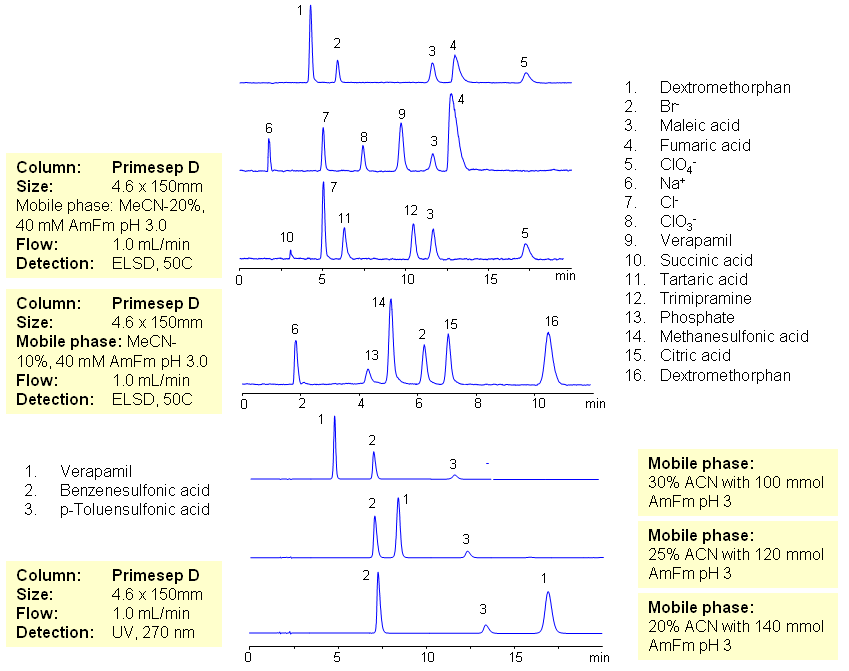
The majority of drugs in the pharmaceutical industry are administered in salt form. The presence of two counter-ions very often necessitates the use of two methods. The nature of these counterparts in drugs can be an inorganic cation and organic acid, inorganic anion and organic base, and organic cation and organic anion. Furthermore, the properties of the molecules will result in a differing stoichiometry. The task of simultaneous quantitation of counter-ions can be achieved by using mixed-mode columns. The general approach for analysis is based on properties of corresponding counter-ions. Hydrophobic basic drugs, like dextromethorphan, verapamil, trimipramine, and corresponding acidic counter-ions (chloride, chlorate, bromide, bromate, perchlorate, maleate, fumarate,tartrate, succinate, phosphate, citrate, benzosulfonate, toleuensulfonate) can be separated and quantitated in the same run on reversed-phase anion-exchange column. Basic hydrophobic drugs are retained by the reversed-phase mechanism, and counter-ions are retained by the reversed-phase and anion-exchange mechanism. Some polar counter-ions are retained only by the anion-exchange mechanism. Retention time and selectivity of HPLC separation of drugs and counter-ions can be achieved by changing the amount of acetonitrile and the amount of ions in the mobile phase. The detection technique depends on the properties of the counter-ions. In case of low or no UV activity, ELSD can be employed if the counter-ion forms a non-volatile salt with the mobile phase additive (ammonium formate). This HPLC method can be used for simultaneous quantitation of other basic drugs and counter-ions. The presence of two mechanisms of retention allows control over retention times of drug and counter-ion independently, and even allows a change of order of elution when necessary.
| Column | Primesep D , 4.6×150 mm, 5 µm, 100A |
| Mobile Phase | MeCN/H2O |
| Buffer | AmFm pH 3.0 |
| Flow Rate | 1.0 ml/min |
| Detection | ELSD, UV 270 |
| Class of Compounds | Ions, Hydrophilic, Hydrophobic, Base, Acids, Ionizable |
| Analyzing Compounds | Sodium Chloride, Sodium chloride, Sodium Chlorate, Sodium bromide, Sodium bromate, Perchloric Acid, Maleic Acid, Fumaric Acid, Tartaric Acid, Succinic Acid, Phosphoric Acid, Citric acid, Benzosulfonic acid, Dextromethorphan, Verapamil, Trimipramine |
Application Column
Primesep D
The Primesep family of mixed-mode columns offers a wide variety of stationary phases, boasting unprecedented selectivity in the separation of a broad array of chemical compounds across multiple applications. Corresponding Primesep guard columns, available with all stationary phases, do not require holders. SIELC provides a method development service available to all customers. Inquire about our specially-tailored custom LC-phases for specific separations.
Select optionsBromide
Chlorate
Chloride
Citric Acid
Dextromethorphan
Fumaric Acid
Maleic Acid
Organic Acids
Perchlorate
Phosphoric Acid
Pyrilamine
Succinic Acid
Tartaric Acid
Verapamil
p-Toluenesulfonic Acid (PTSA)
UV Detection
