HPLC Method for Separation of 8 Water-Soluble Vitamins on Chromni by SIELC Technologies
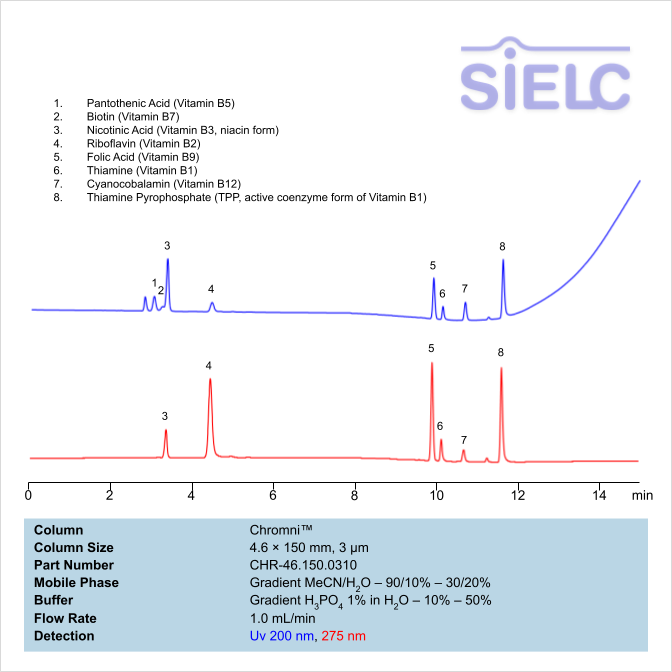
High Performance Liquid Chromatography (HPLC) Method for separation of Vitamin B2 (Riboflavin), Nicotinic Acid (Vitamin B3), Vitamin B6 (Pyridoxine), Folic Acid, Cyanocobalamin, Thiamine diphosphate (Thiamine pyrophosphate), Vitamin B1 (Thiamine), Pantothenic Acid (Vitamin B5), Biotin
Riboflavin (B2), Nicotinic Acid (B3), Folic Acid (B9), Cyanocobalamin (B12), Thiamine Pyrophosphate (coenzyme of B1), Thiamine (B1), Pantothenic Acid (B5), Biotin (B7) are water soluble vitamins with a key function of energy metabolism. These coenzymes are responsible for converting food into usable energy.
Pantothenic Acid, also known as vitamin B5, is an essential nutrient with the chemical formula C19H17NO5. It plays a crucial role in energy and coenzyme A production. That energy and coenzyme are used for synthesis and degradation of proteins, carbohydrates, and fats. You can find detailed UV spectra of Pantothenic Acid (Vitamin B5) and information about its various lambda maxima by visiting the following link.
Biotin (Vitamin B7) is a water-soluble vitamin with the chemical formula C10H16N2O3S. It helps the body breakdown key nutrients in order for it to absorb and utilize them. A lack of biotin can lead to hair loss, rash, and brittle nails. A healthy diet including eggs, milk, and bananas can supply the body with a healthy dose of biotin. You can find detailed UV spectra of Biotin and information about its various lambda maxima by visiting the following link.
Nicotinic acid, also known as niacin and vitamin B3, is a water-soluble B vitamin with C₆H₅NO₂ molecular formula. It is an essential nutrient that is crucial for energy production. Nicotinic acid is commonly used as a dietary supplement to treat vitamin B3 deficiency, and it’s also prescribed in higher doses to help lower cholesterol levels. It works by dilating blood vessels, which can lead to a flushing sensation, hence it is sometimes referred to as “flushing niacin.” You can find detailed UV spectra of Niacin and information about its various lambda maxima by visiting the following link.
Riboflavin, also known as Vitamin B2, is an essential vitamin with the chemical formula C17H20N4O6. It is crucial in the formation of flavin mononucleotide and flavin adenine dinucleotide. Those coenzyme are involved in a large variety of tasks, including but not limited to energy metabolism, cellular respiration, antibody production, and metabolism of niacin and folate. It is also used as yellow food coloring. You can find detailed UV spectra of Riboflavin and information about its various lambda maxima by visiting the following link.
Folic Acid, also known as vitamin B9, folic acid is crucial for many functions in the body, including DNA synthesis and repair, cell division, and growth. As an essential vitamin, Folic acid must be obtained through diet or supplementation, as humans cannot synthesize it. Vitamin B-9 is a crucial prenatal vitamin. that also helps the body use iron properly. It has the chemical formula C19H19N7O6. You can find detailed UV spectra of Folic Acid and information about its various lambda maxima by visiting the following link.
Thiamine, also known as vitamin B1, is an essential nutrient with the chemical formula C12H17ClN4OS. It plays a crucial role in energy metabolism and the proper functioning of the nervous system. It helps the body convert carbohydrates into energy and is vital for the growth, development, and function of cells. You can find detailed UV spectra of Vitamin B1 (Thiamine) and information about its various lambda maxima by visiting the following link.
Cyanocobalamin, also known as vitamin B12, is an essential nutrient with the chemical formula C63H88CoN14O14P. It is naturally present in some foods and available as a dietary supplement and as prescription medication. Vitamin B12 exists in several forms and contains the mineral cobalt, so compounds with vitamin B12 activity are collectively called “cobalamins”. It plays an essential role in the production of the red blood cells and DNA, as well as in the proper functioning of the nervous system. You can find detailed UV spectra of Cyanocobalamin and information about its various lambda maxima by visiting the following link.
Thiamine Pyrophosphate, an active form of Vitamin B1, is a vitamin with the chemical formula C12H19N4O7P2S+. B1 is a water soluble vitamin with a key function of energy metabolism. It is not produced in the body naturally and is stored in very small amounts; therefore must be regularly consumed through diet of whole rains, nuts, seeds, and legumes. It is vital as a coenzyme in carbohydrate metabolism and in decarboxylation of pyruvate, alpha-ketoglutarate, and branched-chain keto acids. You can find detailed UV spectra of Thiamine and information about its various lambda maxima by visiting the following link.
Vitamin B2 (Riboflavin), Nicotinic Acid (Vitamin B3), Vitamin B6 (Pyridoxine), Folic Acid, Cyanocobalamin, Thiamine diphosphate (Thiamine pyrophosphate), Vitamin B1 (Thiamine), Pantothenic Acid (Vitamin B5), Biotin can be retained and analyzed using the Chromni stationary phase column. The analysis utilizes a gradient method with a simple mobile phase consisting of water, acetonitrile (MeCN). Detection is performed using UV.
| Column | Chromni, 4.6 x 150 mm, 3 µm, 100 A, dual ended |
| Mobile Phase | MeCN/H2O – see table |
| Buffer | H3PO4 – see table |
| Flow Rate | 1.0 ml/min |
| Detection | UV 200 nm, 275 nm |
Gradient Elution Program for HPLC Method
| Time (min) | A – H2O (%) | B – MeCN (%) | C – H3PO4 1% in H2O (%) | Notes |
| 0 | 0 | 90 | 10 | Starting Conditions (Hold) |
| 4 | 0 | 90 | 10 | Gradient Start |
| 15 | 20 | 30 | 50 | Gradient End |
| 15.01 | 0 | 90 | 10 | Column Equilibration |
| 25 | 0 | 90 | 10 | End of Run |
| Class of Compounds | Vitamins |
| Analyzing Compounds | Vitamin B2 (Riboflavin), Nicotinic Acid (Vitamin B3), Vitamin B6 (Pyridoxine), Folic Acid, Cyanocobalamin, Thiamine diphosphate (Thiamine pyrophosphate), Vitamin B1 (Thiamine), Pantothenic Acid (Vitamin B5), Biotin |
Application Column
Chromni
Column Diameter: 4.6 mm
Column Length: 150 mm
Particle Size: 3 µm
Pore Size: 100 A
Column options: dual ended
Cyanocobalamin
Folic Acid
Nicotinic Acid (Vitamin B3)
Pantothenic Acid (Vitamin B5)
Thiamine diphosphate (Thiamine pyrophosphate)
Vitamin B1 (Thiamine)
Vitamin B2 (Riboflavin)
Vitamin B6 (Pyridoxine)