| Synonyms |
|
|---|
Applications:
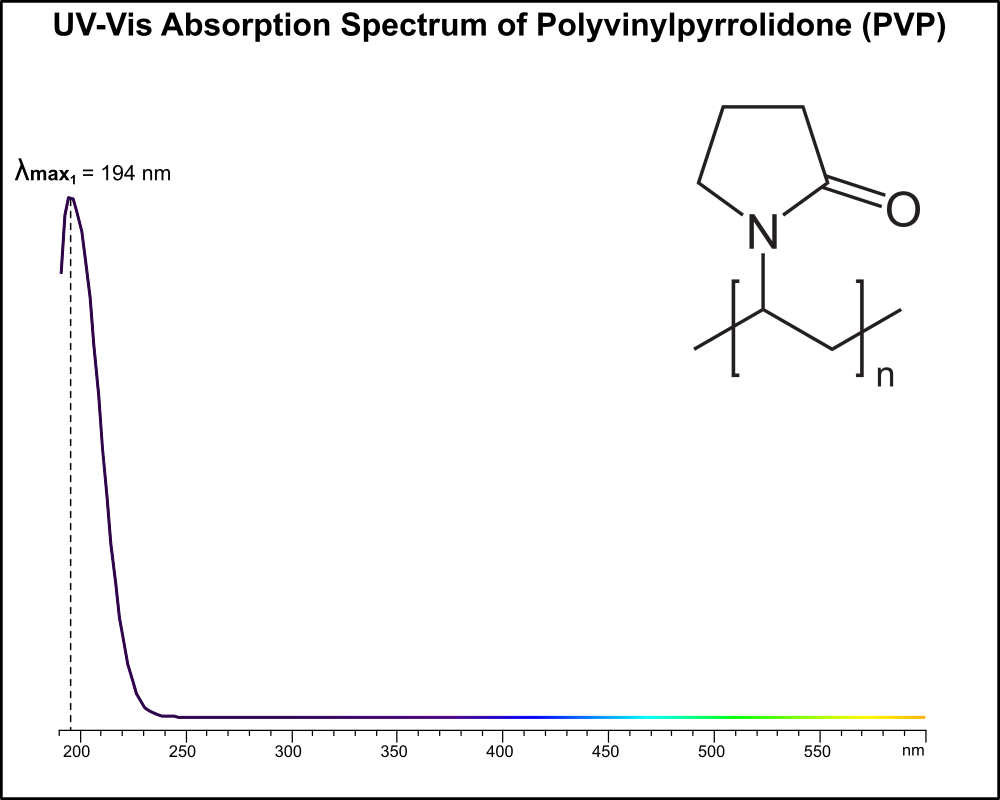
Uv-Vis Spectrum of Polyvinylpyrrolidone
March 31, 2026
Access the UV-Vis Spectrum SIELC Library
If you are looking for optimized HPLC method to analyze Polyvinylpyrrolidone(PVP) check our HPLC Applications library
For optimal results in HPLC analysis, it is recommended to measure absorbance at a wavelength that matches the absorption maximum of the compound(s) being analyzed. The UV spectrum shown can assist in selecting an appropriate wavelength for your analysis. Please note that certain mobile phases and buffers may block wavelengths below 230 nm, rendering absorbance measurement at these wavelengths ineffective. If detection below 230 nm is required, it is recommended to use acetonitrile and water as low UV-transparent mobile phases, with phosphoric acid and its salts, sulfuric acid, and TFA as buffers.
For some compounds, the UV-Vis Spectrum is affected by the pH of the mobile phase. The compound was dissolved in water. This analysis was done with the mobile phase made of 20% acetonitrile and 80% water.

HPLC Method for Analysis of Polyvinylpyrrolidone(PVP) on PVP Column
August 7, 2025
HPLC Method for Polyvinylpyrrolidone(PVP) on PVP by SIELC Technologies
High Performance Liquid Chromatography (HPLC) Method for Analysis of Polyvinylpyrrolidone(PVP)
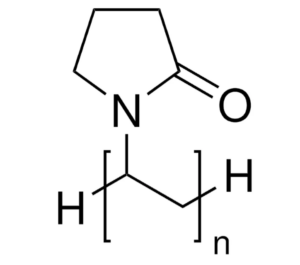
Polyvinylpyrrolidone (PVP)
Polyvinylpyrrolidone (PVP) is a versatile synthetic polymer widely used in life sciences and biochemical research. As a water-soluble compound, it performs multiple critical functions, including:
- Acting as a stabilizing agent
- Serving as an emulsifier and suspending agent
- Enhancing solubility of various compounds
- Functioning as a protective colloid
- Operating as a complexing agent
Its role as a protective colloid is especially important for stabilizing proteins, enzymes, and other sensitive biological molecules. This makes PVP particularly well-suited for forming stable complexes with iodine in pharmaceutical and medical formulations.
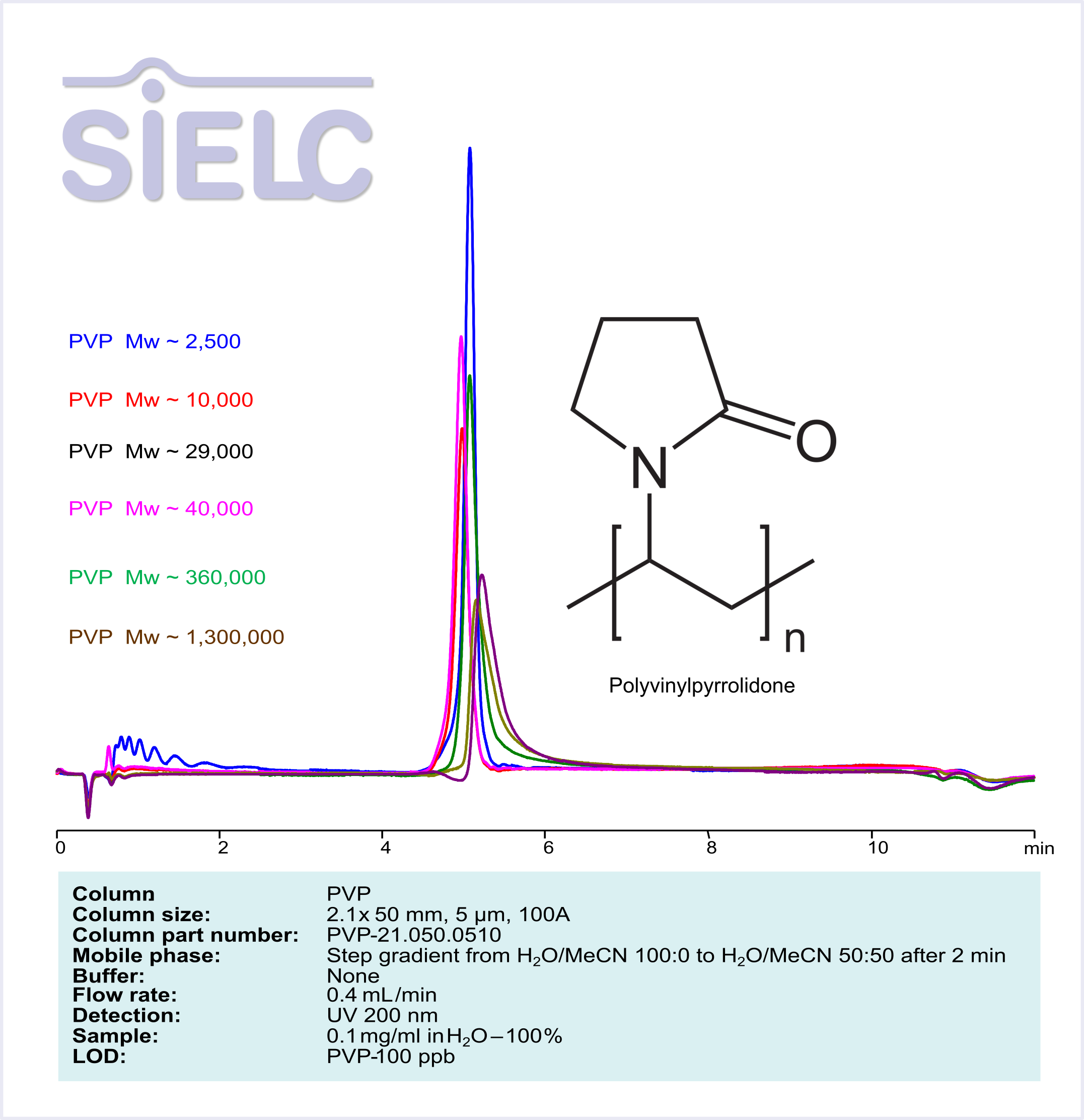
[compound] can be retained and analyzed using the PVP column. The analysis utilizes an step gradient method with a simple mobile phase consisting of water and acetonitrile (MeCN). Detection is performed using UV at 200 nm. The signal from the blank injection was subtracted from all sample chromatograms to correct for background noise and baseline drift.
| Column | PVP, 2.1 x 50 mm, 5 µm, 100 A, dual ended |
| Mobile Phase | Step gradient from H2O/MeCN (100:0) to H2O/MeCN (50:50) after 2 minutes |
| Buffer | None |
| Flow Rate | 0.4 mL/min |
| Detection | UV at 200 nm |
| LOD | PVP – 100 ppb |
| Class of Compounds | Polymer |
| Analyzing Compounds | Polyvinylpyrrolidone(PVP) |
Application Column
PVP
Column Diameter: 2.1 mm
Column Length: 50 mm
Particle Size: 5 µm
Pore Size: 100 A
Column options: dual ended
HPLC Method for Separation of PVP on PVP Column
July 15, 2025
HPLC Method for Separation Polyvinylpyrrolidone(PVP) on PVP by SIELC Technologies
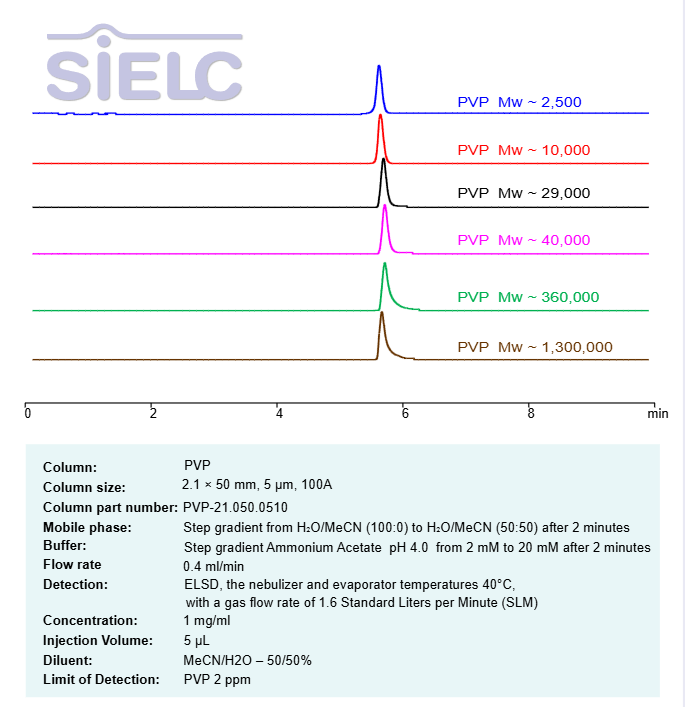
High Performance Liquid Chromatography (HPLC) Method for Analysis of Polyvinylpyrrolidone(PVP)
Polyvinylpyrrolidone (PVP)
Polyvinylpyrrolidone (PVP) is a versatile synthetic polymer widely used in life sciences and biochemical research. As a water-soluble compound, it performs multiple critical functions, including:
- Acting as a stabilizing agent
- Serving as an emulsifier and suspending agent
- Enhancing solubility of various compounds
- Functioning as a protective colloid
- Operating as a complexing agent
Its role as a protective colloid is especially important for stabilizing proteins, enzymes, and other sensitive biological molecules. This makes PVP particularly well-suited for forming stable complexes with iodine in pharmaceutical and medical formulations.
Polyvinylpyrrolidone(PVP) can be retained and analyzed using the PVP column. The analysis utilizes an step gradient method with a simple mobile phase consisting of water, acetonitrile (MeCN), and ammonium acetate. Detection is performed using ELSD.
| Column | PVP, 2.1 x 50 mm, 5 µm, 100 A, dual ended |
| Mobile Phase | Step gradient MeCN/H2O |
| Buffer | Ammonium Acetate pH 4.0 – 20 mM |
| Flow Rate | 0.4 ml/min |
| Detection | ELSD |
| LOD | PVP 2.0 ppm |
| Class of Compounds | Polymer |
| Analyzing Compounds | Polyvinylpyrrolidone(PVP) |
Application Column
PVP
Column Diameter: 2.1 mm
Column Length: 50 mm
Particle Size: 5 µm
Pore Size: 100 A
Column options: dual ended
HPLC Method for Separation PEI and PVP on PVP Column
July 15, 2025
HPLC Method for separation Polyvinylpyrrolidone(PVP) , Polyethylenimine PEI on PVP by SIELC Technologies
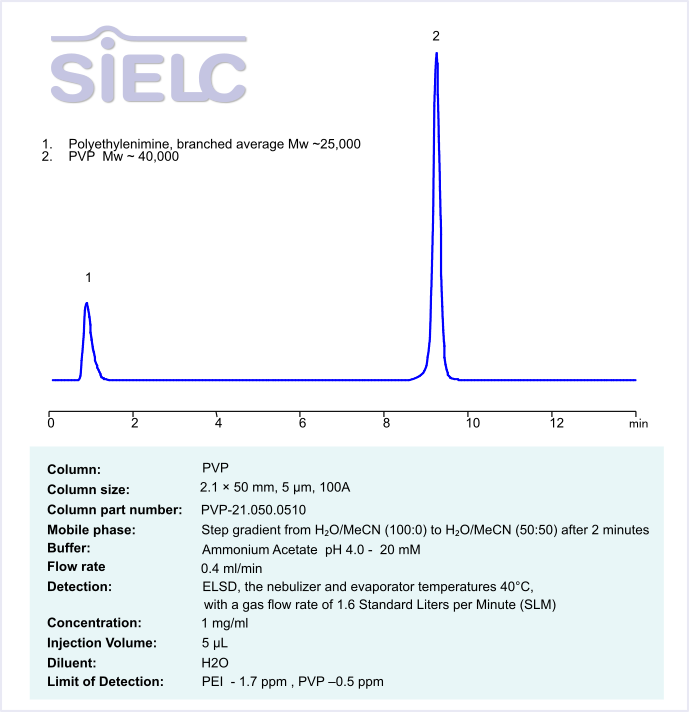
High Performance Liquid Chromatography (HPLC) Method for Analysis of Polyvinylpyrrolidone(PVP) , Polyethylenimine PEI
PEI: Polyethylenimine
- Structure: Branched or linear polymer made of ethylene imine units.
- Formula: (C2H5N)n(C_2H_5N)_n(C2H5N)n
- Charge: Cationic (positively charged in aqueous solution)
- Properties:
- Highly branched (usually) with a high density of amine groups.
- Strong polycation—used to bind negatively charged molecules like DNA or proteins.
- Applications:
- Gene delivery (non-viral vectors)
- Flocculation in water treatment
- Adhesion promoter
- Antimicrobial coatings
- Paper and textile processing
🧪 PVP: Polyvinylpyrrolidone
- Structure: Linear polymer of N-vinylpyrrolidone
- Formula: (C6H9NO)n(C_6H9NO)_n(C6H9NO)n
- Charge: Nonionic
- Properties:
- Water-soluble
- Biocompatible and inert
- Forms clear solutions
- Applications:
- Pharmaceutical excipient (binder in tablets, stabilizer in suspensions)
- Cosmetic formulations (e.g., hair sprays, lotions)
- Blood plasma volume expander (historically)
- Adhesives, coatings, inks
Polyvinylpyrrolidone(PVP) , Polyethylenimine PEI can be retained and analyzed using the PVP column. The analysis utilizes an step gradient method with a simple mobile phase consisting of water, acetonitrile (MeCN), and ammonium acetate. Detection is performed using ELSD.
| Column | PVP, 2.1 x 50 mm, 5 µm, 100 A, dual ended |
| Mobile Phase | Step gradient MeCN/H2O |
| Buffer | Ammonium Acetate pH 4.0 – 20 mM |
| Flow Rate | 0.2 ml/min |
| Detection | ELSD |
| LOD | PVP 0.5 ppm, PEI 1.7 ppm |
*LOD was determined for this combination of instrument, method, and analyte, and it can vary from one laboratory to another even when the same general type of analysis is being performed.
| Class of Compounds | Polymer |
| Analyzing Compounds | Polyvinylpyrrolidone(PVP) , Polyethylenimine PEI |
Application Column
PVP
Column Diameter: 2.1 mm
Column Length: 50 mm
Particle Size: 5 µm
Pore Size: 100 A
Column options: dual ended
Polyvinylpyrrolidone(PVP)
HPLC Method for Separation Povidone-iodine (PVP-I) on PVP Column
July 14, 2025
HPLC Method for Iodide, Polyvinylpyrrolidone(PVP) on PVP by SIELC Technologies
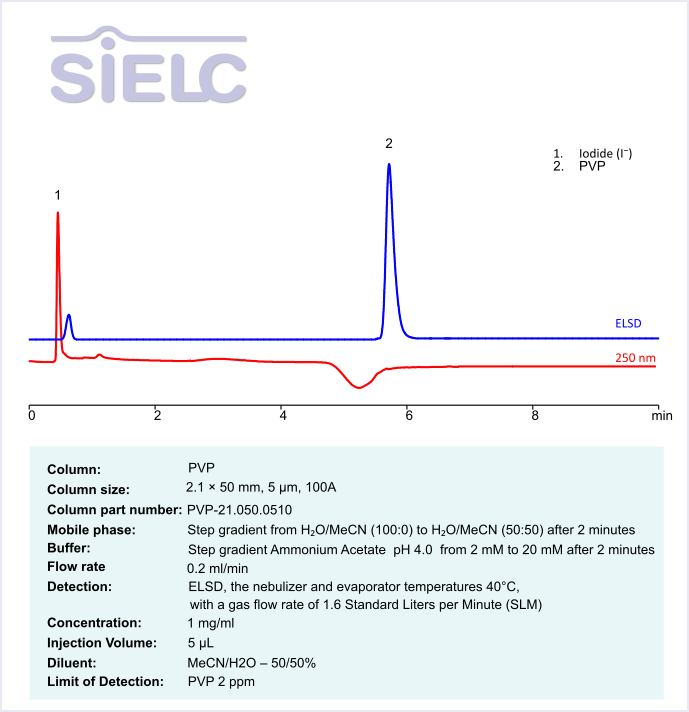
High Performance Liquid Chromatography (HPLC) Method for Analysis of Iodide, Polyvinylpyrrolidone(PVP)
Polidone Iodide (Povidone-Iodine / PVP-I)
Polidone Iodide, also known as Povidone-Iodine (PVP-I), is a widely used antiseptic made from iodine and polyvinylpyrrolidone (PVP). This combination allows for a slow, sustained release of iodine, enhancing antimicrobial effects while reducing irritation.
PVP (Polyvinylpyrrolidone): A water-soluble synthetic polymer that acts as:
- Stabilizer
- Emulsifier
- Solubilizer
- Protective colloid
It helps form a stable complex with iodine, improving its medical use.
Iodine: The active antimicrobial agent, effective against:
- Bacteria
- Viruses
- Fungi
- Protozoa
Slow release from the PVP complex ensures long-lasting, gentle antiseptic action.
Iodide, Polyvinylpyrrolidone(PVP) can be retained and analyzed using the PVP column. The analysis utilizes an step gradient method with a simple mobile phase consisting of water, acetonitrile (MeCN), and ammonium acetate. Detection is performed using ELSD.
| Column | Cannsep A, 2.1 x 100 mm, 5 µm, 100 A, dual ended |
| Mobile Phase | Step gradient MeCN/H2O |
| Buffer | Ammonium Acetate pH 4.0 – 20 mM |
| Flow Rate | 0.4 ml/min |
| Detection | ELSD |
| LOD | PVP 2 ppm |
| Class of Compounds | Polymer |
| Analyzing Compounds | Iodide, Polyvinylpyrrolidone(PVP) |
Application Column

Cannsep A
Column Diameter: 2.1 mm
Column Length: 100 mm
Particle Size: 5 µm
Pore Size: 100 A
Column options: dual ended
Polyvinylpyrrolidone(PVP)
