
| CAS Number | 7439-95-4 |
|---|---|
| Molecular Formula | Mg |
| Molecular Weight | 24.305 |
| InChI Key | RSHAOIXHUHAZPM-UHFFFAOYSA-N |
| Synonyms |
|
Applications:
HPLC ELSD Method for Simultaneous Determination of Magnesium (II) and Sulfate ions on Chromni Column
September 16, 2026
HPLC Method for Analysis of Magnesium, Sulfate on Chromni Column by SIELC Technologies
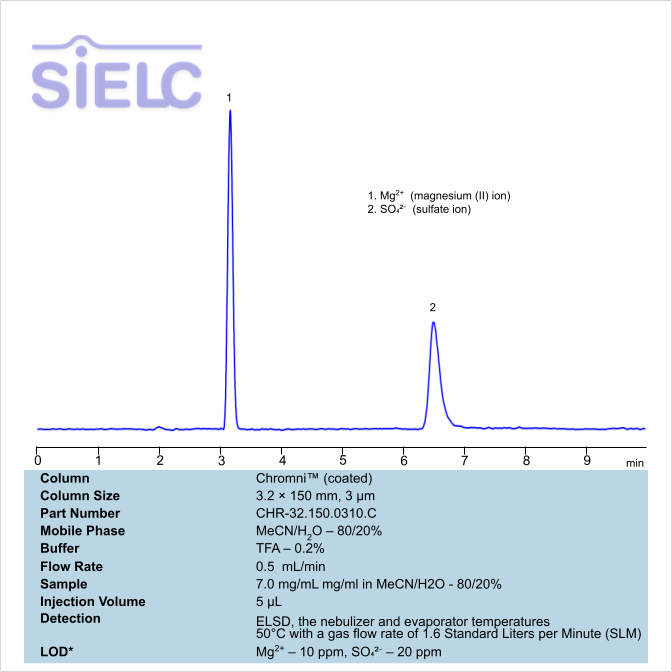
High Performance Liquid Chromatography (HPLC) Method for Analysis of Magnesium, Sulfate.
Magnesium is an element with the symbol Mg. Magnesium ion has the chemical formula of Mg2+. It is a shiny grey metal with a high chemical reactivity, but low density and melting point. While magnesium is abundant in the earth’s crust, it is produced in the cosmos in large, aging stars. It is primarily used as a structural metal in a large variety of contexts from aircrafts to light sources and chemical reagents.
Sulfate is an ionic chemical with the formula SO42-. In nature, it is usually found in geodes like gypsum. It is also created in atmosphere from sulfur dioxide. It is used for a variety of applications, but most notably, coloring wood and creating light-reflecting paints.
Magnesium, Sulfate can be retained and analyzed using the Chromni stationary phase column. The analysis utilizes a gradient method with a simple mobile phase consisting of water and acetonitrile (MeCN). Detection is performed using LC MS.
Condition
| Column | Chromni, 3.2 x 150 mm, 3 µm, 100 A, surface coated |
| Mobile Phase | MeCN/H2O |
| Buffer | TFA – 0.2% |
| Flow Rate | 0.5 ml/min |
| Detection | ELSD, the nebulizer and evaporator temperatures 50°C with a gas flow rate of 1.6 Standard Liters per Minute (SLM) |
| LOD* | Mg2+ – 10 ppm, SO₄²⁻ – 20 ppm |
Description
Application Column
Chromni
Column Diameter: 3.2 mm
Column Length: 150 mm
Particle Size: 3 µm
Pore Size: 100 A
Column options: surface coated
Sulfate

HPLC Method for Analysis of Magnesium Ion on Chromni Column
August 25, 2026
HPLC Method for Analysis of Magnesium on Chromni Column by SIELC Technologies
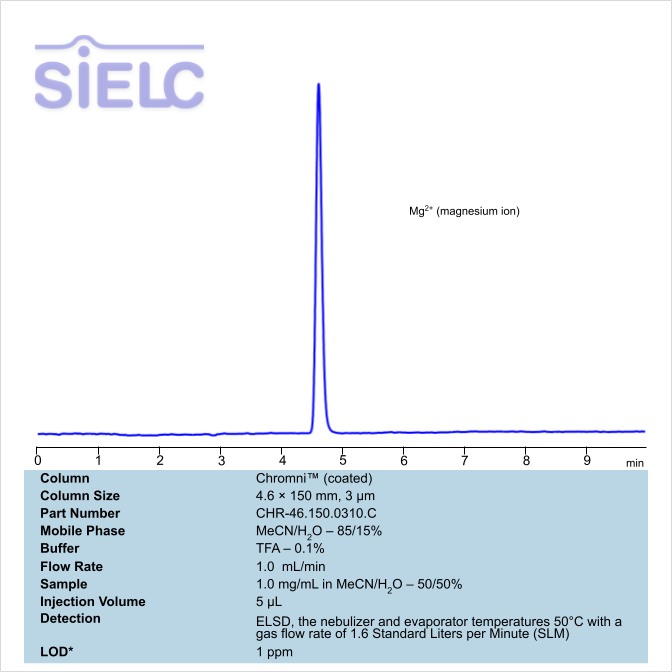
High Performance Liquid Chromatography (HPLC) Method for Analysis of Magnesium.
Magnesium is an element with the symbol Mg. Magnesium ion has the chemical formula of Mg2+. It is a shiny grey metal with a high chemical reactivity, but low density and melting point. While magnesium is abundant in the earth’s crust, it is produced in the cosmos in large, aging stars. It is primarily used as a structural metal in a large variety of contexts from aircrafts to light sources and chemical reagents.
Magnesium can be retained and analyzed using the Chromni stationary phase column. The analysis utilizes an isocraticmethod with a simple mobile phase consisting of water and acetonitrile (MeCN) and TFA. Detection is performed using ELSD.
Condition
| Column | Chromni, 4.6 x 150 mm, 3 µm, 100 A, surface coated |
| Mobile Phase | MeCN/H2O – 85/15% |
| Buffer | TFA – 0.1% |
| Flow Rate | 1.0 ml/min |
| Detection | ELSD |
| Limit Of Detection* | 1 ppm |
Description
| Class of Compounds | Metal |
| Analyzing Compounds | Magnesium |
Application Column
Chromni
Column Diameter: 4.6 mm
Column Length: 150 mm
Particle Size: 3 µm
Pore Size: 100 A
Column options: surface coated
HPLC ELSD Method for Separation of Metal Ions on Primesep 100 Column
October 4, 2005
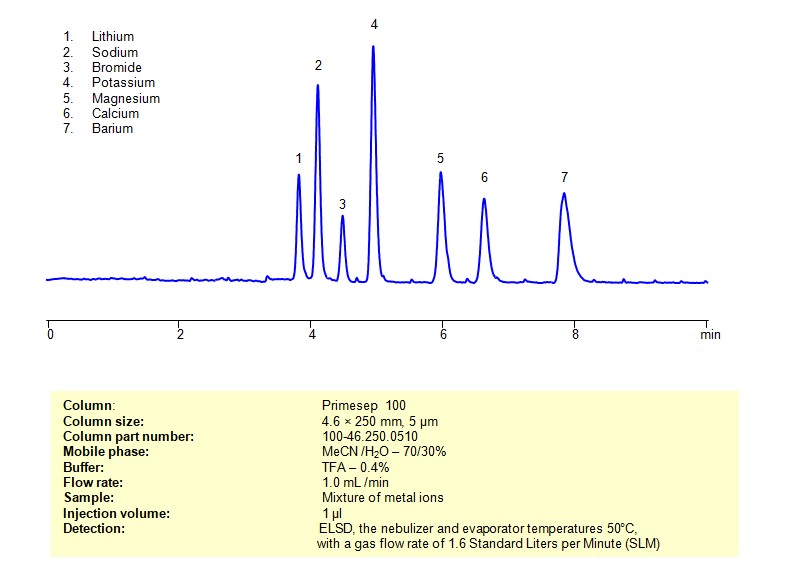
Primesep 100 separates the monovalent cations, lithium, potassium, and sodium, and the divalent cations, zinc, manganese, and calcium. The cations are resolved by cation exchange. The mobile phase mixture of water, acetonitrile (MeCN, ACN) and trifluoroacetic acid (TFA) is evaporative light scattering detection (ELSD) compatible.
| Column | Primesep 100, 4.6×250 mm, 5 µm, 100A |
| Mobile Phase | MeCN/H2O – 70/30% |
| Buffer | TFA- 0.4% |
| Flow Rate | 1.0 ml/min |
| Detection | ELSD 50C |
| Class of Compounds | Ions, Hydrophilic, Ionizable, Vitamin, Supplements |
| Analyzing Compounds | Sodium, Magnesium, Calcium, Lithium, Barium |
Application Column
Primesep 100
Column Diameter: 4.6 mm
Column Length: 250 mm
Particle Size: 5 µm
Pore Size: 100 A
Column options: dual ended
Bromide
Calcium
Lithium
Magnesium
Potassium
Sodium
