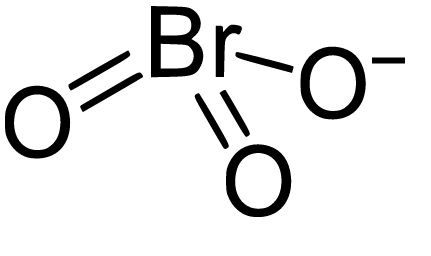
| CAS Number | 15541-45-4 |
|---|---|
| Molecular Formula | BrO3 |
| Molecular Weight | 127.902 |
| InChI Key | SXDBWCPKPHAZSM-UHFFFAOYSA-M |
| LogP | -4.63 |
| Synonyms |
|
Applications:
ELSD HPLC Method for Analysis of Inorganic Ions on Chromni Column
July 17, 2026
HPLC Method for Chlorate, Nitrate, Bromate, Chloride, Sodium, Sulfate on Chromni by SIELC Technologies
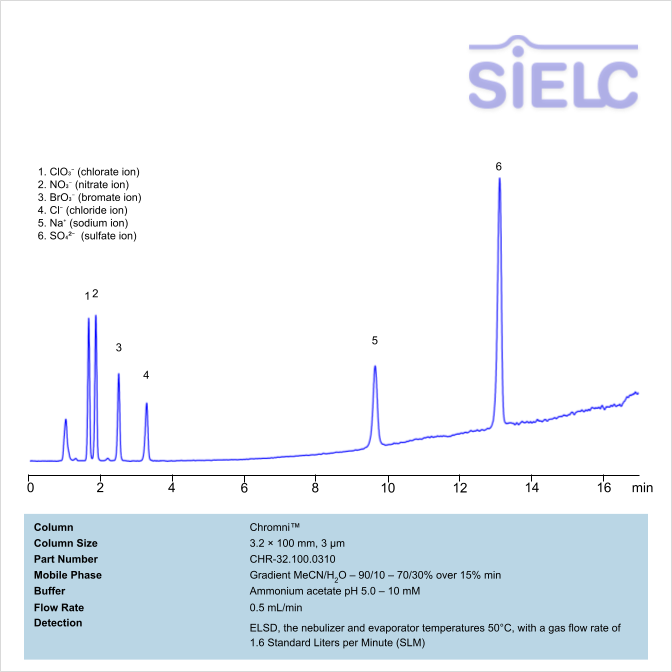
High Performance Liquid Chromatography (HPLC) Method for Analysis of Chlorate, Nitrate, Bromate, Chloride, Sodium, Sulfate.
Chlorate is a a compound with the chemical formula ClO3–. It is an oxidizer that works on Large variety of organics and other easily oxidized materials. Historically, it was used in pyrotechnics, but it faded out of use due to Chlorate’s instability. Magnesium chlorate has been found on Mars.
Nitrate, NO3–, is a compound of nitrogen and oxygen. It is essential as a nutrient in plants; therefore, it is often used in fertilizers. It is easily found in leafy greens. While it is important for cardiovascular health, too high of exposure to it can be dangerous.
Bromate is an oxyanion with the chemical formula BrO3–. It is formed in water through a reaction of ozone and bromide. It is suspected to be a human carcinogen.
Chloride is typically used to refer to a compound or molecule that contains a chlorine anion: Cl–. It is an electrolyte that is essential for bodily functions including blood pH, fluid balance, cellular functions, and more. Imbalance of chloride can indicate underlying health problems.
Sodium, which has a chemical symbol of Na, is a soft alkali metal that is highly reactive. It is found in abundance in everyday materials like table salt, sea water, and even the Earth’s crust. It is crucial for the body’s function and fluid balance.
Sulfate is an ionic chemical with the formula SO42-. In nature, it is usually found in geodes like gypsum. It is also created in atmosphere from sulfur dioxide. It is used for a variety of applications, but most notably, coloring wood and creating light-reflecting paints.
Chlorate, Nitrate, Bromate, Chloride, Sodium, Sulfate can be retained and analyzed using the Chromni stationary phase column. The analysis utilizes an isocratic method with a simple mobile phase consisting of water and acetonitrile (MeCN) with an Ammonium Acetate buffer. Detection is performed using MS.
| Column | Chromni, 3.2 x 100 mm, 3 µm, 100 A, dual ended |
| Mobile Phase | Gradient MeCN/H2O – 90/10-70/30% over 15 min |
| Buffer | Ammonium Acetate pH 5.0 – 10 mM |
| Flow Rate | 0.5 mL/min |
| Detection | ELSD |
Application Column
Chromni
Column Diameter: 3.2 mm
Column Length: 100 mm
Particle Size: 3 µm
Pore Size: 100 A
Column options: dual ended
Chlorate
Chloride
Nitrate
Sodium
Sulfate

HPLC Method for Analysis of Bromate Ion on Chromni Column
July 16, 2026
HPLC Method for Analysis of Bromate on Chromni Column by SIELC Technologies
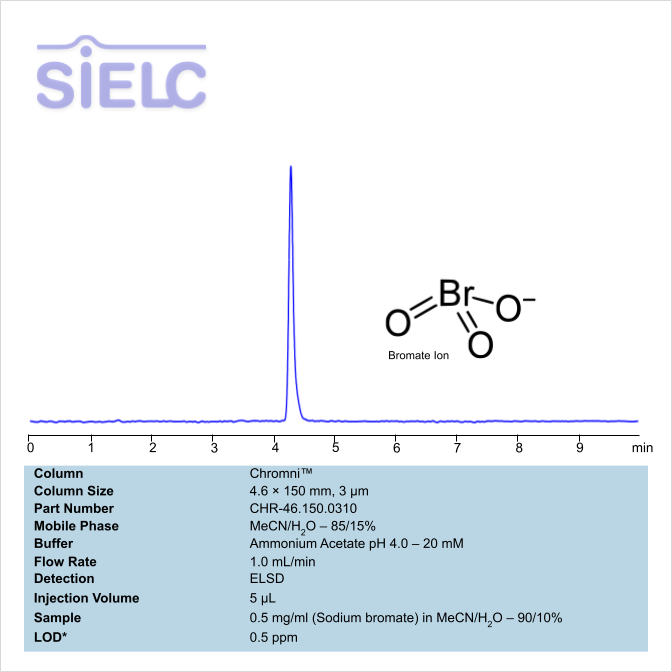
High Performance Liquid Chromatography (HPLC) Method for Analysis of Bromate.
Bromate is an oxyanion with the chemical formula BrO3–. It is formed in water through a reaction of ozone and bromide. It is suspected to be a human carcinogen.
Bromate can be retained and analyzed using the Chromni stationary phase column. The analysis utilizes an isocratic method with a simple mobile phase consisting of water and acetonitrile (MeCN). Detection is performed using UV.
Condition
| Column | Chromni, 4.6 x 150 mm, 3 µm, 100 A, dual ended |
| Mobile Phase | MeCN/H2O – 85/15% |
| Buffer | Ammonium Acetate pH 4 – 20 mM |
| Flow Rate | 1.0 mL/min |
| Detection | ELSD |
| Limit Of Detection* | 0.5 ppm |
Description
| Class of Compounds | Oxyanion |
| Analyzing Compounds | Bromate |
Application Column
Chromni
Column Diameter: 4.6 mm
Column Length: 150 mm
Particle Size: 3 µm
Pore Size: 100 A
Column options: dual ended
HPLC Separation of Polar Pesticides on Newcrom B Column
November 19, 2020
HPLC Method for Glyphosate, Phosphorous acid, Fosetyl-Al, Bromide, Chlorate, Perchlorate, Bialaphos, Aminomethylphosphonic acid (AMPA), Bromate, Sodium Bromate, 3-(Methylphosphinico)propionic acid on Newcrom B by SIELC Technologies
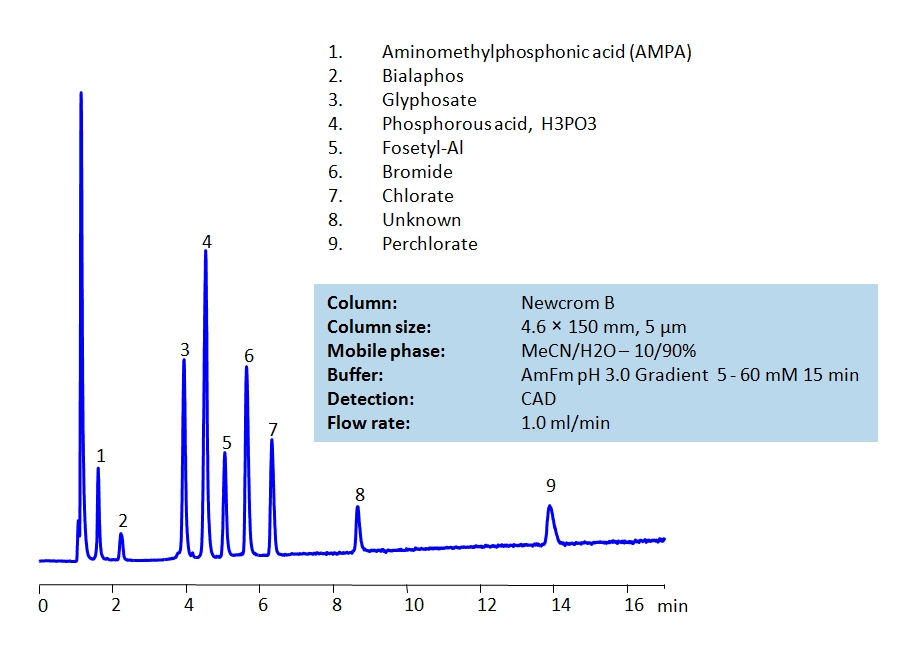
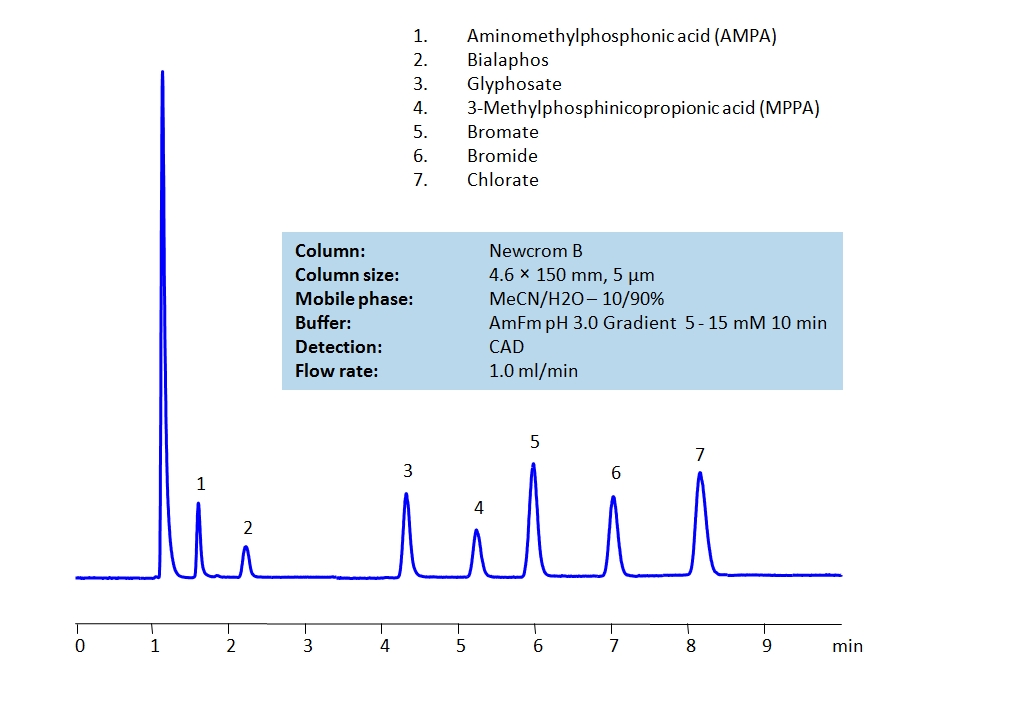
High Performance Liquid Chromatography (HPLC) Method for Analysis of Glyphosate, Phosphorous acid, Fosetyl-Al, Bromide, Chlorate, Perchlorate, Bialaphos, Aminomethylphosphonic acid (AMPA), Bromate, Sodium Bromate, 3-(Methylphosphinico)propionic acid.
Pesticide is a more generic term that includes herbicides, fungicides and insecticides in its definition. Herbicides are used to control unwanted plants, they are also known as weedkillers. Insecticides are used to kill insects. Fungicides are used to kill parasitic fungi. All are heavily used in agriculture. By using HPLC, many different pesticides can be separated and their retention characteristics controlled using the Newcrom B mixed-mode column.
| Column | Newcrom B, 4.6 x 150 mm, 5 µm, 100 A, dual ended |
| Mobile Phase | MeCN/H2O – 10/90% |
| Buffer | AmFm pH 3.0 Gradient 5 – 60 mM 15 min |
| Flow Rate | 1 ml/min |
| Detection | CAD |
| Column | Newcrom B, 4.6 x 150 mm, 5 µm, 100 A, dual ended |
| Mobile Phase | MeCN/H2O – 10/90% |
| Buffer | AmFm pH 3.0 Gradient 5 – 15 mM 10 min |
| Flow Rate | 1 ml/min |
| Detection | CAD |
| Class of Compounds | Pesticides, Herbicides, Fungicides, Insecticides |
| Analyzing Compounds | Glyphosate, Phosphorous acid, Fosetyl-Al, Bromide, Chlorate, Perchlorate, Bialaphos, Aminomethylphosphonic acid (AMPA), Bromate, Sodium Bromate, 3-(Methylphosphinico)propionic acid |
Application Column
Newcrom B
Column Diameter: 4.6 mm
Column Length: 150 mm
Particle Size: 5 µm
Pore Size: 100 A
Column options: dual ended
Aminomethylphosphonic acid (AMPA)
Bialaphos
Bromate
Bromide
Chlorate
Fosetyl-Al
Glyphosate
Perchlorate
Phosphorous acid
Sodium Bromate
HPLC Separation of Chlorate and Bromate Ions
March 27, 2004
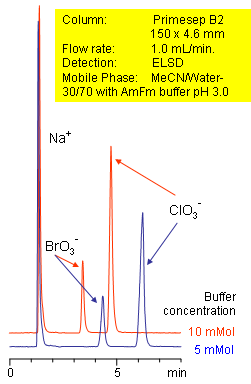
Primesep B2 separates chlorate and bromate by an ion-exchange mechanism. The anion-exchange properties of the column allow retention of hydrophilic compounds, and these properties can be adjusted by simply changing the ammonium formate buffer concentration. The HPLC separation uses a mobile phase of water, acetonitrile (MeCN, ACN) and ammonium formate with evaporative light scattering detection (ELSD).
| Column | Primesep B2, 4.6×150 mm, 5 µm, 100A |
| Mobile Phase | MeCN/H2O – 30/70% |
| Buffer | AmFm pH 3.0 |
| Flow Rate | 1.0 ml/min |
| Detection | CAD |
| Class of Compounds | Ions, Hydrophilic, Ionizable |
| Analyzing Compounds | Sodium Chlorate, Sodium Bromate |
Application Column
Primesep B2
The Primesep family of mixed-mode columns offers a wide variety of stationary phases, boasting unprecedented selectivity in the separation of a broad array of chemical compounds across multiple applications. Corresponding Primesep guard columns, available with all stationary phases, do not require holders. SIELC provides a method development service available to all customers. Inquire about our specially-tailored custom LC-phases for specific separations.
Select optionsChlorate
Sodium Bromate
Sodium Chlorate
