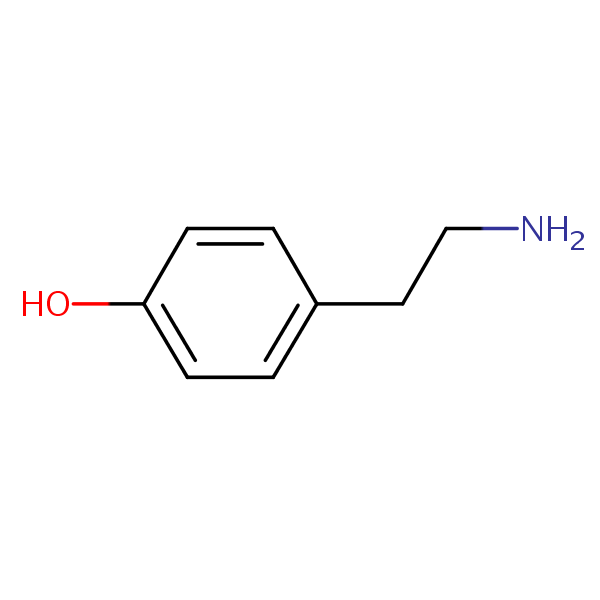
| CAS Number | 51-67-2 |
|---|---|
| Molecular Formula | C8H11NO |
| Molecular Weight | 137.183 |
| InChI Key | DZGWFCGJZKJUFP-UHFFFAOYSA-N |
| LogP | 0.309 |
| Synonyms |
|
Applications:
HPLC Method for Analysis of Tyramine on Primesep 100 Column on Alltesta™
September 23, 2025
HPLC Method for Tyramine on Primesep 100 by SIELC Technologies
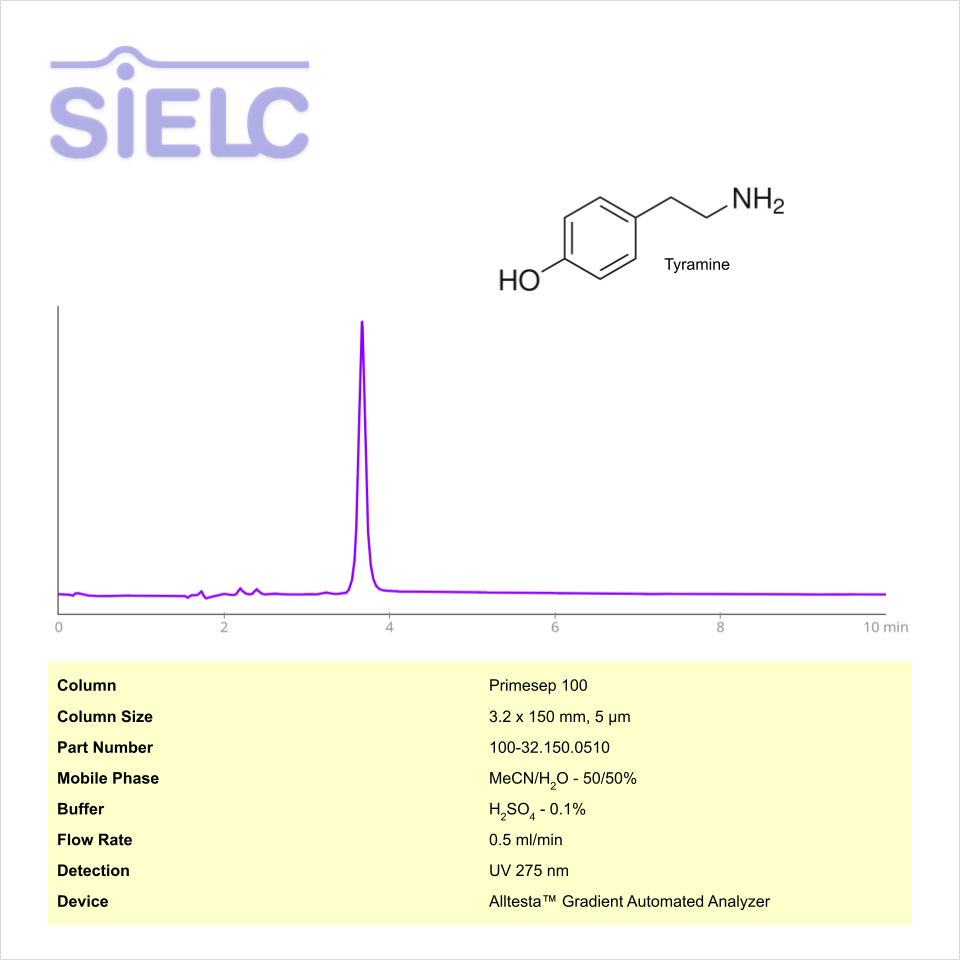
High Performance Liquid Chromatography (HPLC) Method for Analysis of Tyramine
Tyramine is an amine compound with the molecular formula C8H11NO. As a monoamine oxidase (MAO) substrate, it is broken down by the enzyme MAO in the body. It is typically found in fermented, aged, smoked, and dried foods.
Tyramine can be retained and analyzed using the Primesep 100 stationary phase column. The analysis utilizes an isocratic method with a simple mobile phase consisting of water and acetonitrile (MeCN) with a sulfuric acid buffer. Detection is performed using UV.
| Column | Primesep 100, 3.2 x 150 mm, 5 µm, 100 A, dual ended |
| Mobile Phase | MeCN – 50% |
| Buffer | Sulfuric Acid |
| Flow Rate | 0.5 ml/min |
| Detection | UV 275 nm |
| Class of Compounds | Amine |
| Analyzing Compounds | Tyramine |
Application Column
Primesep 100
Column Diameter: 3.2 mm
Column Length: 150 mm
Particle Size: 5 µm
Pore Size: 100 A
Column options: dual ended

HPLC Method for Analysis of Tyramine on Primesep 100 Column on Cromite™
September 23, 2025
HPLC Method for Tyramine on Primesep 100 by SIELC Technologies
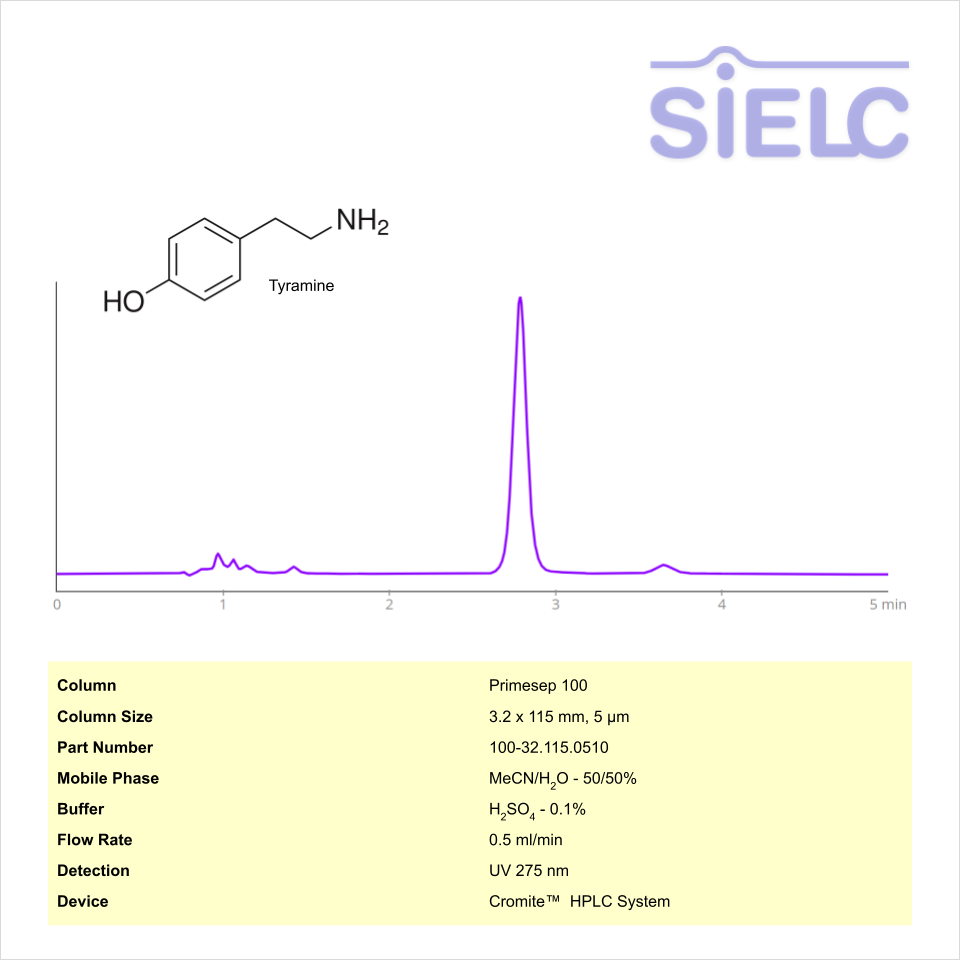
High Performance Liquid Chromatography (HPLC) Method for Analysis of Tyramine
Tyramine is an amine compound with the molecular formula C8H11NO. As a monoamine oxidase (MAO) substrate, it is broken down by the enzyme MAO in the body. It is typically found in fermented, aged, smoked, and dried foods.
Tyramine can be retained and analyzed using the Primesep 100 stationary phase column. The analysis utilizes an isocratic method with a simple mobile phase consisting of water and acetonitrile (MeCN) with a sulfuric acid buffer. Detection is performed using UV.
| Column | Primesep 100, 3.2 x 100 mm, 5 µm, 100 A, dual ended |
| Mobile Phase | MeCN – 50% |
| Buffer | Sulfuric Acid |
| Flow Rate | 0.5 ml/min |
| Detection | UV 275 nm |
| Class of Compounds | Amine |
| Analyzing Compounds | Tyramine |
Application Column
Primesep 100
Column Diameter: 3.2 mm
Column Length: 100 mm
Particle Size: 5 µm
Pore Size: 100 A
Column options: dual ended
Alltesta HPLC Method for Analysis of Tyramine on Primesep 100
October 7, 2024
Alltesta HPLC Method for Tyramine on Primesep 100 by SIELC Technologies
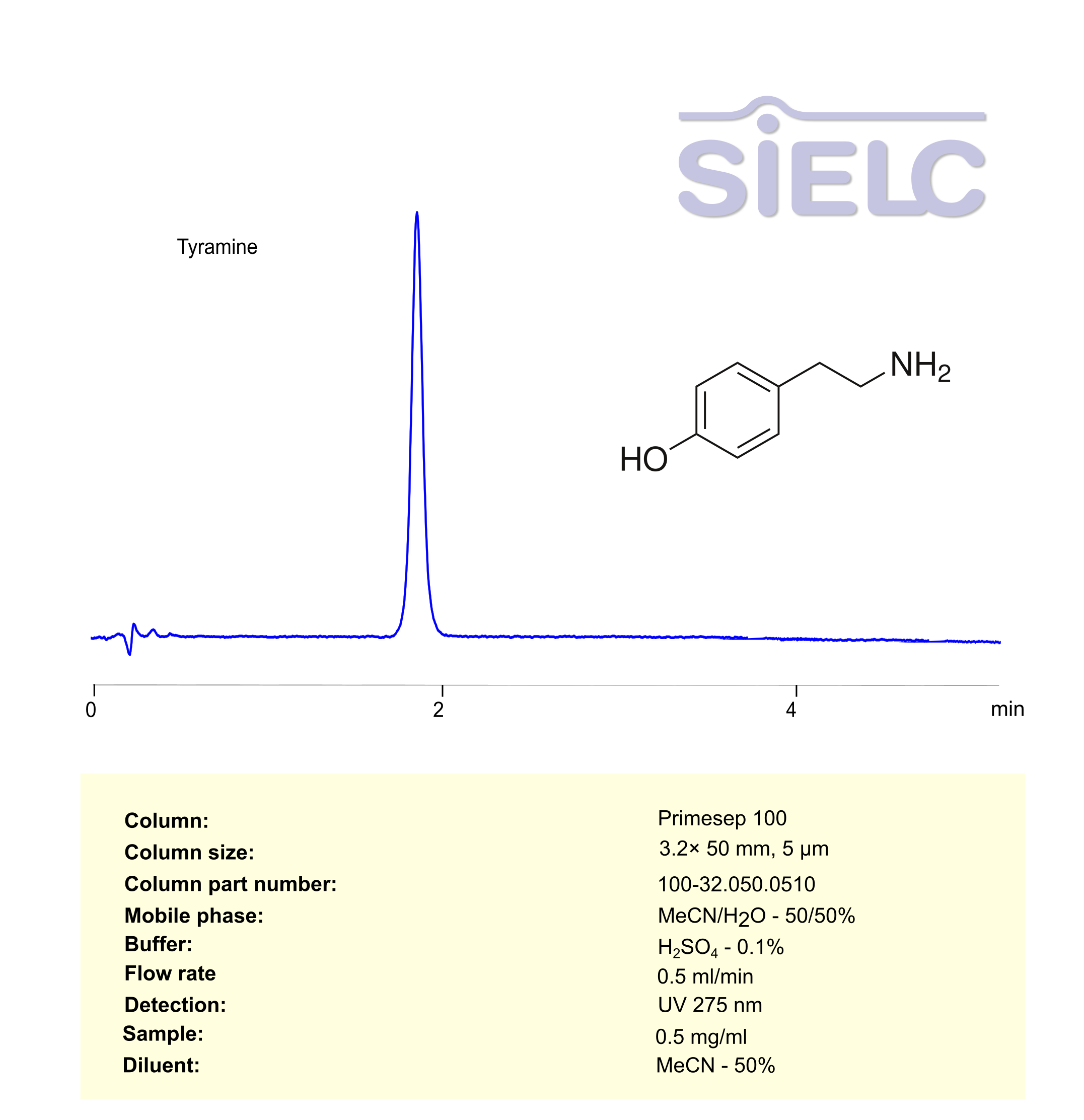
High Performance Liquid Chromatography (HPLC) Method for Analysis of Tyramine
Tyramine is a naturally occurring compound derived from the amino acid tyrosine. It is found in various foods and beverages, especially aged or fermented products such as aged cheeses, cured meats, certain wines, and soy products. Tyramine can affect the release of norepinephrine, a neurotransmitter, and can influence blood pressure.
For people taking monoamine oxidase inhibitors (MAOIs), consuming foods high in tyramine can cause a dangerous spike in blood pressure, known as a hypertensive crisis. This is why individuals on such medications are often advised to follow a low-tyramine diet.
Tyramine can be retained, and analyzed using a Primesep 100 mixed-mode stationary phase column. The analysis utilizes an isocratic method with a simple mobile phase consisting of water, acetonitrile (MeCN), and sulfuric acid as a buffer. Detection is achieved using UV at 275 nm
| Column | Primesep 100, 3.2 x 50 mm, 5 µm, 100 A, dual ended |
| Mobile Phase | MeCN/H2O – 50/50% |
| Buffer | H2SO4 -0.1% |
| Flow Rate | 1.0 ml/min |
| Detection | UV 275 nm |
| Class of Compounds | Amine |
| Analyzing Compounds | Tyramine |
You can view examples of chromatograms obtained using the Allesta instrument and Sielc columns by clicking here.
Application Column
Primesep 100
Column Diameter: 3.2 mm
Column Length: 50 mm
Particle Size: 5 µm
Pore Size: 100 A
Column options: dual ended
UV-Vis Spectrum of Tyramine
July 8, 2024
Access the UV-Vis Spectrum SIELC Library
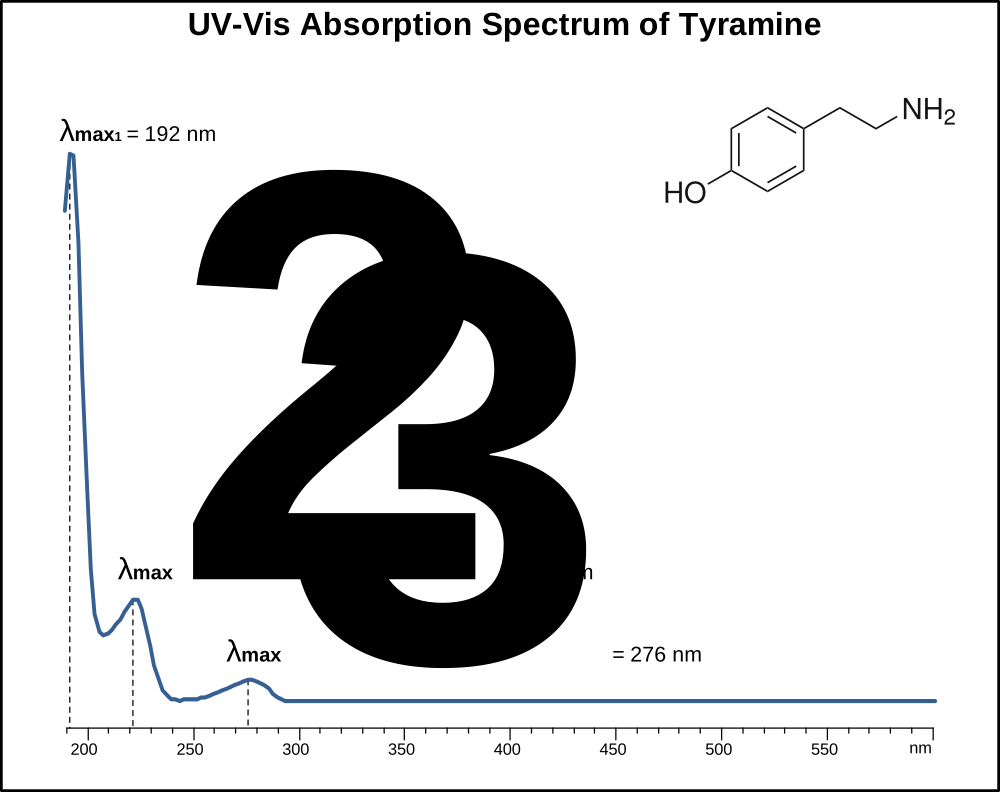
If you are looking for optimized HPLC method to analyze Tyramine check our HPLC Applications library
For optimal results in HPLC analysis, it is recommended to measure absorbance at a wavelength that matches the absorption maximum of the compound(s) being analyzed. The UV spectrum shown can assist in selecting an appropriate wavelength for your analysis. Please note that certain mobile phases and buffers may block wavelengths below 230 nm, rendering absorbance measurement at these wavelengths ineffective. If detection below 230 nm is required, it is recommended to use acetonitrile and water as low UV-transparent mobile phases, with phosphoric acid and its salts, sulfuric acid, and TFA as buffers.
HPLC Method for Analysis of Tyramine on Primesep 100 Column
February 6, 2024
High Performance Liquid Chromatography (HPLC) Method for Analysis of Tyramine on Primesep 100 by SIELC Technologies
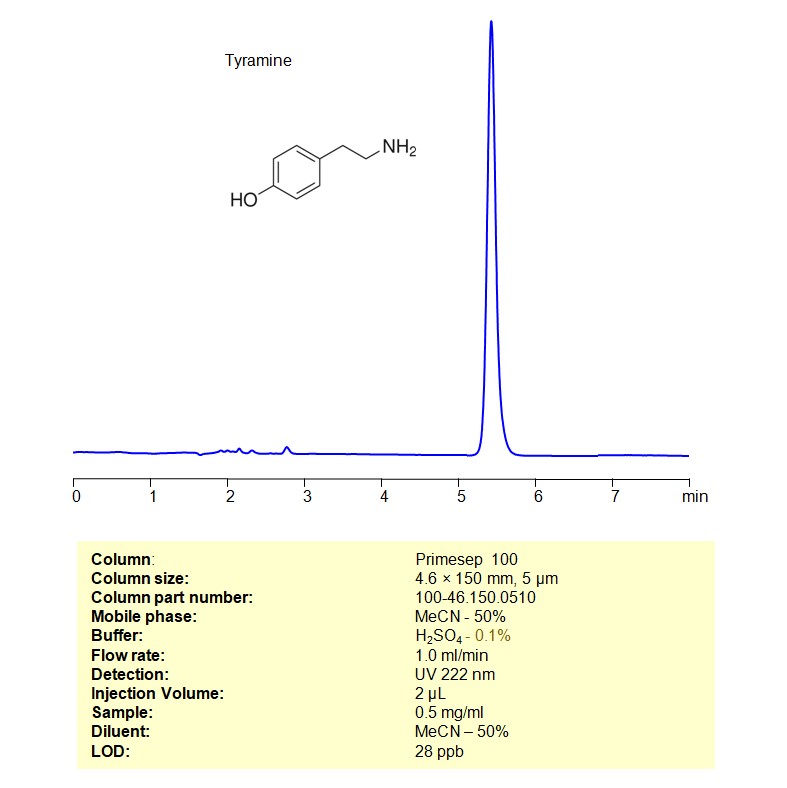
Tyramine is a naturally occurring monoamine compound with the molecular formula C8H11NO. As a monoamine oxidase (MAO) substrate, it is broken down by the enzyme MAO in the body. It belongs to the class of biogenic amines. It is typically found in fermented, aged, smoked, and dried foods. It is derived from the amino acid tyrosine and is found in various foods. Tyramine is particularly known for its potential role in certain food sensitivities and interactions with monoamine oxidase inhibitors (MAOIs), a class of medications. It is a trace amine and has been studied for its potential physiological effects, including its role as a neurotransmitter and its impact on blood pressure regulation. Tyramine is notable for its interaction with MAOIs, a class of antidepressant medications. In individuals taking MAOIs, the consumption of foods high in tyramine can lead to a hypertensive crisis. You can find detailed UV spectra of Tyramine and information about its various lambda maxima by visiting the following link.
Tyramine can be retained and analyzed using a Primesep 100 mixed-mode stationary phase column. The analysis employs an isocratic method with a simple mobile phase comprising water, acetonitrile (MeCN), and sulfuric acid as a buffer. This method allows for detection using UV at 222 nm
| Column | Primesep 100, 4.6 x 150 mm, 5 µm, 100 A, dual ended |
| Mobile Phase | MeCN/H2O – 50/50% |
| Buffer | H2SO4 – 0.1 |
| Flow Rate | 1.0 ml/min |
| Detection | UV 222 nm |
| Samples | 0.5 mg/ml in MeCN/H2O – 50/50% |
| Injection volume | 2 µl |
| LOD* | 28 ppb |
| Class of Compounds | Biogenic amine |
| Analyzing Compounds | Tyramine |
Application Column
Primesep 100
Column Diameter: 4.6 mm
Column Length: 150 mm
Particle Size: 5 µm
Pore Size: 100 A
Column options: dual ended
Separation of Tyramine on Newcrom R1 HPLC column
February 16, 2018
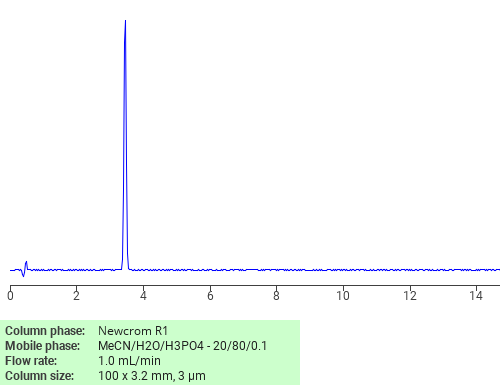
Tyramine can be analyzed by this reverse phase (RP) HPLC method with simple conditions. The mobile phase contains an acetonitrile (MeCN), water, and phosphoric acid. For Mass-Spec (MS) compatible applications the phosphoric acid needs to be replaced with formic acid. Smaller 3 µm particles columns available for fast UPLC applications. This liquid chromatography method is scalable and can be used for isolation impurities in preparative separation. It also suitable for pharmacokinetics.
Application Column
Newcrom R1
The Newcrom columns are a family of reverse-phase-based columns. Newcrom A, AH, B, and BH are all mixed-mode columns with either positive or negative ion-pairing groups attached to either short (25 Å) or long (100 Å) ligand chains. Newcrom R1 is a special reverse-phase column with low silanol activity.
Select options