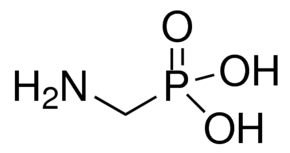
| CAS Number | 1066-51-9 |
|---|---|
| Molecular Formula | CH6NO3P |
| Molecular Weight | 111.04 |
| InChI Key | MGRVRXRGTBOSHW-UHFFFAOYSA-N |
| LogP | -4.7 |
| Synonyms |
|
Applications:
HPLC ELSD Method for Analysis of FMOC Derivatized AMPA and Glyphosate on Chromni Column
August 20, 2026
HPLC Method for Analysis of Aminomethylphosphonic acid (AMPA), Glyphosate on Chromni Column by SIELC Technologies
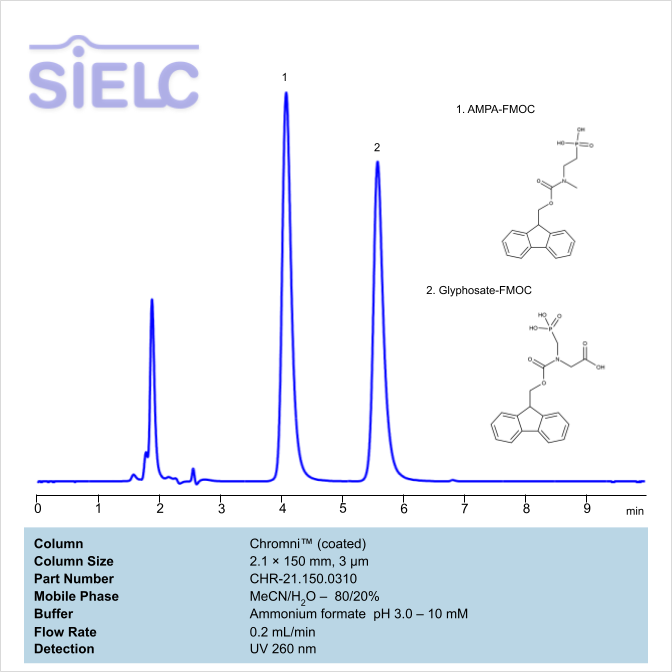
High Performance Liquid Chromatography (HPLC) Method for Analysis of Aminomethylphosphonic acid (AMPA), Glyphosate.
Aminomethylphosphonic Acid is an aminophosphonate with the chemical formula CH6NO3P. It is primarily used as a biocide and pesticide, as well as in research to assess the exposure of glyphosate. It is a major toxic metabolite of glyphosate as is considered to be a similar toxicological concern. You can find detailed UV spectra of Aminomethylphosphonic acid (AMPA) and information about its various lambda maxima by visiting the following link.
Glyphosate is an herbicide with a chemical formula of C3H8NO5P. It works through blocking enzymes, like 5-enolpyruvylshikimate-3-phosphate synthase, essential for plant growth. It is typically found in agricultural work, but can occasionally be found in forestry and garden care. You can find detailed UV spectra of Glyphosate and information about its various lambda maxima by visiting the following link.
Aminomethylphosphonic acid (AMPA), Glyphosate can be retained and analyzed using the Chromni stationary phase column. The analysis utilizes a gradient method with a simple mobile phase consisting of water and acetonitrile (MeCN) and ammonium acetate. Detection is performed using UV.
Condition
| Column | Chromni, 2.1 x 150 mm, 3 µm, 100 A, surface coated |
| Mobile Phase | MeCN/H2O |
| Buffer | AmAc pH 3.0 – 10 mM |
| Flow Rate | 0.2 ml/min |
| Detection | UV 260 nm |
Description
| Class of Compounds | Aminophosphonate & Herbicide |
| Analyzing Compounds | Aminomethylphosphonic acid (AMPA), Glyphosate |
Application Column
Chromni
Column Diameter: 2.1 mm
Column Length: 150 mm
Particle Size: 3 µm
Pore Size: 100 A
Column options: surface coated
Glyphosate

HPLC ELSD Method for Analysis of Aminomethylphosphonic acid (AMPA) on Chromni Column
August 18, 2026
HPLC Method for Analysis of Aminomethylphosphonic acid (AMPA) on Chromni Column by SIELC Technologies
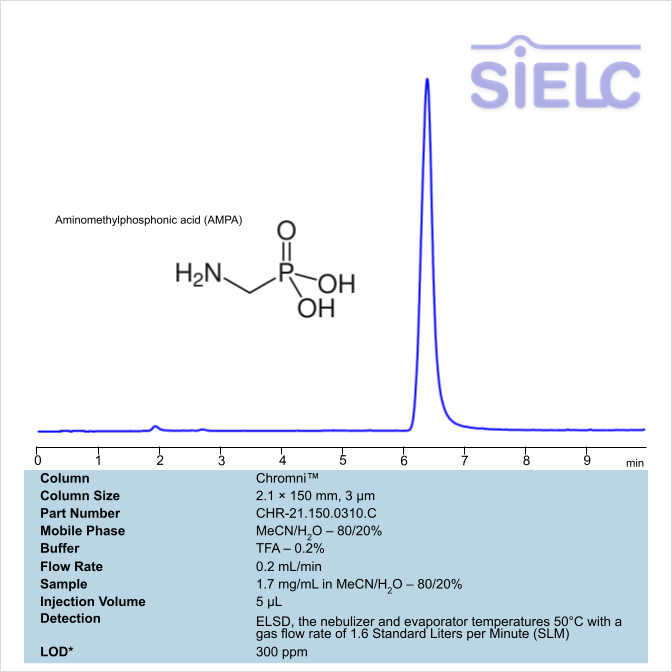
High Performance Liquid Chromatography (HPLC) Method for Analysis of Aminomethylphosphonic acid (AMPA).
Aminomethylphosphonic Acid is an aminophosphonate with the chemical formula CH6NO3P. It is primarily used as a biocide and pesticide, as well as in research to assess the exposure of glyphosate. It is a major toxic metabolite of glyphosate as is considered to be a similar toxicological concern. You can find detailed UV spectra of Aminomethylphosphonic acid (AMPA) and information about its various lambda maxima by visiting the following link.
Aminomethylphosphonic acid (AMPA) can be retained and analyzed using the Chromni stationary phase column. The analysis utilizes an isocraticmethod with a simple mobile phase consisting of water and acetonitrile (MeCN) and TFA. Detection is performed using ELSD.
Condition
| Column | Chromni, 2.1 x 150 mm, 3 µm, 100 A, surface coated |
| Mobile Phase | MeCN/H2O – 80/20% |
| Buffer | TFA – 0.2% |
| Flow Rate | 0.2 ml/min |
| Detection | ELSD |
| Limit Of Detection* | 300 ppm |
Description
| Class of Compounds | Acid |
| Analyzing Compounds | Aminomethylphosphonic acid (AMPA) |
Application Column
Chromni
Column Diameter: 2.1 mm
Column Length: 150 mm
Particle Size: 3 µm
Pore Size: 100 A
Column options: surface coated
Uv-Vis Spectrum of Aminomethylphosphonic Acid
January 9, 2026
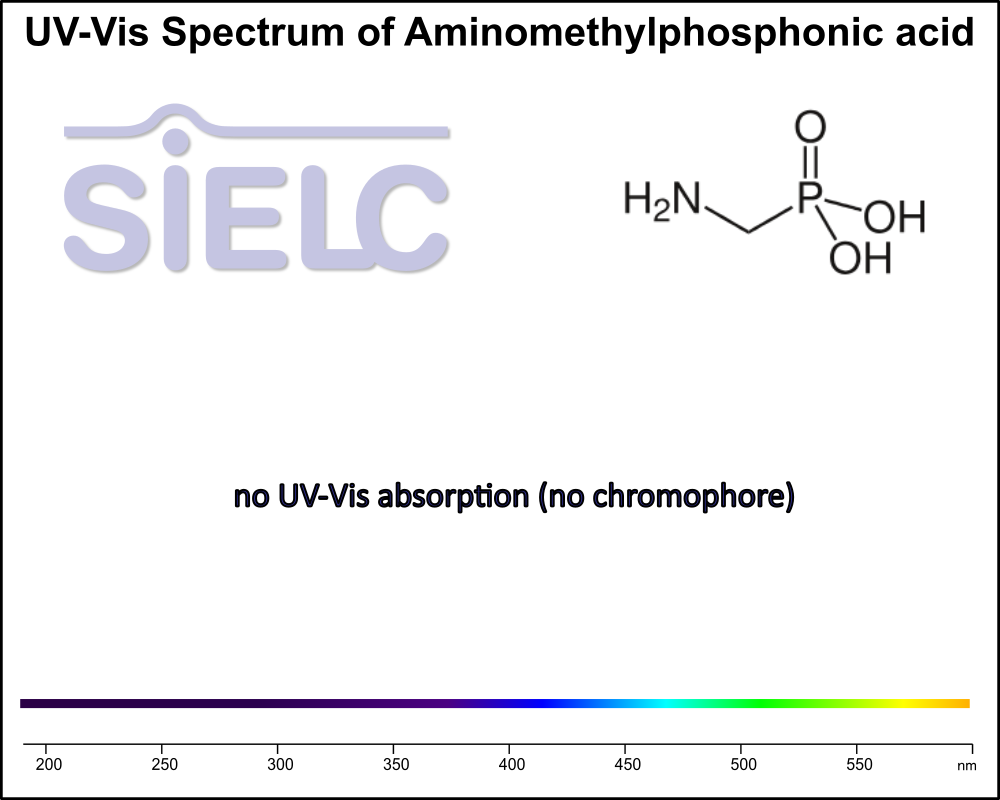
If you are looking for optimized HPLC method to analyze Aminomethylphosphonic acid (AMPA) check our HPLC Applications library
For optimal results in HPLC analysis, it is recommended to measure absorbance at a wavelength that matches the absorption maximum of the compound(s) being analyzed. The UV spectrum shown can assist in selecting an appropriate wavelength for your analysis. Please note that certain mobile phases and buffers may block wavelengths below 230 nm, rendering absorbance measurement at these wavelengths ineffective. If detection below 230 nm is required, it is recommended to use acetonitrile and water as low UV-transparent mobile phases, with phosphoric acid and its salts, sulfuric acid, and TFA as buffers.
For some compounds, the UV-Vis Spectrum is affected by the pH of the mobile phase. The spectra presented here are measured with an acidic mobile phase that has a pH of 3 or lower.
HPLC Separation of Polar Pesticides on Newcrom B Column
November 19, 2020
HPLC Method for Glyphosate, Phosphorous acid, Fosetyl-Al, Bromide, Chlorate, Perchlorate, Bialaphos, Aminomethylphosphonic acid (AMPA), Bromate, Sodium Bromate, 3-(Methylphosphinico)propionic acid on Newcrom B by SIELC Technologies
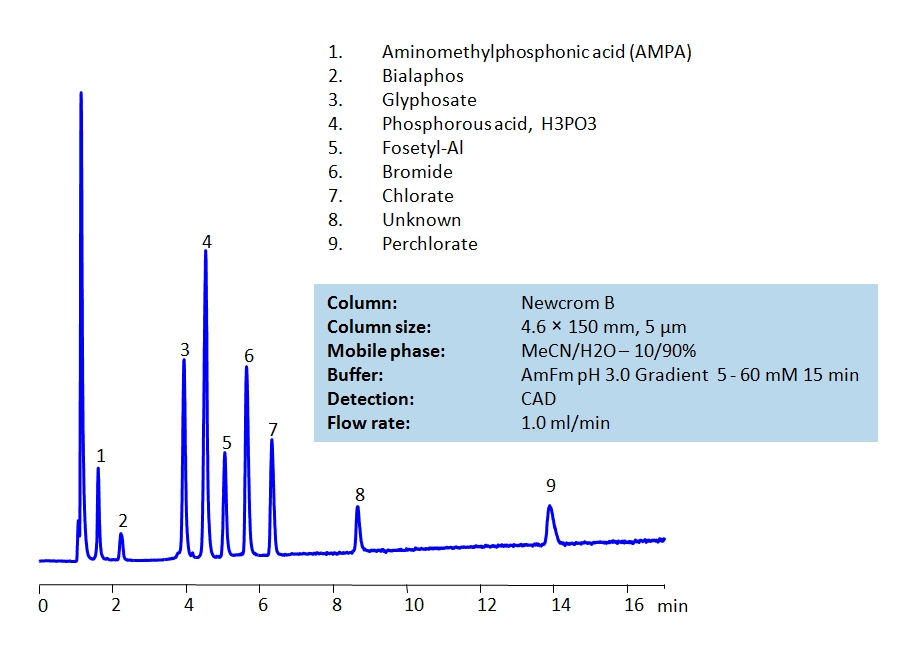
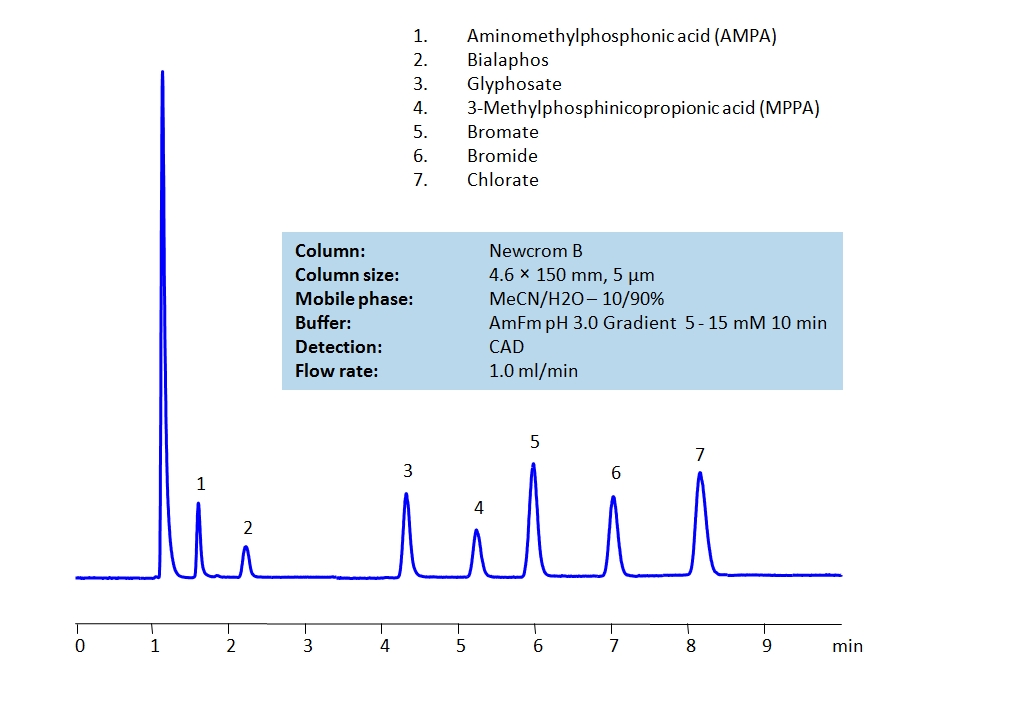
High Performance Liquid Chromatography (HPLC) Method for Analysis of Glyphosate, Phosphorous acid, Fosetyl-Al, Bromide, Chlorate, Perchlorate, Bialaphos, Aminomethylphosphonic acid (AMPA), Bromate, Sodium Bromate, 3-(Methylphosphinico)propionic acid.
Pesticide is a more generic term that includes herbicides, fungicides and insecticides in its definition. Herbicides are used to control unwanted plants, they are also known as weedkillers. Insecticides are used to kill insects. Fungicides are used to kill parasitic fungi. All are heavily used in agriculture. By using HPLC, many different pesticides can be separated and their retention characteristics controlled using the Newcrom B mixed-mode column.
| Column | Newcrom B, 4.6 x 150 mm, 5 µm, 100 A, dual ended |
| Mobile Phase | MeCN/H2O – 10/90% |
| Buffer | AmFm pH 3.0 Gradient 5 – 60 mM 15 min |
| Flow Rate | 1 ml/min |
| Detection | CAD |
| Column | Newcrom B, 4.6 x 150 mm, 5 µm, 100 A, dual ended |
| Mobile Phase | MeCN/H2O – 10/90% |
| Buffer | AmFm pH 3.0 Gradient 5 – 15 mM 10 min |
| Flow Rate | 1 ml/min |
| Detection | CAD |
| Class of Compounds | Pesticides, Herbicides, Fungicides, Insecticides |
| Analyzing Compounds | Glyphosate, Phosphorous acid, Fosetyl-Al, Bromide, Chlorate, Perchlorate, Bialaphos, Aminomethylphosphonic acid (AMPA), Bromate, Sodium Bromate, 3-(Methylphosphinico)propionic acid |
Application Column
Newcrom B
Column Diameter: 4.6 mm
Column Length: 150 mm
Particle Size: 5 µm
Pore Size: 100 A
Column options: dual ended
Aminomethylphosphonic acid (AMPA)
Bialaphos
Bromate
Bromide
Chlorate
Fosetyl-Al
Glyphosate
Perchlorate
Phosphorous acid
Sodium Bromate
