HPLC Method for Analysis of Aminomethylphosphonic acid (AMPA), Glyphosate on Chromni Column by SIELC Technologies
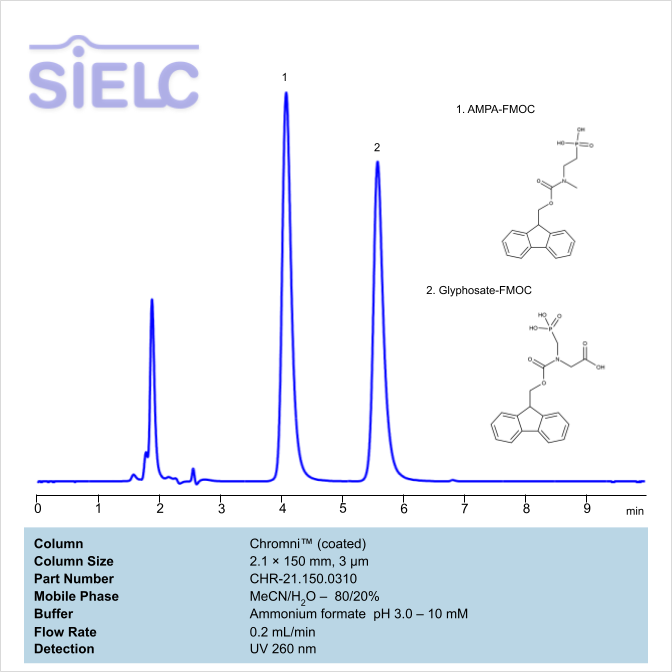
High Performance Liquid Chromatography (HPLC) Method for Analysis of Aminomethylphosphonic acid (AMPA), Glyphosate.
Aminomethylphosphonic Acid is an aminophosphonate with the chemical formula CH6NO3P. It is primarily used as a biocide and pesticide, as well as in research to assess the exposure of glyphosate. It is a major toxic metabolite of glyphosate as is considered to be a similar toxicological concern. You can find detailed UV spectra of Aminomethylphosphonic acid (AMPA) and information about its various lambda maxima by visiting the following link.
Glyphosate is an herbicide with a chemical formula of C3H8NO5P. It works through blocking enzymes, like 5-enolpyruvylshikimate-3-phosphate synthase, essential for plant growth. It is typically found in agricultural work, but can occasionally be found in forestry and garden care. You can find detailed UV spectra of Glyphosate and information about its various lambda maxima by visiting the following link.
Aminomethylphosphonic acid (AMPA), Glyphosate can be retained and analyzed using the Chromni stationary phase column. The analysis utilizes a gradient method with a simple mobile phase consisting of water and acetonitrile (MeCN) and ammonium acetate. Detection is performed using UV.
Condition
| Column | Chromni, 2.1 x 150 mm, 3 µm, 100 A, surface coated |
| Mobile Phase | MeCN/H2O |
| Buffer | AmAc pH 3.0 – 10 mM |
| Flow Rate | 0.2 ml/min |
| Detection | UV 260 nm |
Description
| Class of Compounds | Aminophosphonate & Herbicide |
| Analyzing Compounds | Aminomethylphosphonic acid (AMPA), Glyphosate |
Application Column
Chromni
Column Diameter: 2.1 mm
Column Length: 150 mm
Particle Size: 3 µm
Pore Size: 100 A
Column options: surface coated
Glyphosate