HPLC Method for Analysis of Guanosine, Cytidine, Adenosine, Uridine, Thymidine on Chromni Column by SIELC Technologies
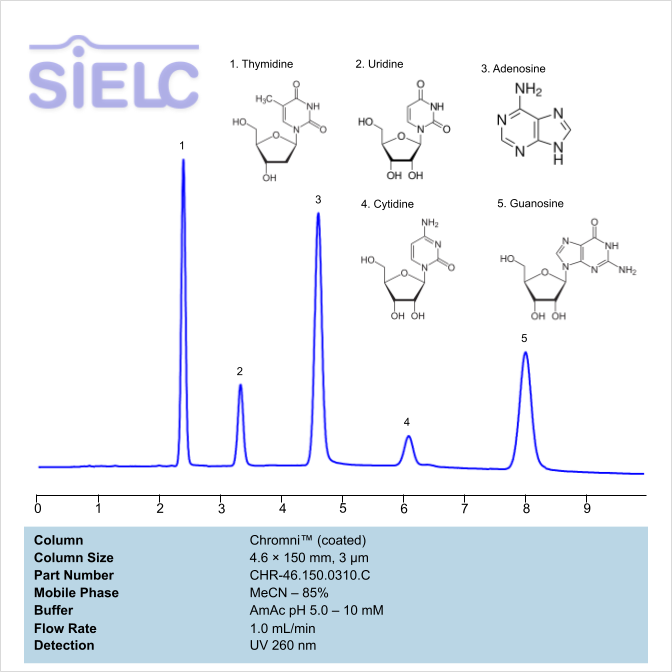
High Performance Liquid Chromatography (HPLC) Method for Analysis of Guanosine, Cytidine, Adenosine, Uridine, Thymidine.
Thymidine, also noted as dT and dThd and known as deoxythymidine, has the chemical formula C10H14N2O5. It is a a pyrimidine deoxynucleoside found as one of the four nucleosides in DNA. It pairs with deoxyadenosine in double sided DNA and is used to synchronize the cells in G1/early S phase. Thymidine’s primary use is in the production of the antiretroviral drug known as azidothymidine. You can find detailed UV spectra of Thymine and information about its various lambda maxima by visiting the following link.
Uridine, also noted as U and Urd, has C9H12O6 chemical formula. It is a pyrimidine analog containing uracil. It is one of the five standard nucleosides. It is a non-essential nutrient, since the body produces it as necessary. While uridine can be found in certain foods in the form of RNA, it is not bioavailable, as it is destroyed in the liver. You can find detailed UV spectra of Uracil and information about its various lambda maxima by visiting the following link.
Adenosine is a key building block of energy-carrying molecules with the chemical formula C10H13N5O4. It has a variety of other uses, including being a inhibitory neurotransmitter which helps with sleep and acting as a blood flow regulator. Medicinally, it is used as treatment for supraventricular tachycardia (SVT). You can find detailed UV spectra of Adenosine and information about its various lambda maxima by visiting the following link.
Cytidine, also noted as C or Cyd, is a nucleoside molecule with the chemical formula C9H13N3O5. It is primarily found in foods with high RNA contents, such as organ meets, brewer’s yeast, and beer. During digestion, Cyd is broken down into ribosyl pyrimidines. When consumed by humans, it is converted into uridine, which is suspected to be the reason behind cytidine’s metabolic effects. You can find detailed UV spectra of Cytidine and information about its various lambda maxima by visiting the following link.
Guanosine, often denoted as G or Guo, is a purine nucleoside with the chemical formula C10H13N5O5. It can be phosphorylated into many other forms, which play vital roles in biochemical possesses like synthesis of nucleic acids, proteins, photosynthesis, and more. It is also required for RNA splicing. It is used in acyclovir, an antiviral drug, to treat herpes. It can also be found in abacavir, an anti-HIV drug, and regadenoson, an A2A adenosine receptor agonist. You can find detailed UV spectra of Guanosine and information about its various lambda maxima by visiting the following link.
Guanosine, Cytidine, Adenosine, Uridine, Thymidine can be retained and analyzed using the Chromni stationary phase column. The analysis utilizes a gradient method with a simple mobile phase consisting of water and acetonitrile (MeCN) and ethanol. Detection is performed using UV.
Condition
| Column | Chromni, 4.6 x 150 mm, 3 µm, 100 A, surface coated |
| Mobile Phase | MeCN/H2O -85% |
| Buffer | AmAc pH 5.0 – 10 mM |
| Flow Rate | 1.0 ml/min |
| Detection | UV 260 nm |
Description
Application Column
Chromni
Column Diameter: 4.6 mm
Column Length: 150 mm
Particle Size: 3 µm
Pore Size: 100 A
Column options: surface coated
Cytidine
Guanosine
Thymidine
Uridine