HPLC Method for Analysis of Resorcinol, 1-Naphthol, N,N-Bis(2-hydroxy)-p-phenylenediamine sulfate, p-Phenylenediamine on Primesep 100 by SIELC Technologies
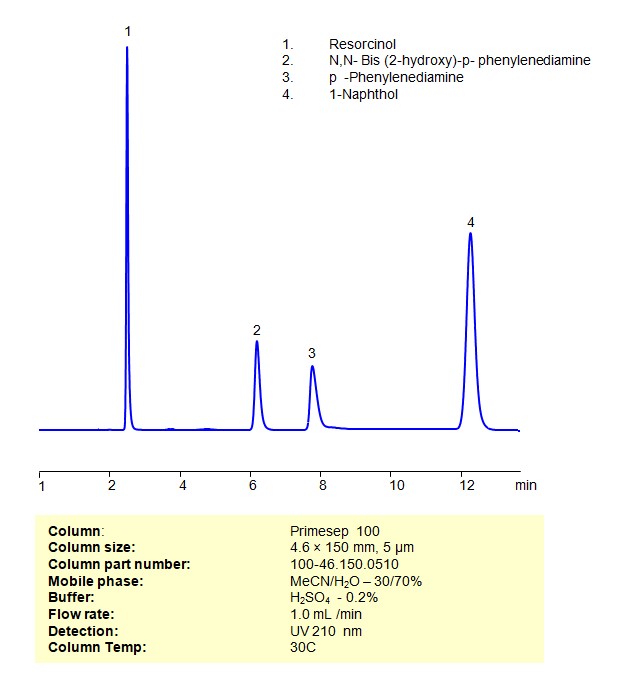
| Column | Primesep 100, 4.6 x 150 mm, 5 µm, 100 A, dual ended |
| Mobile Phase | MeCN/H2O – 30/70% |
| Buffer | H2SO4 -0.2% |
| Flow Rate | 1.0 ml/min |
| Detection | UV 210 nm |
| Samples | N,N-Bis(2-hydroxy)-p-phenylenediamine (0.7 mg/mL) p-Phenylenediamine (1.3 mg/mL) 1-Naphthol (0.18 mg/mL) Resorcinol (0.28 mg/mL) |
| Injection volume | 3 µl |
| Class of Compounds |
Phenols, Aromatic amines |
| Analyzing Compounds | Resorcinol, 1-Naphthol, N,N-Bis(2-hydroxy)-p-phenylenediamine sulfate, p-Phenylenediamine |
Application Column
Primesep 100
Column Diameter: 4.6 mm
Column Length: 150 mm
Particle Size: 5 µm
Pore Size: 100 A
Column options: dual ended
Application Analytes:
1-NaphtholN,N-Bis(2-hydroxy)-p-phenylenediamine sulfate
Resorcinol
p-Phenylenediamine
Application Detection:
UV Detection
SIELC Technologies usually develops more than one method for each compound. Therefore, this particular method may not be the best available method from our portfolio for your specific application. Before you decide to implement this method in your research, please send us an email to research@sielc.com so we can ensure you get optimal results for your compound/s of interest.