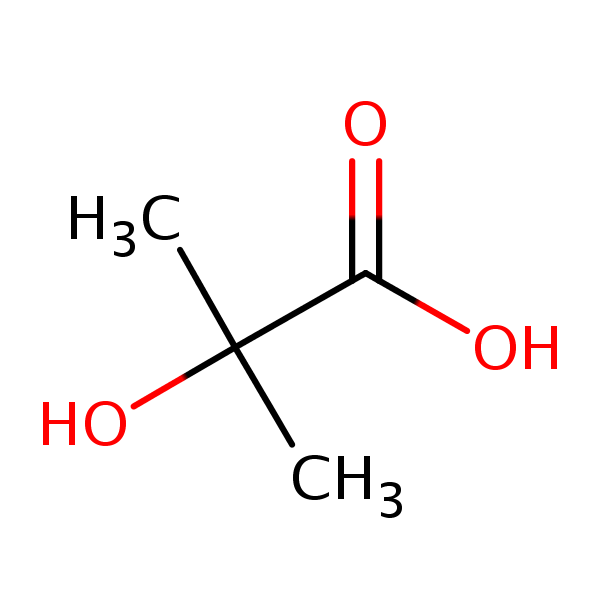
| CAS Number | 594-61-6 |
|---|---|
| Molecular Formula | C4H8O3 |
| Molecular Weight | 104.106 |
| InChI Key | BWLBGMIXKSTLSX-UHFFFAOYSA-N |
| LogP | -0.360 |
| Synonyms |
|
Applications:
HPLC-MS Method for Separation of Metabolites and Biomarkers on Newcrom B Column
September 8, 2023
HPLC Method for Separation and Analysis of N-Acetyl-S-(3-hydroxypropyl)-L-cysteine, 2-Hydroxyisobutyric acid, Perchlorate, N-Acetyl (Carbamoylmethyl) cysteine, Diphenyl phosphate, N-Acetyl-S-propyl-L-cysteine with an MS-Compatible Mobile Phase on a Newcrom B Column by SIELC Technologies.
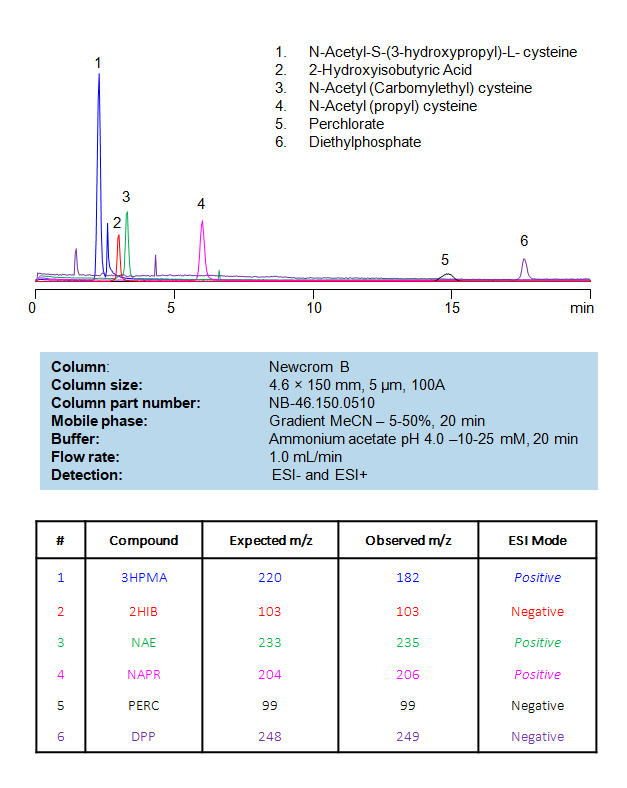
Metabolites and biomarkers are key terms in the fields of biochemistry, pharmacology, and medicine.
N-Acetyl-S-(3-hydroxypropyl)-L-cysteine (3HPMA) is a common metabolite of the herbicide and pollutant Acrolein with the chemical formula C8H15NO4S. It is primarily used to check for tobacco and pollutant exposure in urine samples.
2-Hydroxyisobutyric Acid (2HIB) is a neuro and adrenal toxin with the chemical formula C4H8O3. It is a common metabolite of the fuel additives Methyl tert-butyl ether (MTBE) and Ethyl tert-butyl ether (ETBE).
N-Acetyl(Carbomylethyl)cysteine (NAE) is a metabolite of Acrylamide which can act as a neuro toxin in cases of long term exposure. It has the chemical formula C8H14N2O4S.
N-Acetyl(propyl)cysteine (NAPR) is a metabolite of the popular industrial organic solvent 1-bromopropane (1-BP) with the chemical formula C8H15NO3S. It is s biomarker that forms in the urinary tract when the body detoxifies industrial propyl-based solvents.
Perchlorate, also written as PERC, is an inorganic compound with the formula ClO4–. It is most typically used for explosives. For example, fireworks and rocket propellants. Due to it’s water solubility, it can easily contaminate it. When ingested, it can pose a health risk and cause developmental harm. It inhibits thyroid activity and can be used to treat hyperthyroidism, but can be toxic in large amounts or in regularly-functioning thyroids.
Diphenylphosphate (DPP) is a metabolite of the popular flame retardant triphenyl phosphate (TPHP) with the chemical formula C12H11O4P. It is produced when the body breaks down certain organophosphate glame retardants and is used in medical setting to track contact with the items.
N-Acetyl-S-(3-hydroxypropyl)-L-cysteine, 2-Hydroxyisobutyric acid, Perchlorate, N-Acetyl (Carbamoylmethyl) cysteine, Diphenyl phosphate, N-Acetyl-S-propyl-L-cysteine can be retained, separated, and analyzed on a mixed-mode [columnn] column with a mobile phase consisting of water, Acetonitrile (MeCN), and Ammonium Acetate (AmAc). This analytical method can be detected with high resolution and peak symmetry with many evaporative detection methods, including Evaporative Light Scattering Detection (ELSD), Charged Aerosol Detector (CAD), and Electrospray Ionization (ESI) for Mass Spectrometry (MS).
Condition
| Column | Newcrom B, 4.6 x 150 mm, 5 µm, 100 A, dual ended |
| Mobile Phase | Gradient MeCN/H2O – 5-50%, 20 min |
| Buffer | Gradient Ammonium acetate pH 4.0 –10-25 mM, 20 min |
| Flow Rate | 1.0 ml/min |
| Detection | ESI- and ESI |
Description
| Class of Compounds | Metabolites and Biomarkers |
| Analyzing Compounds | N-Acetyl-S-(3-hydroxypropyl)-L-cysteine, 2-Hydroxyisobutyric acid, Perchlorate, N-Acetyl (Carbamoylmethyl) cysteine, Diphenyl phosphate, N-Acetyl-S-propyl-L-cysteine |
Application Column
Newcrom B
Column Diameter: 4.6 mm
Column Length: 150 mm
Particle Size: 5 µm
Pore Size: 100 A
Column options: dual ended
Diphenyl phosphate
N-Acetyl (Carbamoylmethyl) cysteine
N-Acetyl-S-(3-hydroxypropyl)-L-cysteine
N-Acetyl-S-propyl-L-cysteine
Perchlorate

Separation of 2-Hydroxyisobutyric acid on Newcrom R1 HPLC column
February 16, 2018
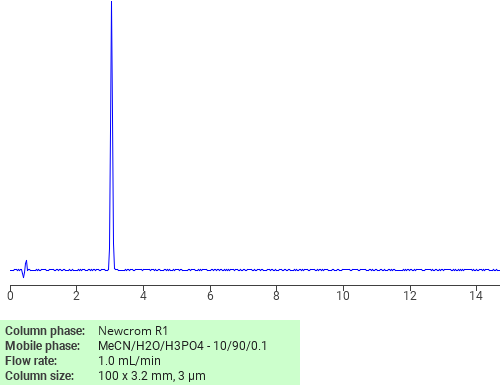
2-Hydroxyisobutyric acid can be analyzed by this reverse phase (RP) HPLC method with simple conditions. The mobile phase contains an acetonitrile (MeCN), water, and phosphoric acid. For Mass-Spec (MS) compatible applications the phosphoric acid needs to be replaced with formic acid. Smaller 3 µm particles columns available for fast UPLC applications. This liquid chromatography method is scalable and can be used for isolation impurities in preparative separation. It also suitable for pharmacokinetics.
Application Column
Newcrom R1
The Newcrom columns are a family of reverse-phase-based columns. Newcrom A, AH, B, and BH are all mixed-mode columns with either positive or negative ion-pairing groups attached to either short (25 Å) or long (100 Å) ligand chains. Newcrom R1 is a special reverse-phase column with low silanol activity.
Select options
