
| CAS Number | 14124-67-5 |
|---|---|
| Molecular Formula | O3Se-2 |
| Molecular Weight | 126.97 |
| InChI Key | MCAHWIHFGHIESP-UHFFFAOYSA-L |
| Synonyms |
|
Applications:
HPLC Method for Separation of Chloride, Selenite, Selenate, and Phosphate on Chromni Column
October 5, 2026
HPLC Method for Analysis of Selenite, Selenate, Chloride, Sodium, Phosphate on Chromni Column by SIELC Technologies
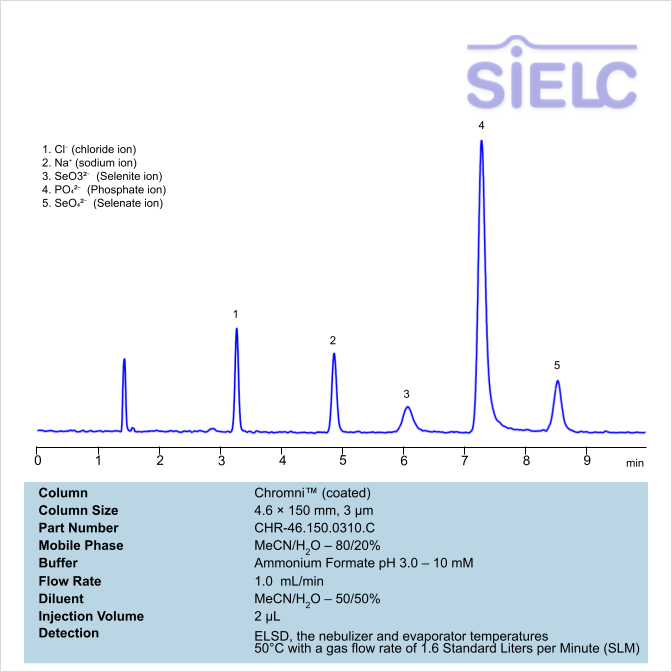
High Performance Liquid Chromatography (HPLC) Method for Analysis of Selenite, Selenate, Chloride, Sodium, Phosphate.
Chloride is typically used to refer to a compound or molecule that contains a chlorine anion: Cl–. It is an electrolyte that is essential for bodily functions including blood pH, fluid balance, cellular functions, and more. Imbalance of chloride can indicate underlying health problems.
Sodium, which has a chemical symbol of Na, is a soft alkali metal that is highly reactive. It is found in abundance in everyday materials like table salt, sea water, and even the Earth’s crust. It is crucial for the body’s function and fluid balance.
Selenite, the anion, not the crystal, has the chemical formula SeO32-. It’s an oxyanion of selenium.
Phosphate, PO43-, is a compound that plays an important part in biological energy transfer. It contains phosphorus, which is also a key component in bones and teeth. It is also a buffer, which helps maintain pH levels in a body.
Selenate is an ion of selenium with the chemical formula SeO32. It is a good oxidizer, easily reduced to selenite and selenium.
Selenite, Selenate, Chloride, Sodium, Phosphate can be retained and analyzed using the Chromni stationary phase column. The analysis utilizes an isocratic method with a simple mobile phase consisting of water and acetonitrile (MeCN). Detection is performed using ELSD.
Condition
| Column | Chromni, 4.6 x 150 mm, 3 µm, 100 A, surface coated |
| Mobile Phase | MeCN/H2O – 80/20 |
| Buffer | AmFM pH 3.0 – 10 mM |
| Flow Rate | 1.0 ml/min |
| Detection | ELSD, the nebulizer and evaporator temperatures 50°C with a gas flow rate of 1.6 Standard Liters per Minute (SLM) |
Description
Application Column
Chromni
Column Diameter: 4.6 mm
Column Length: 150 mm
Particle Size: 3 µm
Pore Size: 100 A
Column options: surface coated
Phosphate
Selenate
Selenite
Sodium

