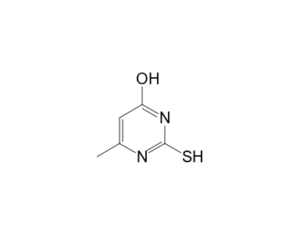
Methylthiouracil

Methylthiouracil

CAS Number56-04-2
Molecular Formula C5H6N2OS
Molecular Weight142.18
InChI KeyHWGBHCRJGXAGEU-UHFFFAOYSA-N
LogP-0.2
Synonyms
  • methylthiouracil
  • 6-Methyl-2-thiouracil
  • 56-04-2
  • 4-hydroxy-2-mercapto-6-methylpyrimidine
  • Thimecil
  • 2-Mercapto-6-methylpyrimidin-4-ol
  • Methiocil
  • Alkiron
  • 2-Thio-6-methyluracil
  • Thiomecil
  • Thiothymin
  • Metacil
  • Basethyrin
  • Prostrumyl
  • Thyreonorm
  • Thyreostat
  • Tiomeracil
  • Antibason
  • Basecil
  • Methacil
  • Methiacil
  • Methicil
  • Muracil
  • Orcanon
  • Strumacil
  • Thiomidil
  • Thioryl
  • Thiuryl
  • Tiotiron
  • Thyril
  • Thyreostat I
  • Tiorale M
  • 6-Methylthiouracil
  • 4-Methyl-2-thiouracil
  • 4(1H)-Pyrimidinone, 2,3-dihydro-6-methyl-2-thioxo-
  • 6-methyl-2-thioxo-2,3-dihydropyrimidin-4(1H)-one
  • 6-Thio-4-methyluracil
  • Usaf ek-6454
  • 6-Methyl-2-mercaptouracil
  • C5H6N2OS
  • Uracil, 6-methyl-2-thio-
  • 6-methyl-2-sulfanylpyrimidin-4-ol
  • 6-Methyl-2-thiouracyl
  • Methyl thiouracil
  • Rcra waste number U164
  • 6-Metil-tiouracile
  • Methacil (VAN)
  • Alkiron (VAN)
  • Metacil (VAN)
  • 2-Mercapto-4-hydroxy-6-methylpyrimidine
  • 2-Mercapto-6-methylpyrimid-4-one
  • Metiltiouracile
  • Metiltiouracilo
  • Thiothyron
  • Muracin
  • Methylthiouracil [INN]
  • Metiltiouracile [DCIT]
  • 2-Thio-6-methyl-1,3-pyrimidin-4-one
  • Methylthiouracile
  • 2-Thio-4-oxo-6-methyl-1,3-pyrimidine
  • 2-Mercapto-6-methylpyrimidin-4(1H)-one
  • Methylthiouracilum
  • 2-Mercapto-6-methyl-4-pyrimidinol
  • CCRIS 409
  • 6-Metil-tiouracile [Italian]
  • NSC 193526
  • NSC-193526
  • Metiltiouracilo [INN-Spanish]
  • Methylthiouracile [INN-French]
  • Methylthiouracilum [INN-Latin]
  • MTU
  • 2,3-Dihydro-6-methyl-2-thioxo-4(1H)-pyrimidinone
  • 6-Methyl-2-thiouracyl [Czech]
  • HSDB 3366
  • 2-Mercapto-6-methyl-4-pyrimidone
  • 6-methyl-2-sulfanylidene-1H-pyrimidin-4-one
  • EINECS 200-252-3
  • RCRA waste no. U164
  • Methylthiouracil [USP:INN]
  • UNII-QW24888U5F
  • AI3-25476
  • MLS000069452
  • DTXSID2020890
  • CHEBI:82346
  • 6-Methyl-2-thio-2,4-(1H3H)-pyrimidinedione
  • 6-Methyl-2-thio-2,4-(1H,3H)-pyrimidinedione
  • QW24888U5F
  • NSC-9378
  • NSC 43815
  • 6-Methyl-4-oxo-2-thioxo1,2,3,4-tetrahydropyrimidine
  • NCGC00091124-02
  • 6-methyl-2-sulfanylidene-1,2,3,4-tetrahydropyrimidin-4-one
  • Methylthiouracil (INN)
  • SMR000059030
  • 1123-10-0
  • DTXCID60890
  • WLN: T6MYMVJ BUS F1
  • CAS-56-04-2
  • 6-Methyl-2-thio-2,3H)-pyrimidinedione
  • 6-Methyl-2-(methylthio)-4(3H)-pyrimidinone; 6-Methyl-2-(methylthio)-4-hydroxypyrimidine; 6-Methyl-2-(methylthio)-4-pyrimidone; NSC 193525; NSC 37678
  • 4-Hydroxy-6-methyl-2-thiopyrimidine
  • Thioyl
  • prostru myl
  • methylthiouracil-
  • Thimecil (TN)
  • Prestwick_330
  • Methyl-6-thiouracil
  • Cc1cc(O)nc(S)n1
  • Spectrum_001031
  • Opera_ID_172
  • Spectrum2_001276
  • Spectrum3_000676
  • Spectrum4_000864
  • Spectrum5_001325
  • 2-Thiouracil, 6-methyl-
  • BSPBio_002371
  • KBioGR_001527
  • KBioSS_001511
  • METHYLTHIOURACIL [MI]
  • MLS002415706
  • MLS004491793
  • DivK1c_000719
  • SCHEMBL159989
  • SPECTRUM1500408
  • SPBio_001272
  • METHYLTHIOURACIL [HSDB]
  • METHYLTHIOURACIL [IARC]
  • CHEMBL1330588
  • METHYLTHIOURACIL [MART.]
  • SCHEMBL11433163
  • URACIL,6-METHYL,2-THIO
  • HMS502D21
  • KBio1_000719
  • KBio2_001511
  • KBio2_004079
  • KBio2_006647
  • KBio3_001591
  • METHYLTHIOURACIL [WHO-DD]
  • NSC9378
  • NINDS_000719
  • 2-thio-6-methyl-pyrimidin-4-one
  • HMS1757B09
  • HMS1923M13
  • HMS2091F08
  • HMS2231B20
  • HMS3370O12
  • HMS3652O03
  • KUC108906N
  • Pharmakon1600-01500408
  • 2-thio-6-methyl-pyrimidin-4 -one
  • BCP21374
  • HY-B0513
  • NSC 9378
  • STR00648
  • Tox21_111088
  • Tox21_201870
  • Tox21_300497
  • BBL013188
  • CCG-39119
  • MFCD00006040
  • NSC193526
  • NSC757116
  • s3138
  • STL163967
  • STL352586
  • STL352692
  • AKOS000119183
  • AKOS001015710
  • AKOS001777669
  • AKOS002663079
  • AKOS025117304
  • Tox21_111088_1
  • 4-hydroxy-6-methyl-pyrimidine-2-thiol
  • AM87068
  • CCG-214821
  • DB13644
  • KSC-27-038
  • LS-1371
  • NSC-757116
  • PS-4510
  • 6-methyl-2-thioxo-1H-pyrimidin-4-one
  • IDI1_000719
  • NCGC00091124-01
  • NCGC00091124-03
  • NCGC00091124-04
  • NCGC00091124-05
  • NCGC00091124-06
  • NCGC00093364-02
  • NCGC00178683-01
  • NCGC00254505-01
  • NCGC00259419-01
  • 4-Hydroxy-2-mercapto-6-methyl pyrimidine
  • 6-methyl-2-sulfanylpyrimidin-4(3H)-one
  • AC-10803
  • SBI-0051446.P003
  • 4-hydroxy-6-methylpyrimidine-2(1h)-thione
  • EU-0095998
  • FT-0621218
  • M0443
  • SW088218-2
  • EN300-16769
  • 4-Hydroxy-2-mercapto-6-methylpyrimidine, 95%
  • 6-Methyl-2-thio-2,4(1H,3H)-pyrimidinedione
  • C19265
  • D07231
  • A830898
  • AC-907/30003038
  • SR-05000002026
  • 2,3-dihydro-6-methyl-2-thioxopyrimidin-4(1H)-one
  • 4[1H]-Pyrimidinone, 2,3-dihydro-6-methyl-thioxo
  • 6-Methyl-2-thioxo-2,3-dihydro-4(1H)-pyrimidinone
  • Q6824062
  • SR-05000002026-1
  • W-105535
  • 4 (1H)-pirimidinona, 2,3-dihidro-6-metil-2-tioxo-
  • 6-Methyl-2-thioxo-2,3-dihydro-4(1H)-pyrimidinone
  • #Z56771013
  • 6-Methyl-4-oxo-2-thioxo-1,2,3,4-tetrahydropyrimidine
  • F0213-0019
  • F0827-0300
  • 6-Methyl-2-thiouracil, VETRANAL(TM), analytical standard
  • 6-Methyl-2-thiouracil, purum, >=98.0% S basis (elemental analysis)
  • InChI=1/C5H6N2OS/c1-3-2-4(8)7-5(9)6-3/h2H,1H3,(H2,6,7,8,9

Applications:

HPLC Method for Separation of Thiourea, Thiouracil (TU), Methylthiouracil (MTU) and Propylthiouracil (PTU) on Primesep P

August 4, 2023

HPLC Method for Separation of Thiourea, Thiouracil, Methylthiouracil, Propylthiouracil on Primesep P Column by SIELC Technologies
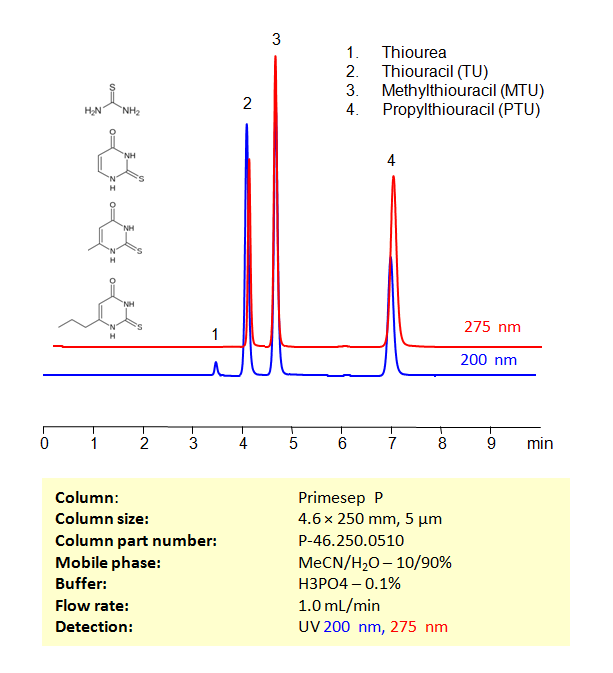
HPLC Method for Separation of Thiourea, Thiouracil (TU), Methylthiouracil (MTU) And Propylthiouracil (PTU) on Primesep P  Column by SIELC Technologies
HPLC Method for Analysis of Thiourea, Thiouracil, Methylthiouracil, Propylthiouracil on Primesep P Column by SIELC Technologies

Thiourea, Thiouracil (TU), Methylthiouracil (MTU), and Propylthiouracil (PTU) are organic compounds that belong to the class of thioureas, which are characterized by the presence of a thiocarbonyl functional group (C=S).

Each of these compounds has different properties and uses due to the different structures and substitution patterns on the thiourea core. They are all important molecules in both the field of chemistry and medicine.

Thiourea is a versatile chemical compound with the formula (NH2)2CS. It is structurally similar to urea, except that the oxygen atom is replaced by a sulfur atom. It is a white crystalline solid when pure. Thiourea is used in a variety of applications. It is a reagent in organic synthesis, often used in the toning of silver-gelatin photography prints, as a component of hair preparations and bleaches, and as a radioprotective agent in cancer therapy. In agriculture, thiourea is used as a soil treatment agent to promote germination and stimulate flowering and fruiting. You can find detailed UV spectra of Thiourea and information about its various lambda maxima by visiting the following link.

Methylthiouracil is an organosulfur with the chemical formula C5H6N2OS. It is used primarily in antithyroid preparation. It is also used in the treatment of hyperthyroidism. The drug works by inhibiting the synthesis of thyroid hormones, thereby reducing the excessive production of these hormones seen in conditions such as Graves’ disease. While it is not used medically in the United States, it is said to have mechanism of action and side effects similar to propylthiouracil.

Propylthiouracil (PTU) is a medication with the chemical formula C7H10N2OS. It is primarily used to treat hyperthyroidism, a condition where the thyroid gland produces too much thyroid hormone. It belongs to a class of drugs called thioureas and specifically to a subgroup known as thioamides.

PTU works by reducing the amount of thyroid hormone produced by the thyroid gland. It inhibits the enzyme thyroid peroxidase, preventing the iodination of tyrosine residues in thyroglobulin and the coupling of these iodotyrosine residues, which are key steps in the synthesis of thyroid hormones.

Additionally, PTU has a unique property among thioamides – it also inhibits the peripheral conversion of thyroxine (T4) to triiodothyronine (T3), the more potent form of thyroid hormone.

The drug is usually taken orally and it’s often used for Graves’ disease, an autoimmune disorder that is the most common cause of hyperthyroidism. However, like all medications, PTU has potential side effects. The most serious one is liver damage, which can be fatal. Because of this, PTU is typically used when other treatments cannot be used, either because of allergies, during early pregnancy, or in preparation for thyroidectomy.

Using a Primesep P Mixed-mode phase column and a mobile phase consisting of water and Acetonitrile (MeCN) with Phosphoric acid as a buffer, Thiourea, Thiouracil, Methylthiouracil, Propylthiouracil can be retained, separated, and analyzed. This analysis method can be UV detected at 200 nm.

Condition

ColumnPrimesep P, 4.6 x 250 mm, 5 µm, 100 A, dual ended
Mobile PhaseMeCN -10%
BufferH3PO4 – 0.1%
Flow Rate1.0 ml/min
DetectionUV 200, 275 nm

Description

Class of CompoundsAmide, Urea
Analyzing CompoundsThiourea, Thiouracil, Methylthiouracil, Propylthiouracil

Application Column

Primesep P

Column Diameter: 4.6 mm
Column Length: 250 mm
Particle Size: 5 µm
Pore Size: 100 A
Column options: dual ended

Add to cart
Application Analytes:
Methylthiouracil
Propylthiouracil
Thiouracil
Thiourea

Application Detection:
UV Detection
SIELC Technologies usually develops more than one method for each compound. Therefore, this particular method may not be the best available method from our portfolio for your specific application. Before you decide to implement this method in your research, please send us an email to research@sielc.com so we can ensure you get optimal results for your compound/s of interest.