
| CAS Number | 502-65-8 |
|---|---|
| Molecular Formula | C40H56 |
| Molecular Weight | 536.9 |
| InChI Key | OAIJSZIZWZSQBC-GYZMGTAESA-N |
| LogP | 15.6 |
| Synonyms |
|
Applications:
HPLC Method for Analysis of Lycopene and beta-Carotene on Lipak Column on Cromite™
August 19, 2026
HPLC Method for Analysis of beta-Carotene, Lycopene on Lipak Column by SIELC Technologies
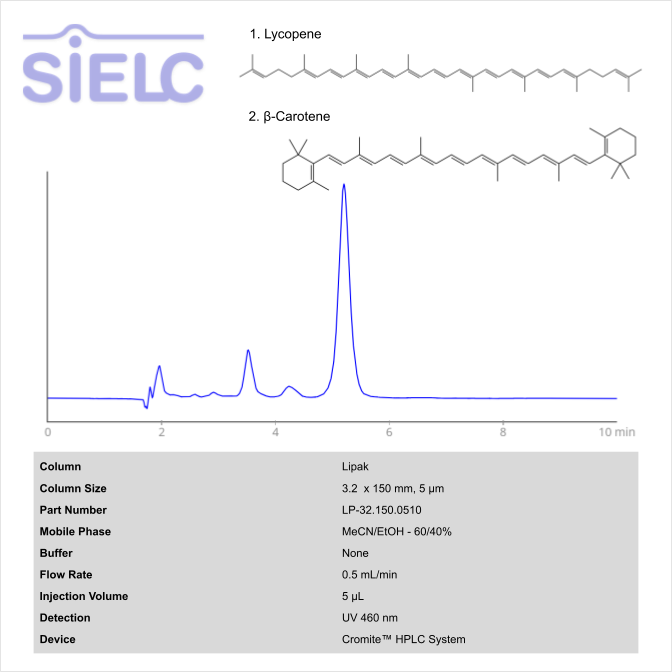
High Performance Liquid Chromatography (HPLC) Method for Analysis of beta-Carotene, Lycopene.
Lycopene is a carotenoid hydrocarbon with C40H56 molecular formula. It is found primarily in tomatoes, watermelon, grapefruits, and red guavas. Gac has the highest concentration of lycopene at 2~6 per gram. Lycopene in non-toxic, but can be a rare allergen. You can find detailed UV spectra of Lycopene and information about its various lambda maxima by visiting the following link.
beta-Carotene, also written as β-Carotene, is a pigment with the chemical formula C40H56. It is found primarily in fungi, plants, and fruit. Especially high amounts of it are found in carrots, pumpkins, spinach, and sweet potatoes. In dietary contexts, it is used as a pro-vitamin, as it converts to retinol in the body. In fact, it is the worldwide primary dietary source of provitamin A and is the best known provitamin a carotenoid. You can find detailed UV spectra of beta-Carotene and information about its various lambda maxima by visiting the following link.
beta-Carotene, Lycopene can be retained and analyzed using the Lipak stationary phase column. The analysis utilizes an isocratic method with a simple mobile phase consisting of water and acetonitrile (MeCN) and ethanol. Detection is performed using Vis.
Condition
| Column | Lipak, 3.2 x 150 mm, 5 µm, 100 A, dual ended |
| Mobile Phase | MeCN/EtOH – 60/40% |
| Buffer | None |
| Flow Rate | 0.5 ml/min |
| Detection | UV 460 nm |
Description
| Class of Compounds | Pigment |
| Analyzing Compounds | beta-Carotene, Lycopene |
Application Column
Lipak
Column Diameter: 3.2 mm
Column Length: 150 mm
Particle Size: 5 µm
Pore Size: 100 A
Column options: dual ended
beta-Carotene

HPLC Method for Analysis of Lycopene and β-Carotene in Tomatoes on Lipak Column
August 12, 2026
HPLC Method for Analysis of Lycopene, beta-Carotene on Lipak Column by SIELC Technologies
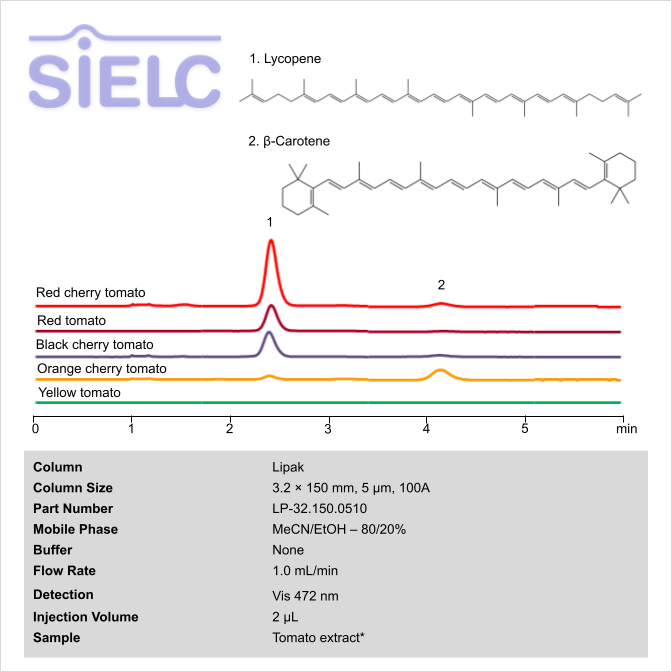
High Performance Liquid Chromatography (HPLC) Method for Analysis of Lycopene, beta-Carotene.
Lycopene is a carotenoid hydrocarbon with C40H56 molecular formula. It is found primarily in tomatoes, watermelon, grapefruits, and red guavas. Gac has the highest concentration of lycopene at 2~6 per gram. Lycopene in non-toxic, but can be a rare allergen. You can find detailed UV spectra of Lycopene and information about its various lambda maxima by visiting the following link.
beta-Carotene, also written as β-Carotene, is a pigment with the chemical formula C40H56. It is found primarily in fungi, plants, and fruit. Especially high amounts of it are found in carrots, pumpkins, spinach, and sweet potatoes. In dietary contexts, it is used as a pro-vitamin, as it converts to retinol in the body. In fact, it is the worldwide primary dietary source of provitamin A and is the best known provitamin a carotenoid. You can find detailed UV spectra of beta-Carotene and information about its various lambda maxima by visiting the following link.
*Lycopene and β – Carotene Extraction from Tomato
Weigh 5.0 g of homogenized tomato sample into a centrifuge tube.
Add 10.0 mL of hexane/acetone (3:1, v/v).
Mix the sample using an ika ultra turrax tube drive until or an equivalent tube homogenizer/mixer until the sample is thoroughly homogenized and extracted.
Centrifuge for 5–10 minutes to separate the solid matrix from the organic extract.
Carefully transfer the clear organic supernatant to a clean tube.
Protect the extract from direct light throughout the procedure.
If necessary, dilute the extract with the extraction solvent to obtain a suitable concentration for HPLC analysis.
Filter the final solution through a 0.45 µm PTFE filter before injection.
Inject 2 µL of the filtered extract into the HPLC system.
Lycopene, beta-Carotene can be retained and analyzed using the Lipak stationary phase column. The analysis utilizes an isocratic method with a simple mobile phase consisting of water and acetonitrile (MeCN) and ethanol. Detection is performed using Vis.
Condition
| Column | Lipak, 3.2 x 150 mm, 5 µm, 100 A, dual ended |
| Mobile Phase | MeCN/EtOH – 80/20% |
| Buffer | None |
| Flow Rate | 1.0 ml/min |
| Detection | Vis 472 nm |
Description
| Class of Compounds | Pigment |
| Analyzing Compounds | Lycopene, beta-Carotene |
*Lycopene and β – Carotene Extraction from Tomato
Weigh 5.0 g of homogenized tomato sample into a centrifuge tube.
Add 10.0 mL of hexane/acetone (3:1, v/v).
Mix the sample using an ika ultra turrax tube drive until or an equivalent tube homogenizer/mixer until the sample is thoroughly homogenized and extracted.
Centrifuge for 5–10 minutes to separate the solid matrix from the organic extract.
Carefully transfer the clear organic supernatant to a clean tube.
Protect the extract from direct light throughout the procedure.
If necessary, dilute the extract with the extraction solvent to obtain a suitable concentration for HPLC analysis.
Filter the final solution through a 0.45 µm PTFE filter before injection.
Inject 2 µL of the filtered extract into the HPLC system.
Application Column
Lipak
Column Diameter: 3.2 mm
Column Length: 150 mm
Particle Size: 5 µm
Pore Size: 100 A
Column options: dual ended
beta-Carotene
HPLC Method for Analysis of Lycopene on Lipak Column
July 9, 2026
HPLC Method for Analysis of Lycopene on Lipak Column by SIELC Technologies
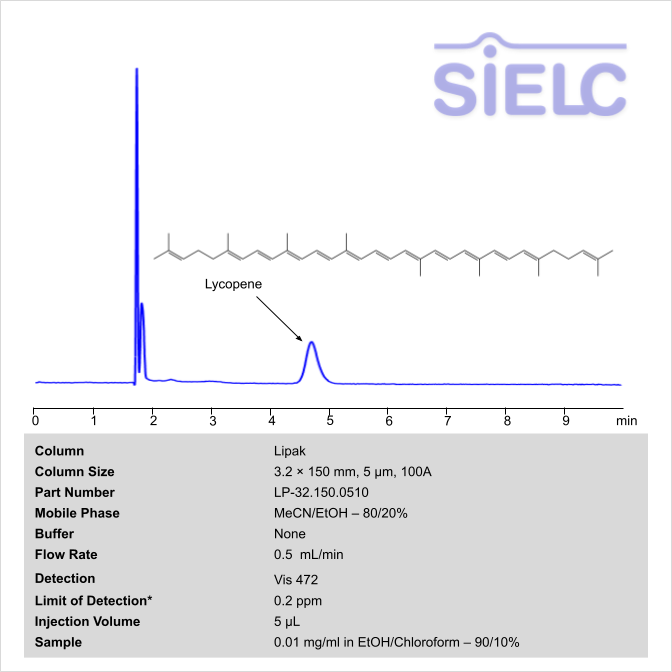
High Performance Liquid Chromatography (HPLC) Method for Analysis of Lycopene.
Lycopene is a carotenoid hydrocarbon with C40H56 molecular formula. It is found primarily in tomatoes, watermelon, grapefruits, and red guavas. Gac has the highest concentration of lycopene at 2~6 per gram. Lycopene in non-toxic, but can be a rare allergen. You can find detailed UV spectra of Lycopeneand information about its various lambda maxima by visiting the following link.
Lycopene can be retained and analyzed using the Lipak stationary phase column. The analysis utilizes an isocratic method with a simple mobile phase consisting of water and acetonitrile (MeCN) and ethanol. Detection is performed using UV.
Condition
| Column | Lipak, 3.2 x 150 mm, 5 µm, 100 A, dual ended |
| Mobile Phase | MeCN/EtOH – 40% |
| Buffer | None |
| Flow Rate | 0.5 ml/min |
| Detection | Vis 427 nm |
| Limit Of Detection* | 0.2 ppm |
Description
| Class of Compounds | Hydrocarbon |
| Analyzing Compounds | Lycopene |
Application Column
Lipak
Column Diameter: 3.2 mm
Column Length: 150 mm
Particle Size: 5 µm
Pore Size: 100 A
Column options: dual ended
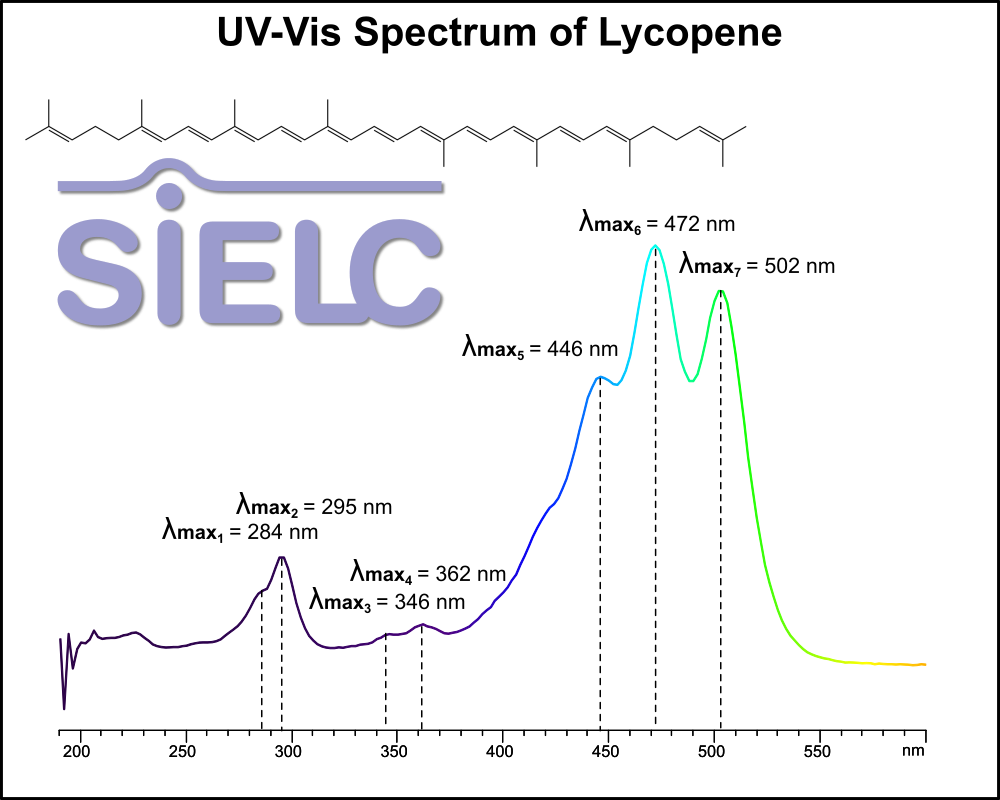
Uv-Vis Spectrum of Lycopene
July 8, 2026
Access the UV-Vis Spectrum SIELC Library
If you are looking for optimized HPLC method to analyze Lycopene check our HPLC Applications library
UV/Vis.: λmax: 284, 295, 346, 362, 446, 472, 502 nm
For optimal results in HPLC analysis, it is recommended to measure absorbance at a wavelength that matches the absorption maximum of the compound(s) being analyzed. The UV spectrum shown can assist in selecting an appropriate wavelength for your analysis. Please note that certain mobile phases and buffers may block wavelengths below 230 nm, rendering absorbance measurement at these wavelengths ineffective. If detection below 230 nm is required, it is recommended to use acetonitrile and water as low UV-transparent mobile phases, with phosphoric acid and its salts, sulfuric acid, and TFA as buffers.
For some compounds, the UV-Vis Spectrum is affected by the pH of the mobile phase. The compound was dissolved in ethanol. This analysis was done with the mobile phase of hexane, IPA, and TFA.
