HPLC Method for Analysis of beta-Carotene, Lycopene on Lipak Column by SIELC Technologies
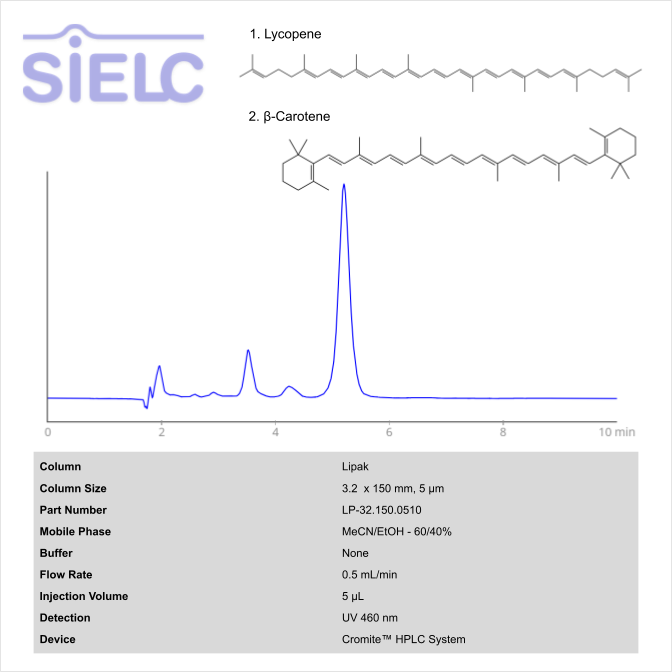
High Performance Liquid Chromatography (HPLC) Method for Analysis of beta-Carotene, Lycopene.
Lycopene is a carotenoid hydrocarbon with C40H56 molecular formula. It is found primarily in tomatoes, watermelon, grapefruits, and red guavas. Gac has the highest concentration of lycopene at 2~6 per gram. Lycopene in non-toxic, but can be a rare allergen. You can find detailed UV spectra of Lycopene and information about its various lambda maxima by visiting the following link.
beta-Carotene, also written as β-Carotene, is a pigment with the chemical formula C40H56. It is found primarily in fungi, plants, and fruit. Especially high amounts of it are found in carrots, pumpkins, spinach, and sweet potatoes. In dietary contexts, it is used as a pro-vitamin, as it converts to retinol in the body. In fact, it is the worldwide primary dietary source of provitamin A and is the best known provitamin a carotenoid. You can find detailed UV spectra of beta-Carotene and information about its various lambda maxima by visiting the following link.
beta-Carotene, Lycopene can be retained and analyzed using the Lipak stationary phase column. The analysis utilizes an isocratic method with a simple mobile phase consisting of water and acetonitrile (MeCN) and ethanol. Detection is performed using Vis.
Condition
| Column | Lipak, 3.2 x 150 mm, 5 µm, 100 A, dual ended |
| Mobile Phase | MeCN/EtOH – 60/40% |
| Buffer | None |
| Flow Rate | 0.5 ml/min |
| Detection | UV 460 nm |
Description
| Class of Compounds | Pigment |
| Analyzing Compounds | beta-Carotene, Lycopene |
Application Column
Lipak
Column Diameter: 3.2 mm
Column Length: 150 mm
Particle Size: 5 µm
Pore Size: 100 A
Column options: dual ended
beta-Carotene