HPLC Method for Analysis of Paraquat, Diquat on BIST B+ by SIELC Technologies.
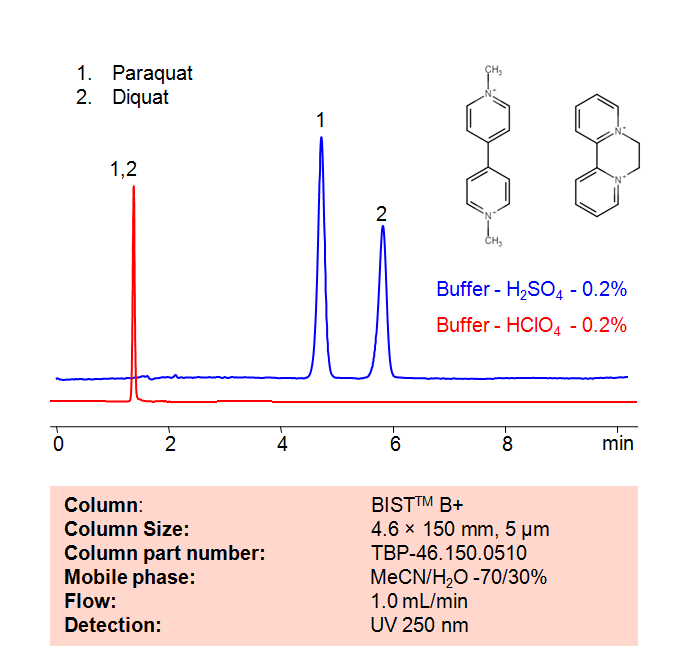
Paraquat is a widely used, non-selective herbicide known for its high efficacy in controlling a wide range of weeds. It has been an important tool in agriculture since its introduction in the mid-20th century. However, its use is accompanied by significant safety concerns due to its high toxicity. You can find detailed UV spectra of Paraquat, Diquat and information about its various lambda maxima by visiting the following link.
Diquat is an organic dication that is used as a contact herbicide. It has the chemical formula C12H12Br2N2. It is considered moderately toxic and harmful if swallowed, inhaled, or absorbed through skin. It degrades slowly when in nature due to bonding strongly to minerals and organic particles. Due to that, it is no longer approved for use in the European Union.
Paraquat, Diquat are two of the most popular herbicides on the market. With fairly similar structures and interactions with typical ion-exchange columns, they are usually extremely difficult to separate. Using SIELC’s newly introduced BIST™ method, Paraquat, Diquat, which protonate in water, can be retained on a positively-charged anion-exchange BIST B+ column. There are two keys to this retention method: 1) a multi-charged, negative buffer, such as Sulfuric acid (H2SO4), which acts as a bridge, linking the positively-charged herbicide analytes to the positively-charged column surface and 2) a mobile phase consisting mostly of organic solvent (such as MeCN) to minimize the formation of a solvation layer around the charged analytes. What allows these two compounds to be separated using BIST™ is the slight difference in charge position between the two analytes. Since the analytes interact so close to the surface, the minor difference in charge distribution is magnified and therefore significantly affects each analyte’s retention ability. Using this new and unique analysis method, Paraquat and Diquat can be retained and UV detected at 250 nm.
Condition
| Column | BIST B+, 4.6 x 150 mm, 5 µm, 100 A, dual ended |
| Mobile Phase | MeCN – 70% |
| Buffer | H2SO4 – 0.2% |
| Flow Rate | 1.0 ml/min |
| Detection | UV 250 nm |
| Peak Retention Time | 4.7, 5.9 min |
Description
Application Column
BIST B+
Column Diameter: 4.6 mm
Column Length: 150 mm
Particle Size: 5 µm
Pore Size: 100 A
Column options: dual ended
Paraquat