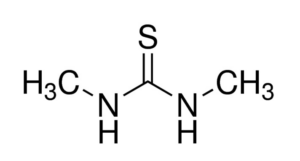
| CAS Number | 534-13-4 |
|---|---|
| Molecular Formula | C3H8N2S |
| Molecular Weight | 104.18 |
| InChI Key | VLCDUOXHFNUCKK-UHFFFAOYSA-N |
| LogP | -0.2 |
| Synonyms |
|
Applications:
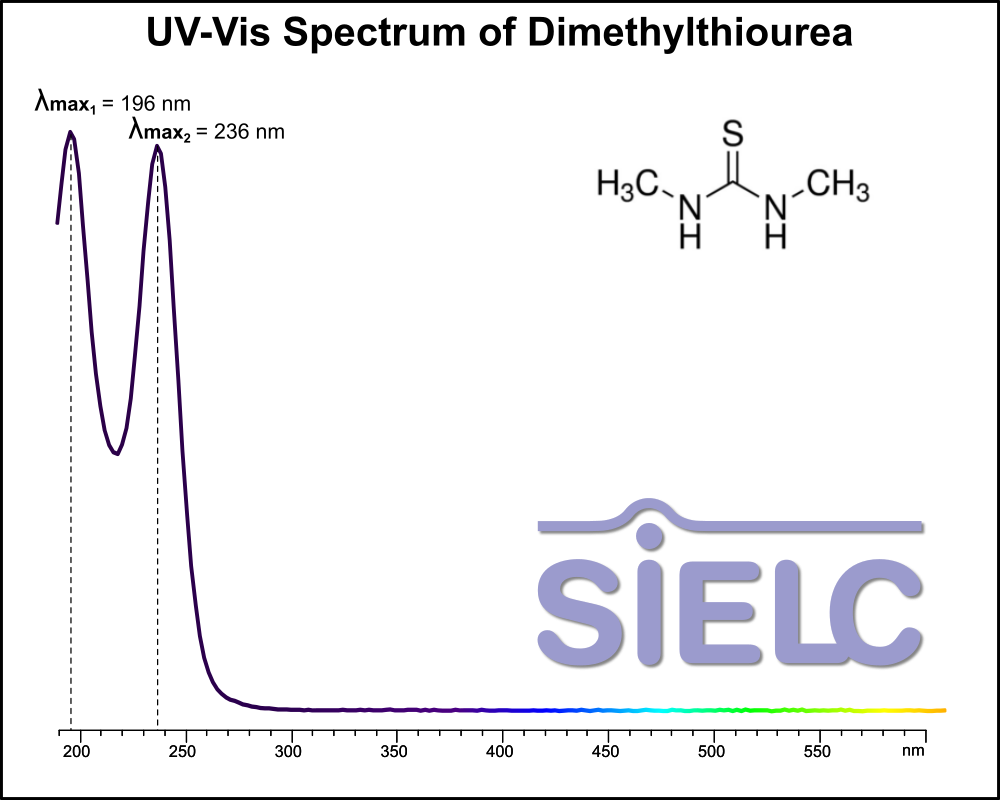
Uv-Vis Spectrum of Dimethylthiourea
January 22, 2026
If you are looking for optimized HPLC method to analyze Dimethylthiourea check our HPLC Applications library
For optimal results in HPLC analysis, it is recommended to measure absorbance at a wavelength that matches the absorption maximum of the compound(s) being analyzed. The UV spectrum shown can assist in selecting an appropriate wavelength for your analysis. Please note that certain mobile phases and buffers may block wavelengths below 230 nm, rendering absorbance measurement at these wavelengths ineffective. If detection below 230 nm is required, it is recommended to use acetonitrile and water as low UV-transparent mobile phases, with phosphoric acid and its salts, sulfuric acid, and TFA as buffers.
For some compounds, the UV-Vis Spectrum is affected by the pH of the mobile phase. The spectra presented here are measured with an acidic mobile phase that has a pH of 3 or lower.

HPLC Method for Analysis of Dimethylthiourea on Primesep P Column
July 25, 2023
Separation type: Liquid Chromatography Mixed-mode
HPLC Method for Analysis of Dimethylthiourea on Primesep P by SIELC Technologies
Dimethylthiourea is an organic compound containing two methyl groups attached to a thiourea molecule. The chemical formula is (CH3)2NCSNH2. Like other thiourea derivatives, dimethylthiourea has a range of uses in various fields, including research and industrial applications.
In research, it’s often used due to its properties as a good hydrogen bond donor and acceptor, allowing it to participate in a variety of reactions. For example, it can be used as a reducing agent in some types of reactions. It also has some interesting properties in terms of its electrical conductivity and its ability to absorb certain types of radiation, which make it useful in some niche applications.
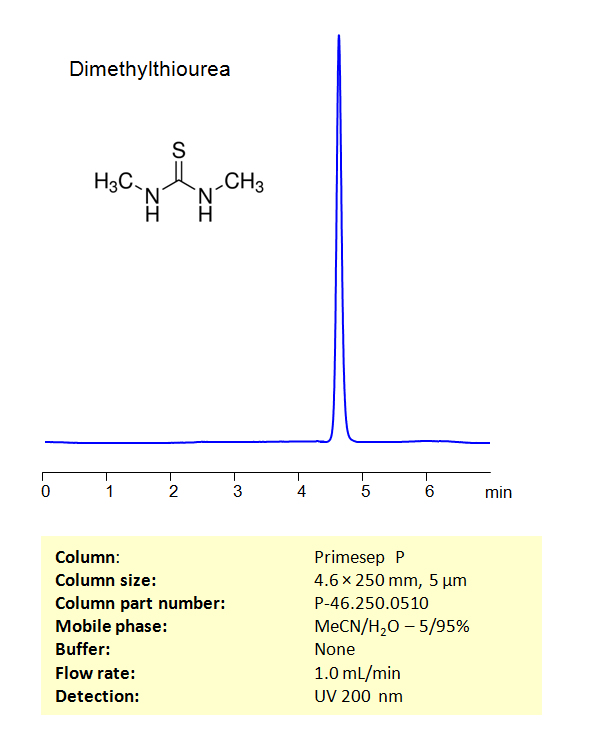
Using a Primesep P Mixed-mode phase column and a mobile phase consisting of water and Acetonitrile (MeCN) with no buffer, dimethylthiourea can be retained and analyzed. This analysis method can be UV detected at 200 nm.
LOD was determined for this combination of instrument, method, and analyte, and it can vary from one laboratory to another even when the same general type of analysis is being performed.
High Performance Liquid Chromatography (HPLC) Method for Analysis of Dimethylthiourea
Condition
| Column | Primesep P, 4.6 x 250 mm, 5 µm, 100 A, dual ended |
| Mobile Phase | MeCN/H2O – 5/95% |
| Buffer | None |
| Flow Rate | 1.0 ml/min |
| Detection | UV 200 nm |
| Peak Retention Time | 4.63 min |
| Sample concentration | 0.03 mg/ml |
| Injection volume | 1 µl |
| LOD | 2 ppb |
Description
| Class of Compounds | Thioureas |
| Analyzing Compounds | Dimethylthiourea |
Application Column
Primesep P
Column Diameter: 4.6 mm
Column Length: 250 mm
Particle Size: 5 µm
Pore Size: 100 A
Column options: dual ended
HPLC Method for Separation of Thiourea and Dimethylthiourea (DMTU) on Primesep P Column
July 25, 2023
HPLC Method for Separation of Thiourea, Dimethylthiourea on Primesep P Column by SIELC Technologies
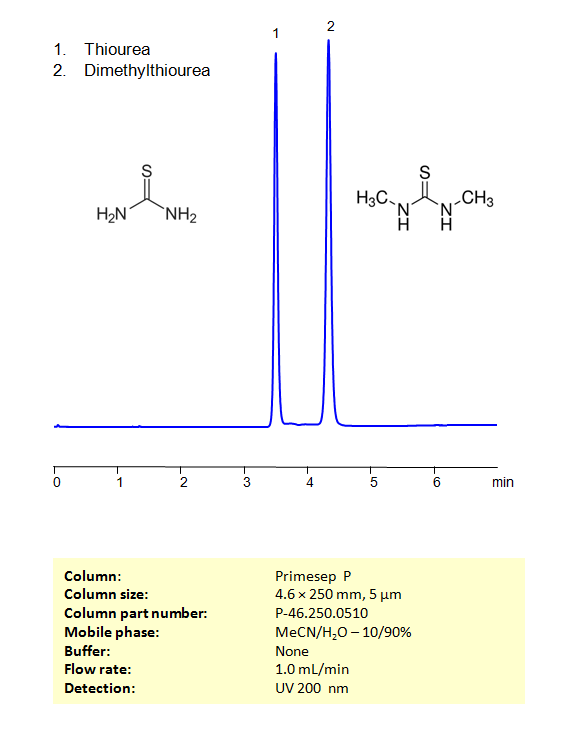
Dimethylthiourea is an organic compound containing two methyl groups attached to a thiourea molecule. The chemical formula is (CH3)2NCSNH2. Like other thiourea derivatives, dimethylthiourea has a range of uses in various fields, including research and industrial applications.
In research, it’s often used due to its properties as a good hydrogen bond donor and acceptor, allowing it to participate in a variety of reactions. For example, it can be used as a reducing agent in some types of reactions. It also has some interesting properties in terms of its electrical conductivity and its ability to absorb certain types of radiation, which make it useful in some niche applications.
You can find detailed UV spectra of Dimethylthiourea and information about its various lambda maxima by visiting the following link.
Thiourea is a versatile chemical compound with the formula (NH2)2CS. It is structurally similar to urea, except that the oxygen atom is replaced by a sulfur atom. It is a white crystalline solid when pure.
Thiourea is used in a variety of applications. It is a reagent in organic synthesis, often used in the toning of silver-gelatin photography prints, as a component of hair preparations and bleaches, and as a radioprotective agent in cancer therapy.
In agriculture, thiourea is used as a soil treatment agent to promote germination and stimulate flowering and fruiting.
You can find detailed UV spectra of Thiourea and information about its various lambda maxima by visiting the following link.
Using a Primesep P Mixed-mode phase column and a mobile phase consisting of water and Acetonitrile (MeCN) with no buffer, Thiourea, Dimethylthiourea can be retained, separated, and analyzed. This analysis method can be UV detected at 200 nm.
Condition
| Column | Primesep P, 4.6 x 250 mm, 5 µm, 100 A, dual ended |
| Mobile Phase | MeCN -10% |
| Buffer | No |
| Flow Rate | 1.0 ml/min |
| Detection | UV 200 nm |
Description
| Class of Compounds | Amide, Urea |
| Analyzing Compounds | Thiourea, Dimethylthiourea |
Application Column
Primesep P
Column Diameter: 4.6 mm
Column Length: 250 mm
Particle Size: 5 µm
Pore Size: 100 A
Column options: dual ended
Thiourea
