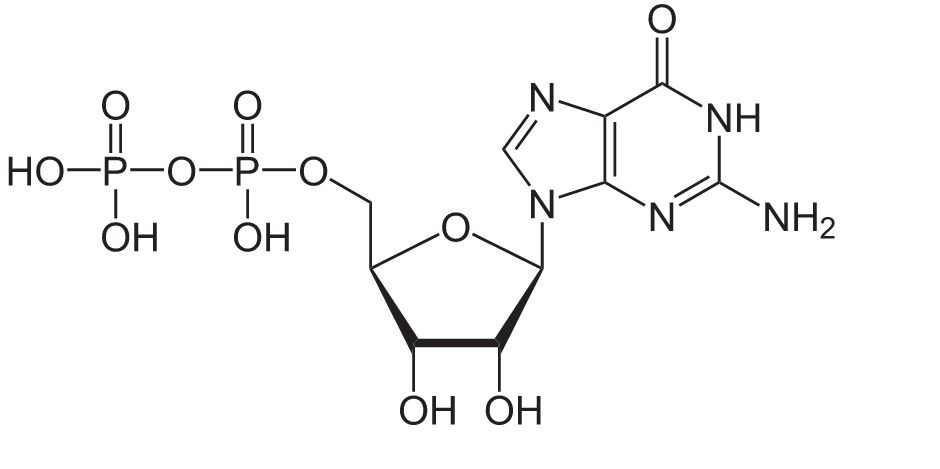
| CAS Number | 146-91-8 |
|---|---|
| Molecular Formula | C10H15N5O11P2 |
| Molecular Weight | 443.202 |
| InChI Key | QGWNDRXFNXRZMB-UUOKFMHZSA-N |
| LogP | -2.75 |
| Synonyms |
|
Applications:
Uv-Vis Spectrum of Guanosine Diphosphate
February 3, 2026
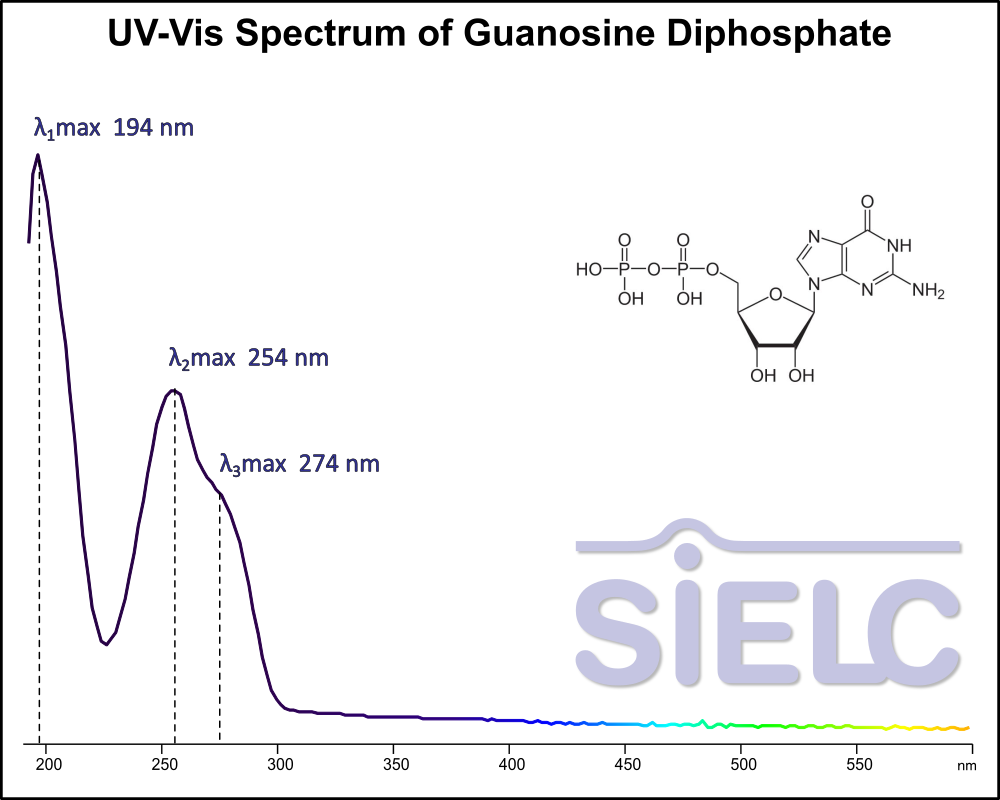
If you are looking for optimized HPLC method to analyze Guanosine Diphosphate check our HPLC Applications library
For optimal results in HPLC analysis, it is recommended to measure absorbance at a wavelength that matches the absorption maximum of the compound(s) being analyzed. The UV spectrum shown can assist in selecting an appropriate wavelength for your analysis. Please note that certain mobile phases and buffers may block wavelengths below 230 nm, rendering absorbance measurement at these wavelengths ineffective. If detection below 230 nm is required, it is recommended to use acetonitrile and water as low UV-transparent mobile phases, with phosphoric acid and its salts, sulfuric acid, and TFA as buffers.
For some compounds, the UV-Vis Spectrum is affected by the pH of the mobile phase. The spectra presented here are measured with an acidic mobile phase that has a pH of 3 or lower.

Separation of Nine Nucleotides by Mixed-Mode Chromatography
July 6, 2015
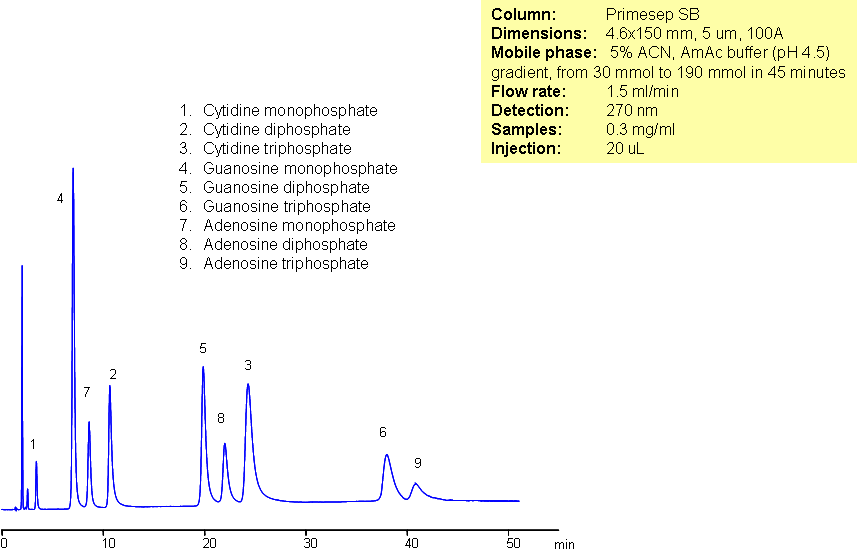
Nucleotides are important biological molecules which serve as subunits of nucleic acids. They are composed of a five-carbon sugar, a nitrogenous base, and at least one phosphate group. Nucleotides cannot be retained by reverse-phase chromatography without an ion-pairing reagent due to their highly polar nature. Primesep SB is capable of retaining and separating nine nucleotides. Primesep SB is a reverse-phase column with strong embedded basic ion-pairing groups.
Application Column
Primesep SB
The Primesep family of mixed-mode columns offers a wide variety of stationary phases, boasting unprecedented selectivity in the separation of a broad array of chemical compounds across multiple applications. Corresponding Primesep guard columns, available with all stationary phases, do not require holders. SIELC provides a method development service available to all customers. Inquire about our specially-tailored custom LC-phases for specific separations.
Select optionsAdenosine Monophosphate
Adenosine Triphosphate
Cytidine Diphosphate
Cytidine Monophosphate
Cytidine Triphosphate
Guanosine Diphosphate
Guanosine Monophosphate
Guanosine Triphosphate
