
| CAS Number | 827-61-2 |
|---|---|
| Molecular Formula | C9H15NO2 |
| Molecular Weight | 169.224 |
| InChI Key | WRJPSSPFHGNBMG-UHFFFAOYSA-N |
| LogP | 0.845 |
| Synonyms |
|
Applications:
HPLC Method for Analysis of Aceclidine on Primesep 100 Column
March 23, 2026
HPLC Method for Aceclidine on Primesep 100 by SIELC Technologies
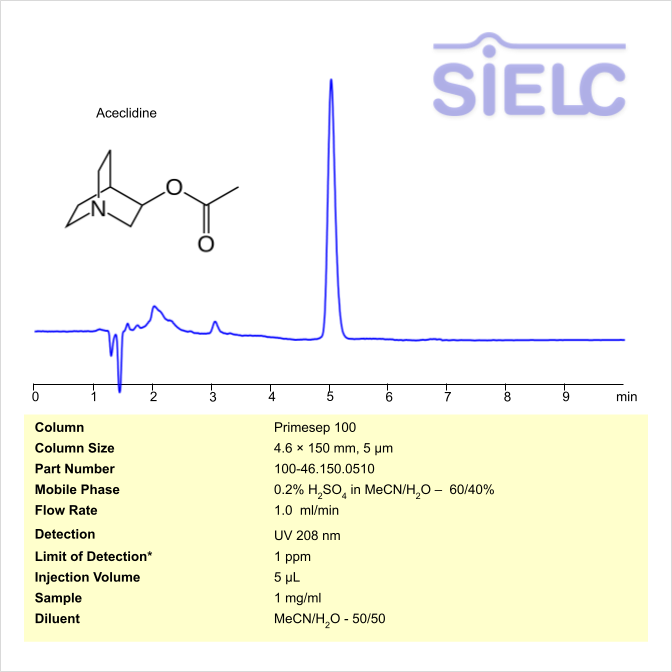
High Performance Liquid Chromatography (HPLC) Method for Analysis of Aceclidine
Aceclidine historically unapproved in the United States, received regulatory authorization from the U.S. Food and Drug Administration in July 2025 in the form of an ophthalmic solution (VIZZ, aceclidine 1.44%) for the treatment of presbyopia, marking its transition from an experimental cholinergic agent to a clinically utilized therapeutic.
Drug class: Muscarinic cholinergic agonist
Mechanism of action: Stimulates muscarinic receptors, leading to smooth muscle contraction and glandular secretion.
Historical use: Studied for glaucoma, gastrointestinal motility, and other parasympathetic-related effects
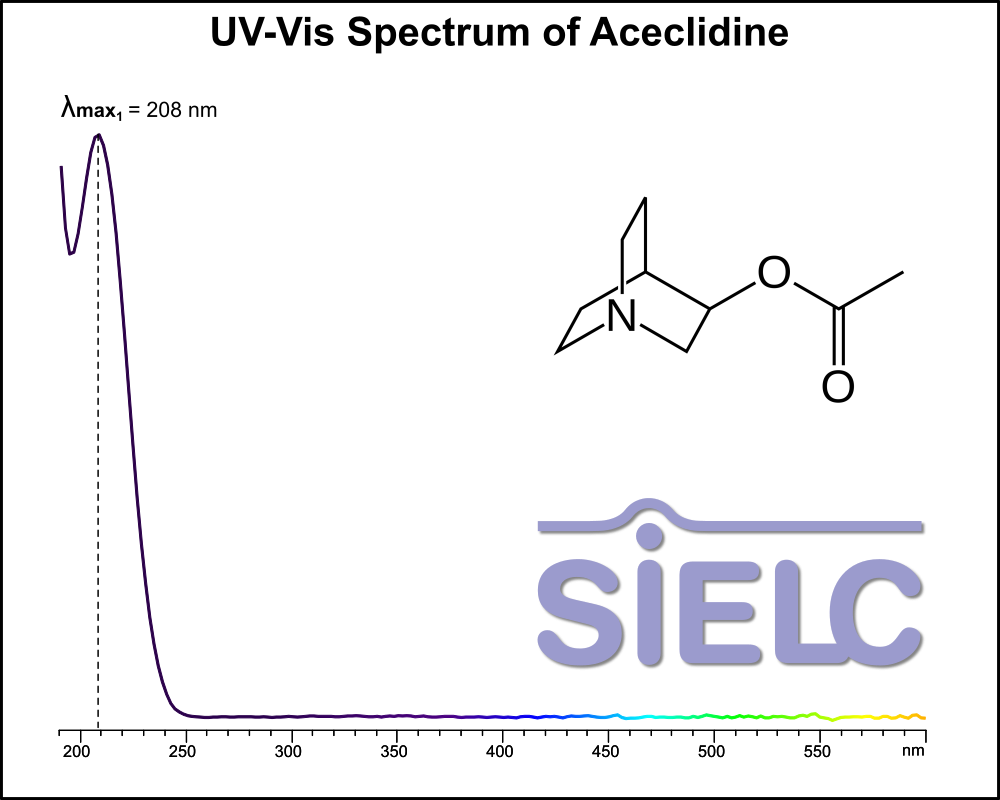
You can find detailed UV spectra of Aceclidine and information about its various lambda maxima by visiting the following link.
Aceclidine can be retained and analyzed using the Primesep 100 stationary phase column. The analysis utilizes an isocratic method with a simple mobile phase consisting of water and acetonitrile (MeCN) with a sulfuric acid as a buffer. Detection is performed using UV.
| Column | Primesep 100, 4.6 x 150 mm, 5 µm, 100 A, dual ended |
| Mobile Phase | MeCN/H2O – 60/40 % |
| Buffer | H2SO4 – 0.2% |
| Flow Rate | 1.0 ml/min |
| Detection | UV 208 nm |
| Class of Compounds | Drug |
| Analyzing Compounds | Aceclidine |
Application Column
Primesep 100
Column Diameter: 4.6 mm
Column Length: 150 mm
Particle Size: 5 µm
Pore Size: 100 A
Column options: dual ended

LC MS-HPLC Method for Analysis of Aceclidine on Primesep 200 Column
March 23, 2026
HPLC Method for Aceclidine on Primesep 200 by SIELC Technologies
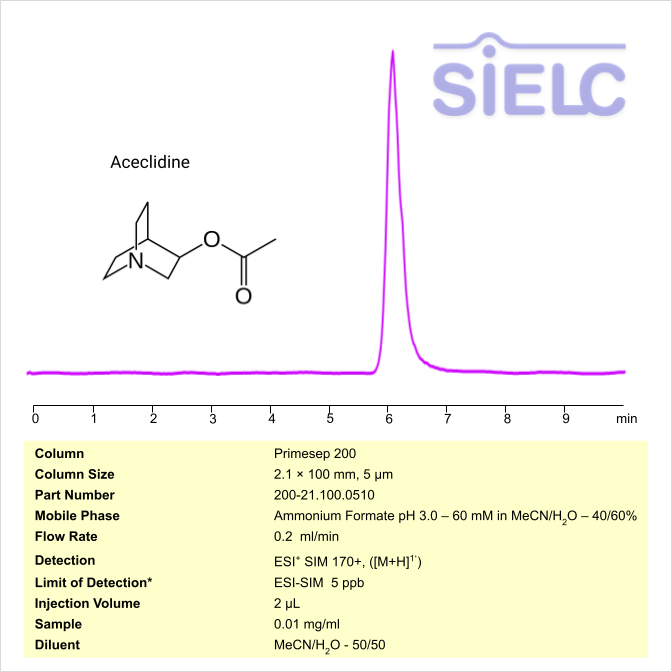
High Performance Liquid Chromatography (HPLC) Method for Analysis of Aceclidine
Aceclidine Drug class: Muscarinic cholinergic agonist
Mechanism of action: Stimulates muscarinic receptors, leading to smooth muscle contraction and glandular secretion.
Historical use: Studied for glaucoma, gastrointestinal motility, and other parasympathetic-related effects
2025 FDA Approval:
- Approved as VIZZ (aceclidine 1.44% ophthalmic solution)
- Indication: Treatment of presbyopia (age-related near vision loss)
You can find detailed UV spectra of Aceclidine and information about its various lambda maxima by visiting the following link.
Aceclidine can be retained and analyzed using the Primesep 200 stationary phase column. The analysis utilizes an isocratic method with a simple mobile phase consisting of water and acetonitrile (MeCN) with a Ammonium format as a buffer. Detection is performed using ESI+ SIM.
| Column | Primesep 200, 2.1 x 150 mm, 5 µm, 100 A, dual ended |
| Mobile Phase | MeCN/H2O – 40/60 % |
| Buffer | AmFm pH 3.0 – 60 mM |
| Flow Rate | 0.2 ml/min |
| Detection | ESI+ SIM 170+, ([M+H]1⁺) |
| Class of Compounds | Drug |
| Analyzing Compounds | Aceclidine |
Application Column
Primesep 200
Column Diameter: 2.1 mm
Column Length: 150 mm
Particle Size: 5 µm
Pore Size: 100 A
Column options: dual ended
Uv-Vis Spectrum of Aceclidine
March 20, 2026
Access the UV-Vis Spectrum SIELC Library
If you are looking for optimized HPLC method to analyze Aceclidine check our HPLC Applications library
For optimal results in HPLC analysis, it is recommended to measure absorbance at a wavelength that matches the absorption maximum of the compound(s) being analyzed. The UV spectrum shown can assist in selecting an appropriate wavelength for your analysis. Please note that certain mobile phases and buffers may block wavelengths below 230 nm, rendering absorbance measurement at these wavelengths ineffective. If detection below 230 nm is required, it is recommended to use acetonitrile and water as low UV-transparent mobile phases, with phosphoric acid and its salts, sulfuric acid, and TFA as buffers.
For some compounds, the UV-Vis Spectrum is affected by the pH of the mobile phase. The spectra presented here are measured with an acidic mobile phase that has a pH of 3 or lower.
Separation of Aceclidine on Newcrom R1 HPLC column
February 16, 2018

Aceclidine can be analyzed by this reverse phase (RP) HPLC method with simple conditions. The mobile phase contains an acetonitrile (MeCN), water, and phosphoric acid. For Mass-Spec (MS) compatible applications the phosphoric acid needs to be replaced with formic acid. Smaller 3 µm particles columns available for fast UPLC applications. This liquid chromatography method is scalable and can be used for isolation impurities in preparative separation. It also suitable for pharmacokinetics.
Application Column
Newcrom R1
The Newcrom columns are a family of reverse-phase-based columns. Newcrom A, AH, B, and BH are all mixed-mode columns with either positive or negative ion-pairing groups attached to either short (25 Å) or long (100 Å) ligand chains. Newcrom R1 is a special reverse-phase column with low silanol activity.
Select options