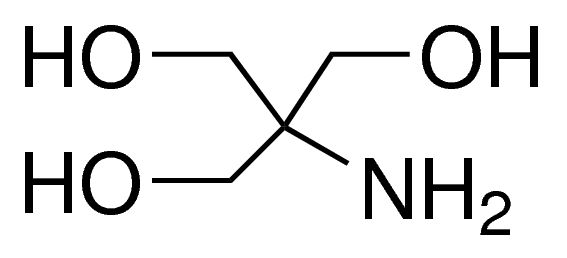
| CAS Number | 77-86-1 |
|---|---|
| Molecular Formula | C4H11NO3 |
| Molecular Weight | 121.136 |
| InChI Key | LENZDBCJOHFCAS-UHFFFAOYSA-N |
| LogP | -2.9 |
| Synonyms |
|
Applications:
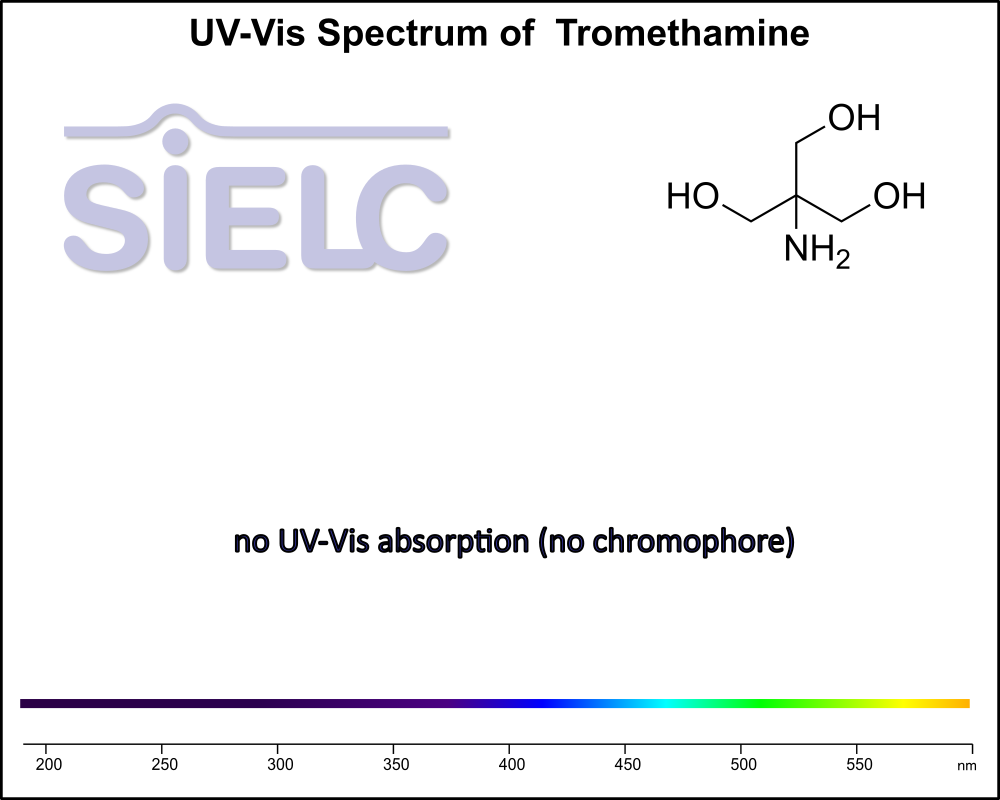
Uv-Vis Spectrum of Tromethamine
January 19, 2026
If you are looking for optimized HPLC method to analyze Trometamol (Tris, Tris(hydroxymethyl)aminomethane, Tromethamine, and or THAM) check our HPLC Applications library
For optimal results in HPLC analysis, it is recommended to measure absorbance at a wavelength that matches the absorption maximum of the compound(s) being analyzed. The UV spectrum shown can assist in selecting an appropriate wavelength for your analysis. Please note that certain mobile phases and buffers may block wavelengths below 230 nm, rendering absorbance measurement at these wavelengths ineffective. If detection below 230 nm is required, it is recommended to use acetonitrile and water as low UV-transparent mobile phases, with phosphoric acid and its salts, sulfuric acid, and TFA as buffers.
For some compounds, the UV-Vis Spectrum is affected by the pH of the mobile phase. The spectra presented here are measured with an acidic mobile phase that has a pH of 3 or lower.

HPLC Method for Separation of Trometamol (Tris) and Sodium on Primesep 100 Column
January 20, 2023
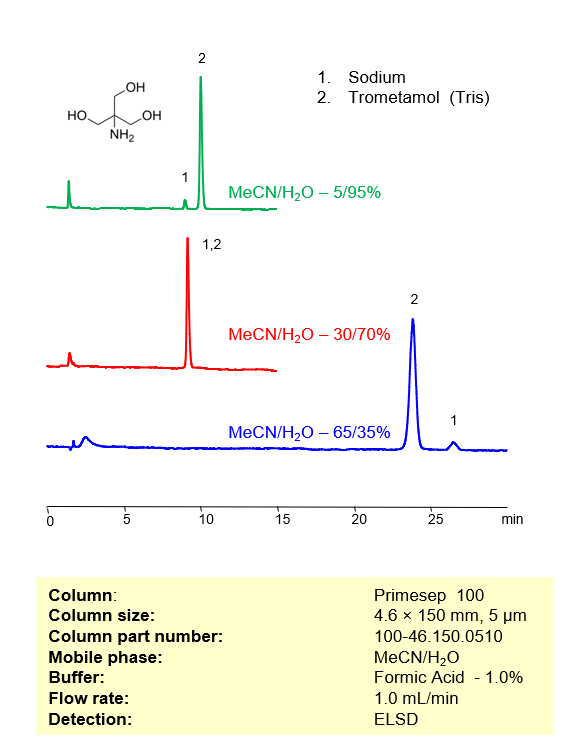
HPLC Method for Separation of Trometamol (Tris) and Sodium on Primesep 100 by SIELC Technologies.
Separation type: Liquid Chromatography Mixed-mode
Sodium, which has a chemical symbol of Na, is a soft alkali metal that is highly reactive. It is found in abundance in everyday materials like table salt, sea water, and even the Earth’s crust. It is crucial for the body’s function and fluid balance.
Trometamol, also known as Tris or Tromethamine, is a buffering agent (or Good’s buffer) with the chemical formula C4H11NO3. It is frequently used in biochemical and molecular biological applications as a component of buffer solutions. Tris is often mixed with Sodium Chloride as a buffer, and the Sodium ion and Tris will often co-elute, delivering inaccurate quantitation results. Due to its ability to increase permeability of cell membranes, it is a component of the Moderna COVID-19 vaccine as well as the Pfizer-BioNTech COVID-19 children’s vaccine.
Trometamol (Tris, Tris(hydroxymethyl)aminomethane, Tromethamine, and or THAM) can be retained, separated, and analyzed on a Primesep 100 mixed-mode stationary phase column using several different isocratic analytical methods with a simple mobile phase of water, Acetonitrile (MeCN), and a Formic acid (FA) buffer. By simply changing the relative concentrations of MeCN and Water, the retention times and order of Tris and Sodium can be significantly manipulated to deliver high quality separations. This analysis method is compatible with evaporative detection methods such as Evaporative Light Scattering Detection (ELSD), Charged Aerosol Detection (CAD), and Electrospray Ionization (ESI) for Mass Spectrometry (LCMS).
Condition
| Column | Primesep 100, 4.6 x 150 mm, 5 µm, 100 A, dual ended |
| Mobile Phase | MeCN/H2O |
| Buffer | Formic Acid – 1.0% |
| Flow Rate | 1.0 ml/min |
| Detection | ELSD, 40C |
Description
| Class of Compounds | Drug |
| Analyzing Compounds | Trometamol (Tris, Tris(hydroxymethyl)aminomethane, Tromethamine, and or THAM) |
Application Column
Primesep 100
Column Diameter: 4.6 mm
Column Length: 150 mm
Particle Size: 5 µm
Pore Size: 100 A
Column options: dual ended
HPLC Method for Analysis of Trometamol (Tris, Tris(hydroxymethyl)aminomethane, Tromethamine, and or THAM)
March 27, 2011
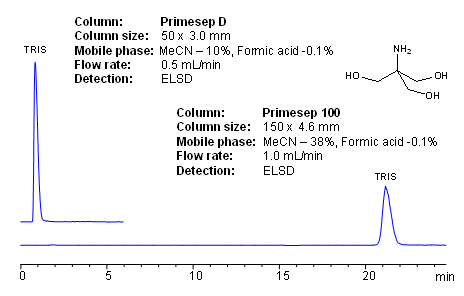
TRIS or tris(hydroxymethyl)aminomethane, is a hydrophilic basic compounds widely used in chemistry, biochemistry, and molecular biology. TRIS pKa (8.1) makes it an effective buffer in pH range of 7-9.2. TRIS is not retained on reversed-phase column and is not UV active, making it hard to be analyzed by HPLC. TRIS was analyzed by mixed-mode HPLC on a Primesep 100 column. Retention time of compound is controlled by the amount and pH of the buffer. No ion-pairing reagent is required for HPLC retention of hydrophilic basic molecules like TRIS. TRIS can be monitored by ELSD/CAD with trifluoroacetic acid in the mobile phase, or by LC/MS with ammonium formate or acetate in the mobile phase.
High Performance Liquid Chromatography (HPLC) Method for Analyses of Trometamol (Tris, Tris(hydroxymethyl)aminomethane, Tromethamine, and or THAM)
| Column | Primesep D, Primesep 100 |
| Mobile Phase | MeCN/H2O |
| Buffer | Formic Acid |
| Flow Rate | 0.5 , 1.0 ml/min |
| Detection | ELSD |
| Class of Compounds |
Amine |
| Analyzing Compounds | Tris (Tris(hydroxymethyl)aminomethane, Tromethamine, and or THAM) |
Application Column
Primesep 100
The Primesep family of mixed-mode columns offers a wide variety of stationary phases, boasting unprecedented selectivity in the separation of a broad array of chemical compounds across multiple applications. Corresponding Primesep guard columns, available with all stationary phases, do not require holders. SIELC provides a method development service available to all customers. Inquire about our specially-tailored custom LC-phases for specific separations.
Select options
Primesep D
The Primesep family of mixed-mode columns offers a wide variety of stationary phases, boasting unprecedented selectivity in the separation of a broad array of chemical compounds across multiple applications. Corresponding Primesep guard columns, available with all stationary phases, do not require holders. SIELC provides a method development service available to all customers. Inquire about our specially-tailored custom LC-phases for specific separations.
Select optionsTrometamol (Tris, Tris(hydroxymethyl)aminomethane, Tromethamine, and or THAM)
