| Synonyms |
|---|
Applications:
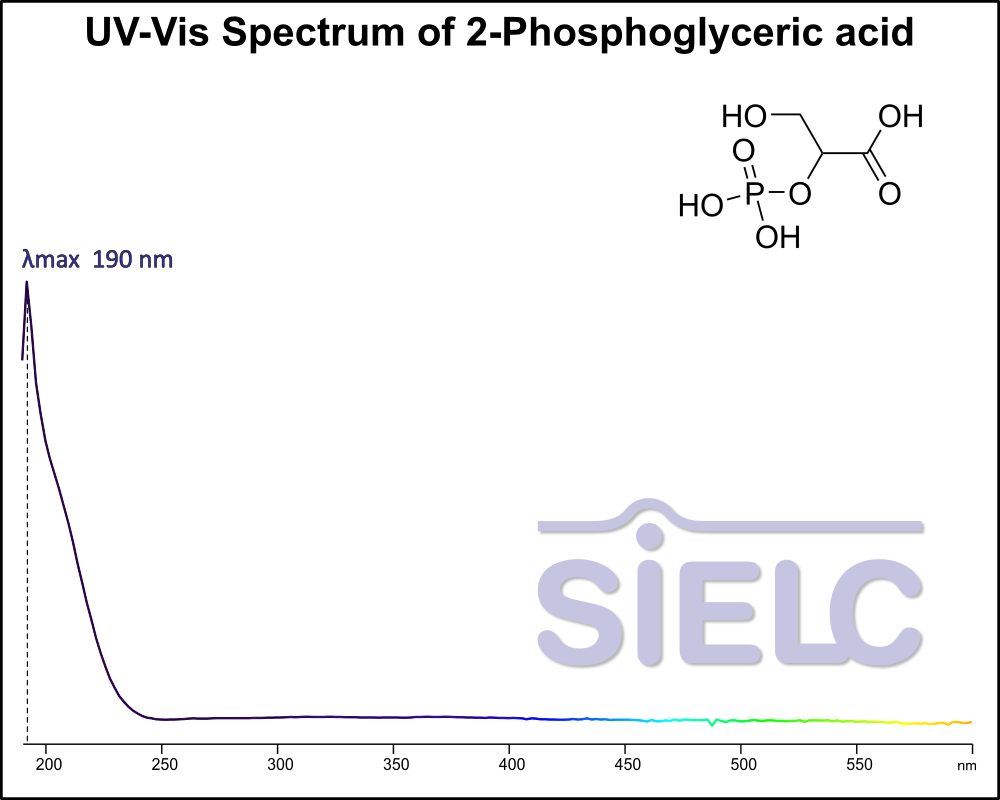
UV-Vis Spectrum of 2-Phosphoglyceric acid
January 8, 2026
If you are looking for optimized HPLC method to analyze 2-Phosphoglyceric acid (2PG) check our HPLC Applications library
For optimal results in HPLC analysis, it is recommended to measure absorbance at a wavelength that matches the absorption maximum of the compound(s) being analyzed. The UV spectrum shown can assist in selecting an appropriate wavelength for your analysis. Please note that certain mobile phases and buffers may block wavelengths below 230 nm, rendering absorbance measurement at these wavelengths ineffective. If detection below 230 nm is required, it is recommended to use acetonitrile and water as low UV-transparent mobile phases, with phosphoric acid and its salts, sulfuric acid, and TFA as buffers.
For some compounds, the UV-Vis Spectrum is affected by the pH of the mobile phase. The spectra presented here are measured with an acidic mobile phase that has a pH of 3 or lower.

ELSD HPLC Method for Analysis of 3-Phosphoglyceric acid (3PG) and 2-Phosphoglyceric acid (2PG) on Newcrom B Column
October 30, 2024
High Performance Liquid Chromatography (HPLC) Method for Analysis of 3-Phosphoglyceric acid (3PG), 2-Phosphoglyceric acid (2PG) on Newcrom B by SIELC Technologies
Separation type: Liquid Chromatography Mixed-mode SIELC Technologies
High Performance Liquid Chromatography (HPLC) Method for Analysis of 3-Phosphoglyceric acid (3PG), 2-Phosphoglyceric acid (2PG)
3-Phosphoglyceric acid (3PG) and 2-Phosphoglyceric acid (2PG) are both intermediates in the glycolytic pathway and the Calvin cycle.
1. 3-Phosphoglyceric Acid (3PG)
- Chemical Structure:
- 3PG has a three-carbon backbone with a phosphate group attached to the third carbon.
- Molecular formula: C₃H₇O₇P
- Role in Metabolism:
- Glycolysis: 3PG is formed from the conversion of fructose 1,6-bisphosphate and is further processed to generate ATP.
- Calvin Cycle: In photosynthesis, 3PG is produced from ribulose bisphosphate (RuBP) and carbon dioxide, catalyzed by the enzyme ribulose bisphosphate carboxylase/oxygenase (RuBisCO). It is the first stable product of carbon fixation.
2. 2-Phosphoglyceric Acid (2PG)
- Chemical Structure:
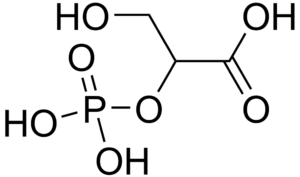
- 2PG has a three-carbon backbone with a phosphate group attached to the second carbon.
- Molecular formula: C₃H₇O₇P
- Role in Metabolism:
- Glycolysis: 2PG is formed from 3-phosphoglycerate via the enzyme phosphoglycerate mutase. It then undergoes dehydration to form phosphoenolpyruvate (PEP).
- Calvin Cycle: 2PG can also arise from the isomerization of 3PG, but it is not a primary product in the Calvin cycle.
Summary of Differences
- Position of Phosphate Group:
- 3PG: Phosphate group at the third carbon.
- 2PG: Phosphate group at the second carbon.
- Metabolic Pathways:
- Both serve as intermediates in glycolysis and the Calvin cycle, but 3PG is more directly associated with the initial steps of carbon fixation in photosynthesis.
Importance
These compounds are crucial for energy metabolism and biosynthesis in various organisms, including plants, animals, and microorganisms. Understanding their roles helps elucidate metabolic pathways like glycolysis and the Calvin cycle, essential for energy production and carbon fixation.
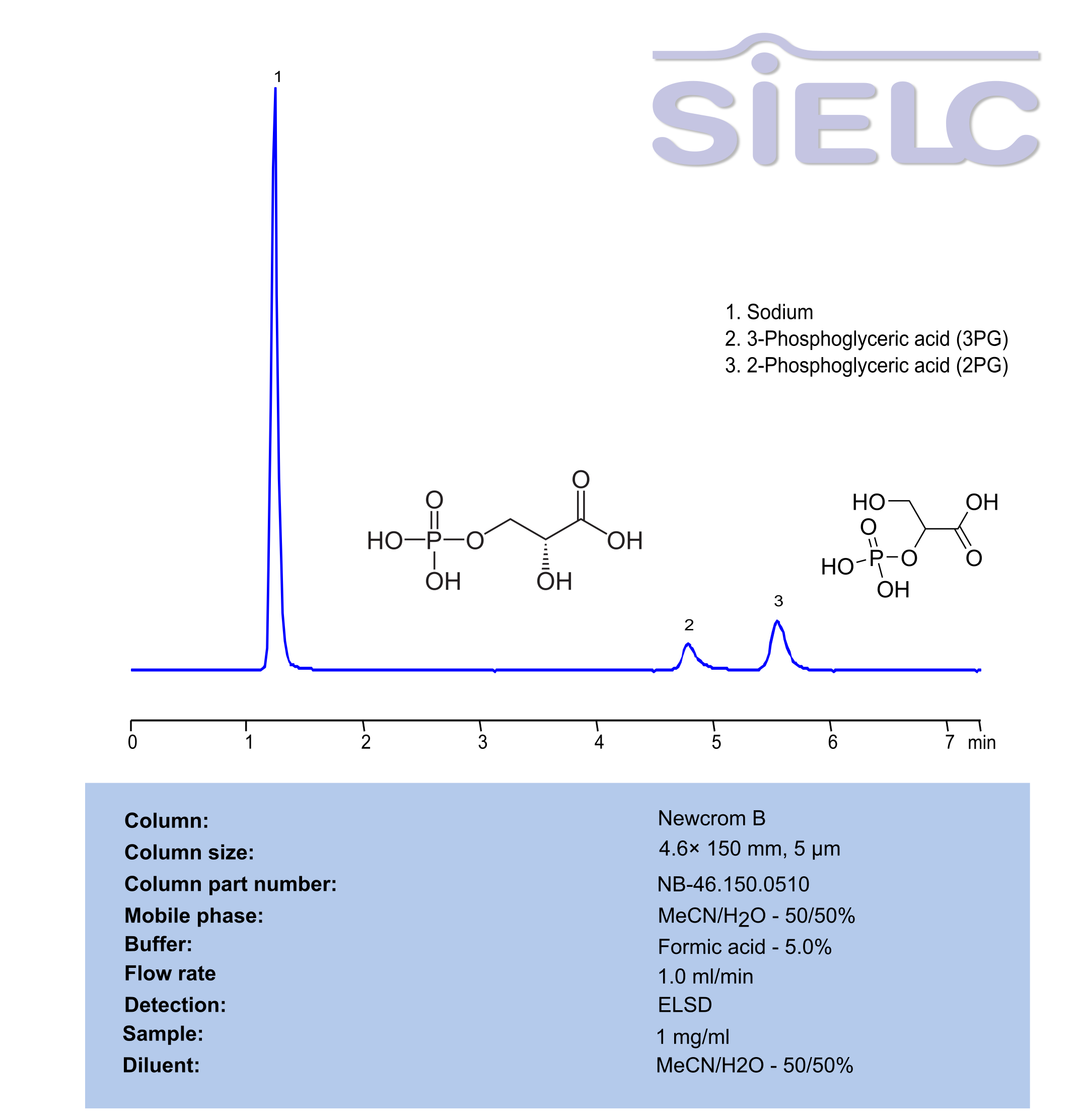
3-Phosphoglyceric acid (3PG), 2-Phosphoglyceric acid (2PG) can be retained, separated and analyzed using a Newcrom B mixed-mode stationary phase column. The analysis employs an isocratic method with a simple mobile phase comprising water, acetonitrile (MeCN), and formic acid as a buffer. This method allows for detection using ELSD.
| Column | Newcrom B, 4.6 x 150 mm, 5 µm, 100 A, dual ended |
| Mobile Phase | MeCN – 50% |
| Buffer | Formic Acid – 5% |
| Flow Rate | 1.0 ml/min |
| Detection | ELSD, the nebulizer and evaporator temperatures 50°C, with a gas flow rate of 1.6 Standard Liters per Minute (SLM) Sample: 1 mg/ml in MeCN/H2O-50/50% |
| Sample | 1 mg/mL |
| Diluent | MeCN/H2O- 50/50% |
| Class of Compounds | |
| Analyzing Compounds | 3-Phosphoglyceric acid (3PG), 2-Phosphoglyceric acid (2PG) |
Application Column
Newcrom B
Column Diameter: 4.6 mm
Column Length: 150 mm
Particle Size: 5 µm
Pore Size: 100 A
Column options: dual ended
3-Phosphoglyceric acid (3PG)
