
| CAS Number | 611-19-8 |
|---|---|
| Molecular Formula | C7H6Cl2 |
| Molecular Weight | 161.030 |
| InChI Key | BASMANVIUSSIIM-UHFFFAOYSA-N |
| LogP | 3.26 |
| Synonyms |
|
Applications:
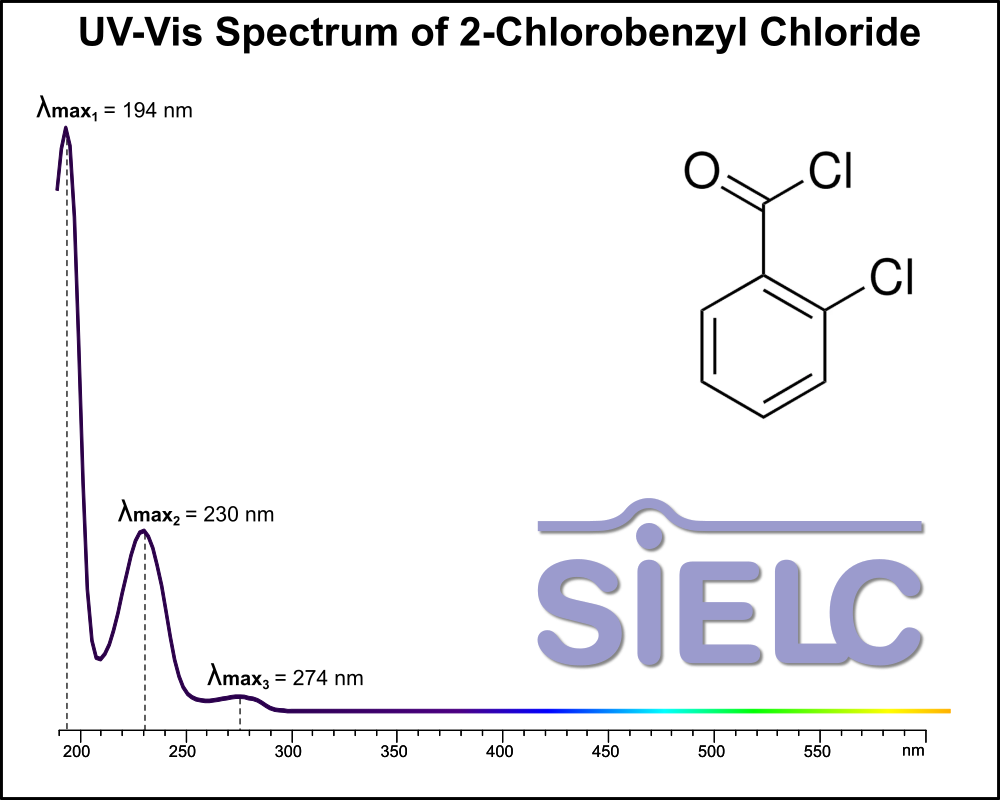
Uv-Vis Spectrum of 2-Chlorobenzyl Chloride
March 20, 2026
Access the UV-Vis Spectrum SIELC Library
If you are looking for optimized HPLC method to analyze 2-Chlorobenzyl chloride check our HPLC Applications library
For optimal results in HPLC analysis, it is recommended to measure absorbance at a wavelength that matches the absorption maximum of the compound(s) being analyzed. The UV spectrum shown can assist in selecting an appropriate wavelength for your analysis. Please note that certain mobile phases and buffers may block wavelengths below 230 nm, rendering absorbance measurement at these wavelengths ineffective. If detection below 230 nm is required, it is recommended to use acetonitrile and water as low UV-transparent mobile phases, with phosphoric acid and its salts, sulfuric acid, and TFA as buffers.
For some compounds, the UV-Vis Spectrum is affected by the pH of the mobile phase. The spectra presented here are measured with an acidic mobile phase that has a pH of 3 or lower.

HPLC Method for Analysis of 2-Chlorobenzyl Chloride and 4-Chlorobenzyl Chloride on Newcrom R1 Column
July 9, 2025
HPLC Method for 2-Chlorobenzyl chloride, 4-Chlorobenzyl chloride on Newcrom R1 by SIELC Technologies
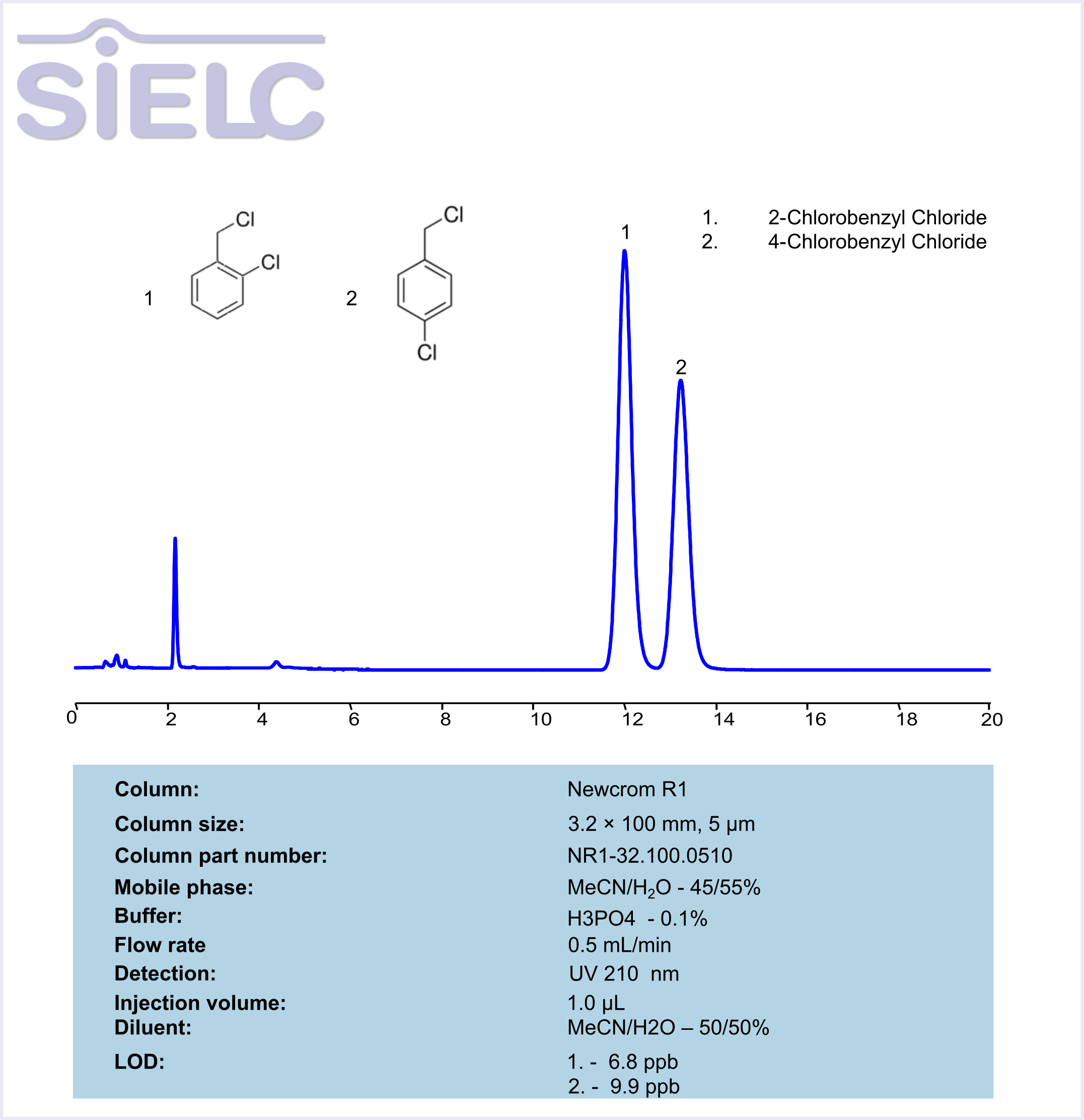
High Performance Liquid Chromatography (HPLC) Method for Analysis of 2-Chlorobenzyl chloride, 4-Chlorobenzyl chloride
2-Chlorobenzyl Chloride
Pharmaceutical intermediate – used to build drugs with chlorinated aromatic structures.
Agrochemicals – precursor for pesticides and herbicides.
Organic synthesis – for introducing a 2-chlorobenzyl group via nucleophilic substitution.
Dyes and pigments – used in manufacturing colorants.
4-Chlorobenzyl Chloride
Pharmaceuticals – key building block for antihistamines, antidepressants, etc.
Polymer chemistry – used to modify or crosslink polymers.
Agrochemical synthesis – like insecticides and fungicides.
Fine chemicals – intermediate for specialty chemical synthesis.
2-Chlorobenzyl chloride, 4-Chlorobenzyl chloride can be retained and analyzed using the Newcrom R1 column. The analysis utilizes an isocratic method with a simple mobile phase consisting of water, acetonitrile (MeCN), and phosphoric acid. Detection is performed using UV at 210 nm.
| Column | Newcrom R1, 3.2 x 100 mm, 5 µm, 100 A, dual ended |
| Mobile Phase | MeCN -45% |
| Buffer | H3PO4 – 0.1% |
| Flow Rate | 1.0 ml/min |
| Detection | UV 210 nm |
| LOD | 6.8 ppb, 9.9 ppb |
*LOD was determined for this combination of instrument, method, and analyte, and it can vary from one laboratory to another even when the same general type of analysis is being performed.
| Class of Compounds | Organic Halides (Alkyl Halides / Arylalkyl Halides) |
| Analyzing Compounds | 2-Chlorobenzyl chloride, 4-Chlorobenzyl chloride |
Application Column
Newcrom R1
Column Diameter: 3.2 mm
Column Length: 100 mm
Particle Size: 5 µm
Pore Size: 100 A
Column options: dual ended
4-Chlorobenzyl chloride
Separation of 2-Chlorobenzyl chloride on Newcrom R1 HPLC column
February 16, 2018

2-Chlorobenzyl chloride can be analyzed by this reverse phase (RP) HPLC method with simple conditions. The mobile phase contains an acetonitrile (MeCN), water, and phosphoric acid. For Mass-Spec (MS) compatible applications the phosphoric acid needs to be replaced with formic acid. Smaller 3 µm particles columns available for fast UPLC applications. This liquid chromatography method is scalable and can be used for isolation impurities in preparative separation. It also suitable for pharmacokinetics.
Application Column
Newcrom R1
The Newcrom columns are a family of reverse-phase-based columns. Newcrom A, AH, B, and BH are all mixed-mode columns with either positive or negative ion-pairing groups attached to either short (25 Å) or long (100 Å) ligand chains. Newcrom R1 is a special reverse-phase column with low silanol activity.
Select options