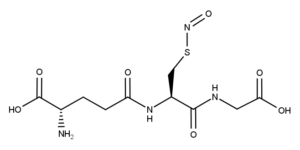
| CAS Number | 57564-91-7 |
|---|---|
| Molecular Formula | C10H16N4O7S |
| Molecular Weight | 336.3 |
| InChI Key | HYHSBSXUHZOYLX-GDVGLLTNSA-N |
| Synonyms |
|
Applications:
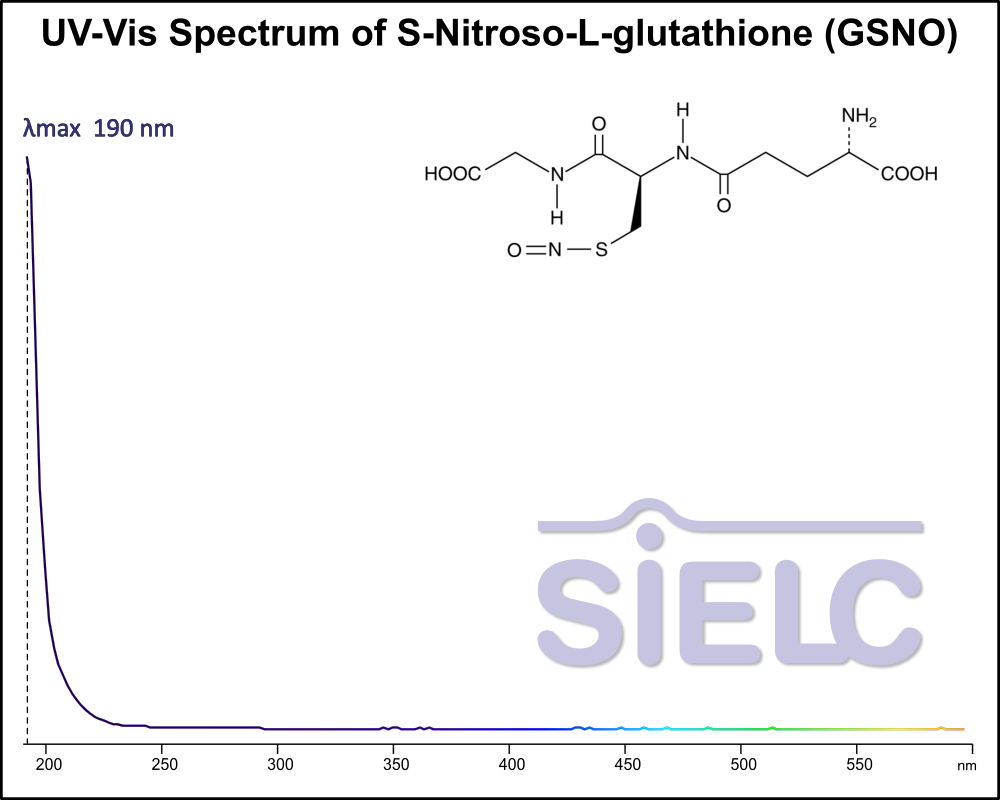
Uv-Vis Spectrum of S-Nitroso-L-glutathione (GSNO)
January 9, 2026
If you are looking for optimized HPLC method to analyze S-Nitroso-L-glutathione (GSNO) check our HPLC Applications library
For optimal results in HPLC analysis, it is recommended to measure absorbance at a wavelength that matches the absorption maximum of the compound(s) being analyzed. The UV spectrum shown can assist in selecting an appropriate wavelength for your analysis. Please note that certain mobile phases and buffers may block wavelengths below 230 nm, rendering absorbance measurement at these wavelengths ineffective. If detection below 230 nm is required, it is recommended to use acetonitrile and water as low UV-transparent mobile phases, with phosphoric acid and its salts, sulfuric acid, and TFA as buffers.
For some compounds, the UV-Vis Spectrum is affected by the pH of the mobile phase. The spectra presented here are measured with an acidic mobile phase that has a pH of 3 or lower.

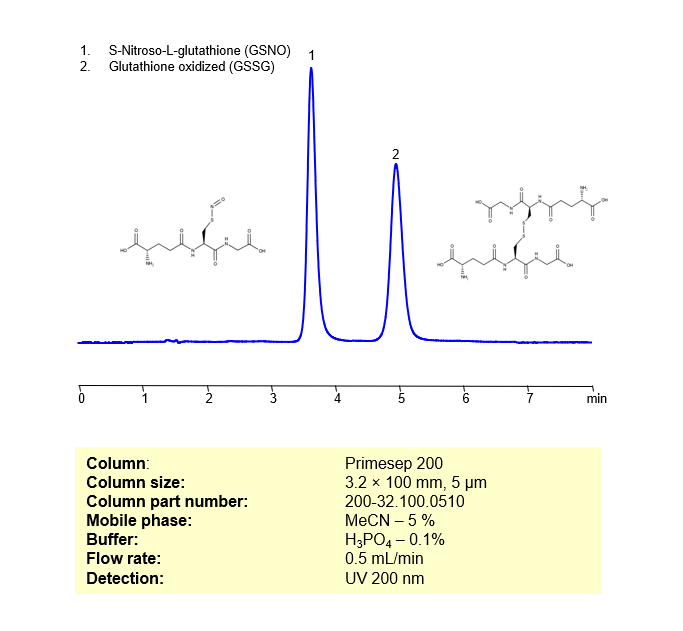
HPLC Method for Separation of S-Nitroso-L-glutathione and Glutathione oxidized on Primesep 200 Column
June 14, 2023
HPLC Method for Separation of S-Nitroso-L-glutathione and Glutathione oxidized on Primesep 200 by SIELC Technologies
Both S-Nitroso-L-glutathione (GSNO) and oxidized glutathione (GSSG) are forms of glutathione, a tripeptide consisting of the amino acids glutamic acid, cysteine, and glycine. Glutathione plays a significant role in maintaining the redox (reduction-oxidation) balance in cells.
S-Nitroso-L-glutathione (GSNO) is a nitric oxide (NO) donor in cells, and it is part of the group of S-nitrosothiols with the chemical formula C10H16N4O7S. The nitric oxide group is attached to the sulfur atom of the cysteine residue in glutathione. GSNO plays a key role in nitric oxide-mediated cellular signaling and can regulate protein function through a process called S-nitrosylation. You can find detailed UV spectra of GSNO and information about its various lambda maxima by visiting the following link.
Oxidized glutathione, or glutathione disulfide (GSSG), is a form of the antioxidant molecule glutathione with the chemical formula C20H32N6O12S2. Glutathione exists in two forms: the reduced form (GSH), which is the active antioxidant, and the oxidized form (GSSG). When glutathione neutralizes a free radical or a reactive oxygen species, it becomes oxidized and forms GSSG. The ratio of GSH to GSSG within cells is often used as a measure of cellular oxidative stress. The body can convert GSSG back into the active GSH form using an enzyme called glutathione reductase, provided there are adequate levels of NADPH, a compound integral to many cellular processes, including the antioxidant response. GSSG is formed when two molecules of glutathione (GSH, the reduced form of glutathione) are linked together by a disulfide bond (-S-S-). This typically occurs in cells under conditions of oxidative stress, when reactive oxygen species (ROS) levels are high. The enzyme glutathione reductase can convert GSSG back to GSH using NADPH as a cofactor, which is an important part of cellular defenses against oxidative stress.
Each form of glutathione plays a unique role in cell signaling and defense mechanisms. While they are related, the specific effects of GSNO and GSSG within cells can be quite different due to their distinct chemical structures and reactivities.
S-Nitroso-L-glutathione (GSNO), Glutathione oxidized (GSSG) can be retained, separated, and analyzed using a reverse-phase Primesep 200, 3.2 x 100 mm, 5 µm, 100 A, dual ended column. The mobile phase for this method consists of water, acetonitrile (MeCN), and Sulfuric acid, which serves as a buffer. This analytical method can be
Condition
| Column | Primesep 200, 3.2 x 100 mm, 5 µm, 100 A, dual ended |
| Mobile Phase | MeCN -10% |
| Buffer | H2SO4 0.2% |
| Flow Rate | 1.0 ml/min |
| Detection | UV 200, 355 nm |
Description
| Class of Compounds | Thiol, Amino acid |
| Analyzing Compounds | S-Nitroso-L-glutathione (GSNO), Glutathione oxidized (GSSG) |
Application Column
Primesep 200
Column Diameter: 3.2 mm
Column Length: 100 mm
Particle Size: 5 µm
Pore Size: 100 A
Column options: dual ended
S-Nitroso-L-glutathione (GSNO)
HPLC Method for Separation of S-Nitroso-L-glutathione and Glutathione oxidized on Primesep 100 Column
June 13, 2023
HPLC Method for Separation of S-Nitroso-L-glutathione and Glutathione oxidized on Primesep 100 by SIELC Technologies
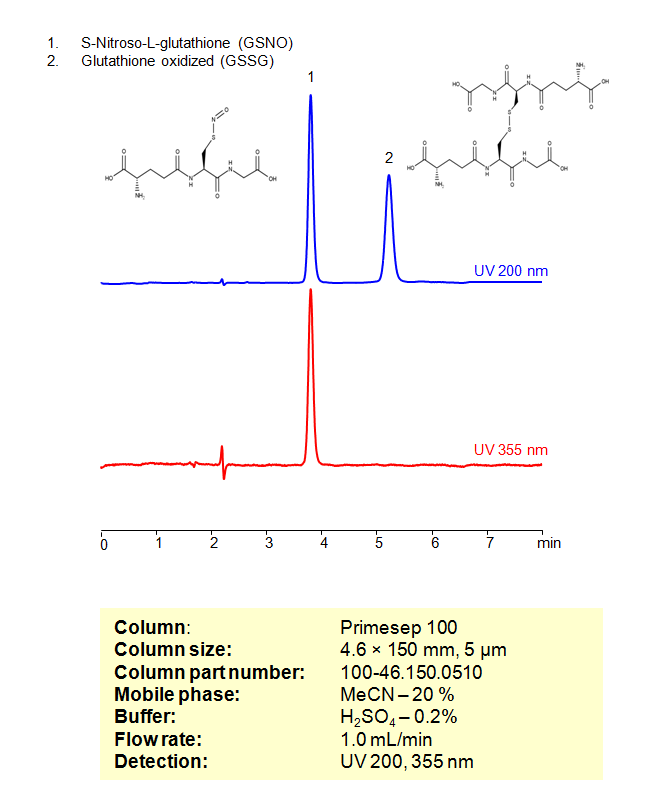
Both S-Nitroso-L-glutathione (GSNO) and oxidized glutathione (GSSG) are forms of glutathione, a tripeptide consisting of the amino acids glutamic acid, cysteine, and glycine. Glutathione plays a significant role in maintaining the redox (reduction-oxidation) balance in cells, but GSNO and GSSG each have unique characteristics:
S-Nitroso-L-glutathione (GSNO) is a nitric oxide (NO) donor in cells, and it is part of the group of S-nitrosothiols with the chemical formula C10H16N4O7S. The nitric oxide group is attached to the sulfur atom of the cysteine residue in glutathione. GSNO plays a key role in nitric oxide-mediated cellular signaling and can regulate protein function through a process called S-nitrosylation. You can find detailed UV spectra of GSNO and information about its various lambda maxima by visiting the following link.
Oxidized glutathione, or glutathione disulfide (GSSG), is a form of the antioxidant molecule glutathione with the chemical formula C20H32N6O12S2. Glutathione exists in two forms: the reduced form (GSH), which is the active antioxidant, and the oxidized form (GSSG). When glutathione neutralizes a free radical or a reactive oxygen species, it becomes oxidized and forms GSSG. The ratio of GSH to GSSG within cells is often used as a measure of cellular oxidative stress. The body can convert GSSG back into the active GSH form using an enzyme called glutathione reductase, provided there are adequate levels of NADPH, a compound integral to many cellular processes, including the antioxidant response. GSSG is formed when two molecules of glutathione (GSH, the reduced form of glutathione) are linked together by a disulfide bond (-S-S-). This typically occurs in cells under conditions of oxidative stress, when reactive oxygen species (ROS) levels are high. The enzyme glutathione reductase can convert GSSG back to GSH using NADPH as a cofactor, which is an important part of cellular defenses against oxidative stress.
Each form of glutathione plays a unique role in cell signaling and defense mechanisms. While they are related, the specific effects of GSNO and GSSG within cells can be quite different due to their distinct chemical structures and reactivities.
Glutathione oxidized (GSSG), S-Nitroso-L-glutathione (GSNO) can be retained, separated, and analyzed using a reverse-phase Primesep 100, 4.6 x 150 mm, 5 µm, 100 A, dual ended column. The mobile phase for this method consists of water, acetonitrile (MeCN), and Sulfuric acid, which serves as a buffer.
Condition
| Column | Primesep 100, 4.6 x 150 mm, 5 µm, 100 A, dual ended |
| Mobile Phase | MeCN -10% |
| Buffer | H2SO4 0.2% |
| Flow Rate | 1.0 ml/min |
| Detection | UV 200, 355 nm |
Description
| Class of Compounds | Thiol, Amino acid |
| Analyzing Compounds | Glutathione oxidized (GSSG), S-Nitroso-L-glutathione (GSNO) |
Application Column
Primesep 100
Column Diameter: 4.6 mm
Column Length: 150 mm
Particle Size: 5 µm
Pore Size: 100 A
Column options: dual ended
S-Nitroso-L-glutathione (GSNO)
