
| CAS Number | 518-28-5 |
|---|---|
| Molecular Formula | C22H22O8 |
| Molecular Weight | 414 |
| InChI Key | YJGVMLPVUAXIQN-XVVDYKMHSA-N |
| LogP | 2 |
| Synonyms |
|
Applications:
Uv-Vis Spectrum of Podophyllotoxin
February 18, 2026
Access the UV-Vis Spectrum SIELC Library
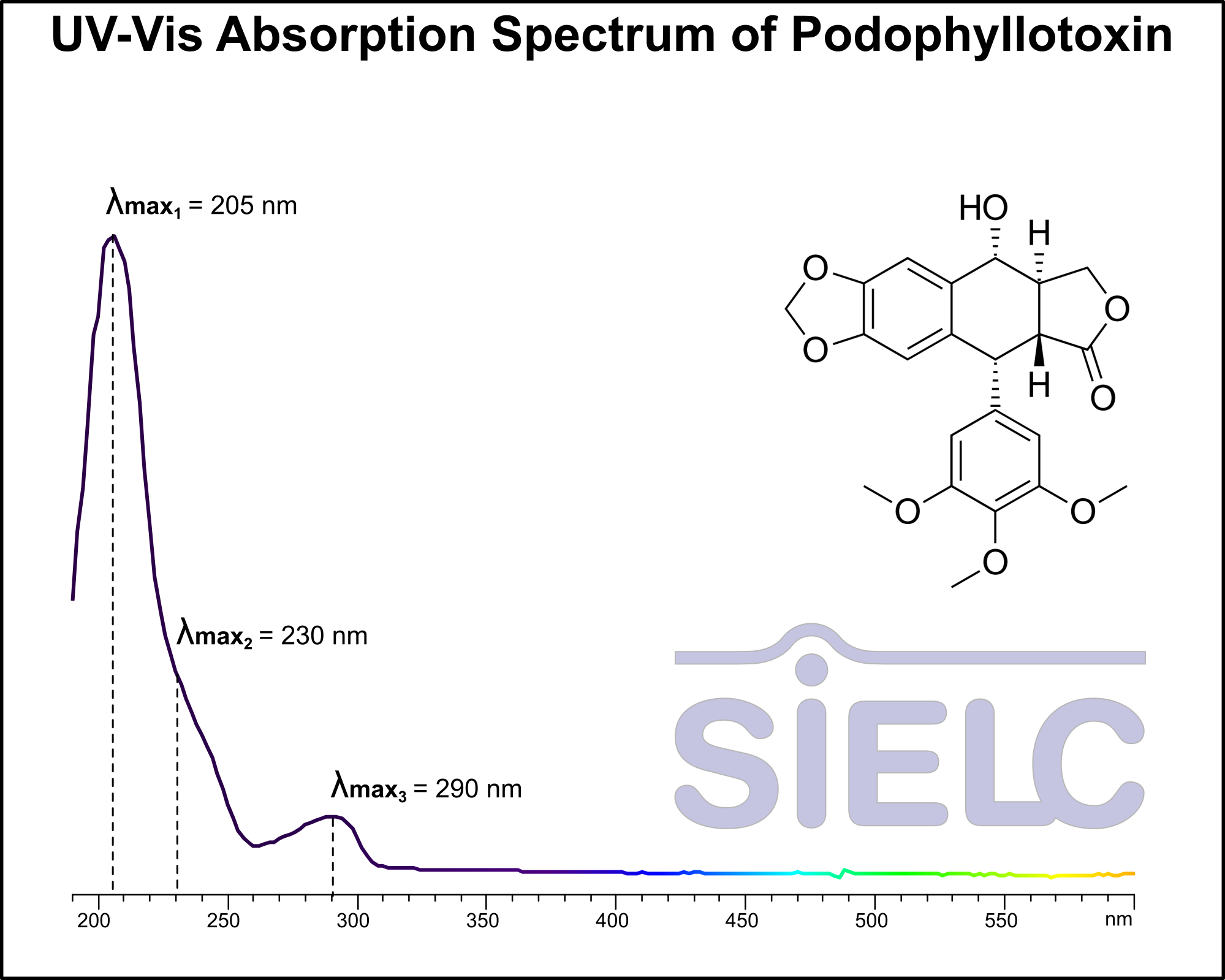
If you are looking for optimized HPLC method to analyze Podophyllotoxin check our HPLC Applications library
For optimal results in HPLC analysis, it is recommended to measure absorbance at a wavelength that matches the absorption maximum of the compound(s) being analyzed. The UV spectrum shown can assist in selecting an appropriate wavelength for your analysis. Please note that certain mobile phases and buffers may block wavelengths below 230 nm, rendering absorbance measurement at these wavelengths ineffective. If detection below 230 nm is required, it is recommended to use acetonitrile and water as low UV-transparent mobile phases, with phosphoric acid and its salts, sulfuric acid, and TFA as buffers.
For some compounds, the UV-Vis Spectrum is affected by the pH of the mobile phase. The spectra presented here are measured with an acidic mobile phase that has a pH of 3 or lower.

HPLC Method for Analysis of Podophyllotoxin on Newcrom R1 Column
October 23, 2023
HPLC Method for Analysis of Podophyllotoxin on Newcrom R1 by SIELC Technologies
Podophyllotoxin is a non-alkaloid toxin lignan with the chemical formula C22H22O8. It is extracted from the roots and rhizomes of Podophyllum species. This compound has been used both in traditional medicine and in modern medicine for its various properties, especially its action against certain skin conditions. Podophyllotoxin is used topically (on the skin) to treat genital warts, which are caused by the human papillomavirus (HPV). It’s found in several over-the-counter preparations, often as a solution or cream. It’s believed that podophyllotoxin exerts its effect on warts by causing local irritation and stimulating the immune system to clear the HPV virus. Podophyllotoxin is also a precursor to several semi-synthetic compounds used in chemotherapy. Two of the most well-known drugs derived from podophyllotoxin are etoposide and teniposide. They are used to treat a variety of malignancies. In cancer treatment, compounds derived from podophyllotoxin work by inhibiting the enzyme topoisomerase II, which is necessary for DNA replication. By doing so, they prevent cancer cells from dividing and growing.
Podophyllotoxin has valuable medical applications, from treating genital warts to serving as a base for powerful chemotherapy drugs. As with any medication or compound, it’s essential to use it correctly and under the guidance of a healthcare provider to maximize benefits and minimize potential risks.
You can find detailed UV spectra of Podophyllotoxin and information about its various lambda maxima by visiting the following link.
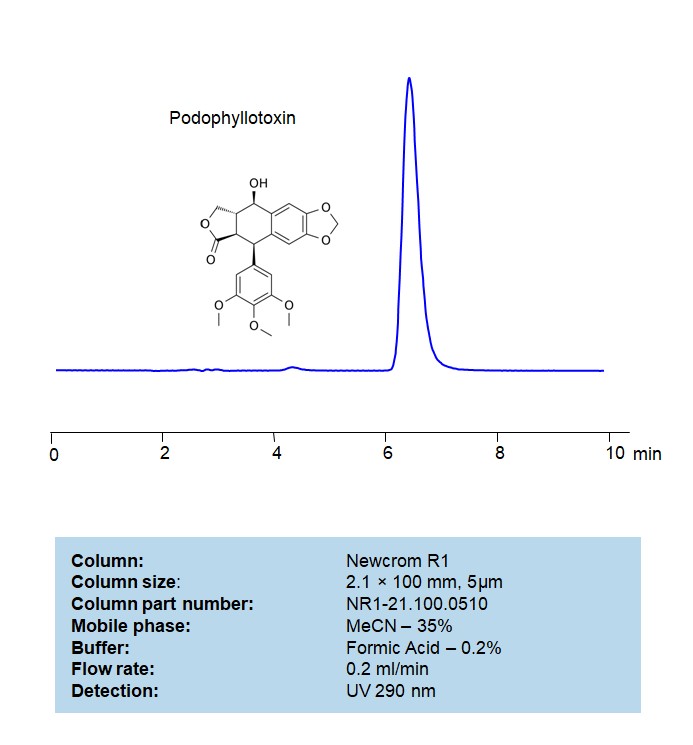
Podophyllotoxin can be retained, separated and analyzed on a Newcrom R1 reverse phase stationary phase column using an isocratic analytical method with a simple mobile phase of water, Acetonitrile (MeCN), and a formic acid as a buffer. This analysis method can be detected using UV at 390 nm, an Evaporative Light Scattering Detector (ELSD), or any other evaporative detection method (CAD, ESI-MS)
| Column | Newcrom R1, 2.1 x 100 mm, 5 µm, 100 A, dual ended |
| Mobile Phase | MeCN – 35%, |
| Buffer | Formic Acid – 0.2% |
| Flow Rate | 0.2 ml/min |
| Detection | UV 290 nm |
| Class of Compounds | alkaloid |
| Analyzing Compounds | Podophyllotoxin |
Application Column
Newcrom R1
Column Diameter: 2.1 mm
Column Length: 100 mm
Particle Size: 5 µm
Pore Size: 100 A
Column options: dual ended
