HPLC Method for Epibatidine on Primesep 200 by SIELC Technologies
High Performance Liquid Chromatography (HPLC) Method for Analysis of Epibatidine
Epibatidine is an alkaloid with the chemical formula C11H13ClN3. It is secreted by the Ecuadorian frog commonly known as Anthony’s Poison Arrow frog from the genus of poison dart frogs, Ameerega. It’s existence in nature is still debated due to limited samples that were collected by John W. Daly, and even fewer samples that were still left when high resolution spectrometry was popularized and used on the compound. As a poison, Epibatidine causes full body numbness which can progress into full body paralysis and respiratory arrest. Due to it’s high toxicity, it is not used as a drug, despite the analgesic effect. You can find detailed UV spectra of Epibatidine and information about its various lambda maxima by visiting the following link.
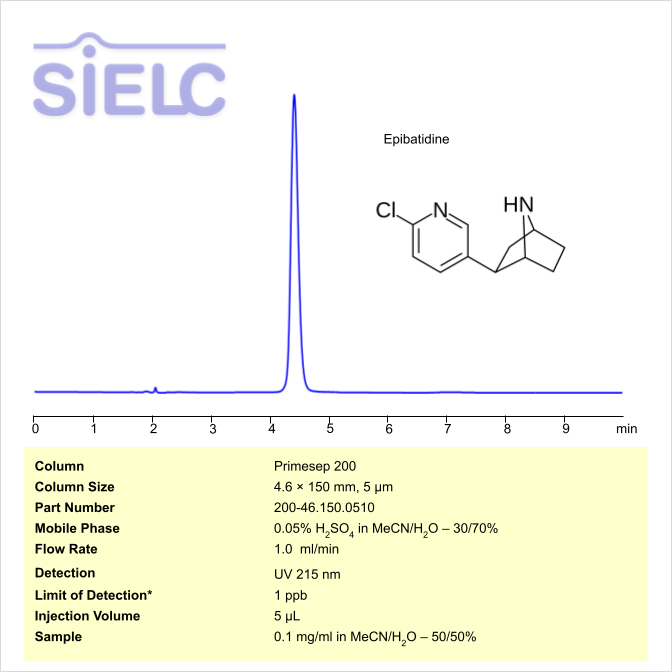
Epibatidine can be retained and analyzed using the Primesep 200 stationary phase column. The analysis utilizes an isocratic method with a simple mobile phase consisting of water and acetonitrile (MeCN) with a sulfuric acid buffer. Detection is performed using UV.
| Column | Primesep 200, 4.6 x 150 mm, 5 µm, 100 A, dual ended |
| Mobile Phase | MeCN/H2O – 30/70% |
| Buffer | H2SO4 – 0.05% |
| Flow Rate | 1.0 ml/m |
| Detection | UV 215nm |
| Class of Compounds | Poison, Alkaloid, Pyridine derivative, Azabicyclic compound, Organochlorine compound |
| Analyzing Compounds | Epibatidine |
Application Column
Primesep 200
Column Diameter: 4.6 mm
Column Length: 150 mm
Particle Size: 5 µm
Pore Size: 100 A
Column options: dual ended