HPLC Method for Analysis of Deoxyguanosine, Guanine and Guanosine on BIST B+ by SIELC Technologies.
Deoxyguanosine is a deoxyribonucleoside with the chemical formula C10H13N5O4. It is a vital part of what makes up DNA.
Guanine, also noted as G and Gua, has the chemical formula C5H5N5O. By forming three hydrogen bonds with the Cytosine, it creates a base pair. It’s name comes from the Spanish term “guano”, meaning bird or bat dropping, as that is said to have been how it was first discovered. Outside of DNA, Guanine that is harvested from fish scales, is occasionally used in cosmetics for it’s luster.
Guanosine is a purine nucleoside with the chemical formula C10H13N5O5. It can be phosphorylated into many other forms, which play vital roles in biochemical possesses like synthesis of nucleic acids, proteins, photosynthesis, and more. It is also required for RNA splicing.
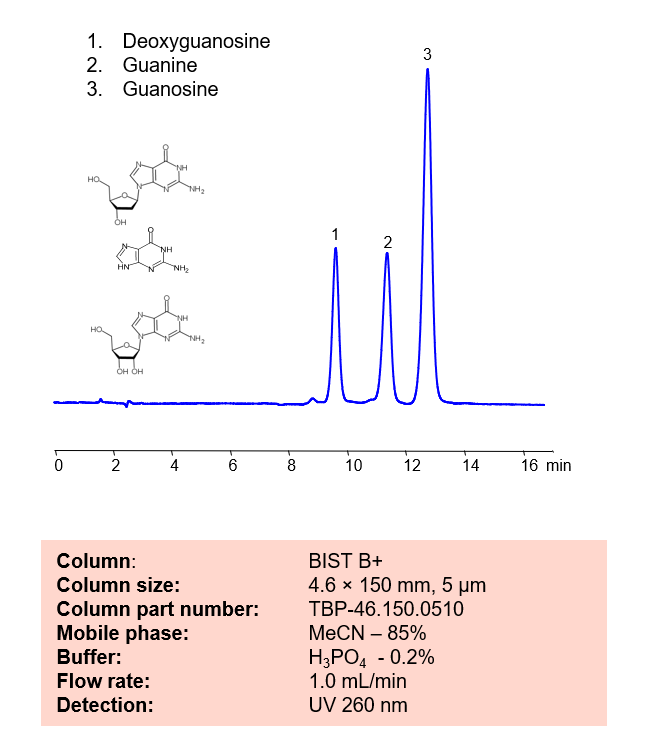
Guanine, Guanosine, Deoxyguanosine can be retained and analyzed using the BIST B+ stationary phase column. The analysis utilizes an isocratic method with a simple mobile phase consisting of water and acetonitrile (MeCN). Detection is performed using UV.
Condition
| Column | BIST B+, 4.6 x 150 mm, 5 µm, 100 A, dual ended |
| Mobile Phase | MeCN – 85% |
| Buffer | H3PO4 – 0.2% |
| Flow Rate | 1.0 ml/min |
| Detection | UV 260 nm |
| Peak Retention Time | 9.6, 11.2, 12.8 min |
Description
| Class of Compounds | Nucleosides |
| Analyzing Compounds | Guanine, Guanosine, Deoxyguanosine |
Application Column
BIST B+
Column Diameter: 4.6 mm
Column Length: 150 mm
Particle Size: 5 µm
Pore Size: 100 A
Column options: dual ended
Guanine
Guanosine