HPLC Method for Analysis of Ethyl red, Crystal Violet on Chromni Column by SIELC Technologies
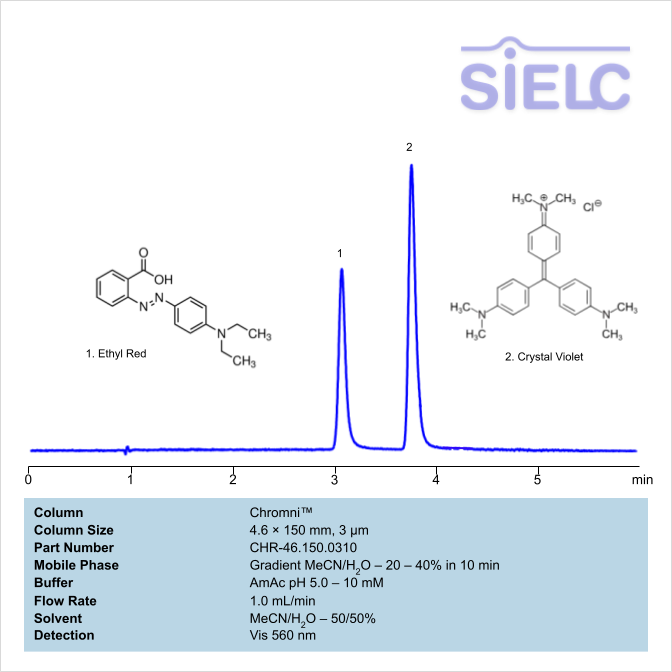
High Performance Liquid Chromatography (HPLC) Method for Analysis of Ethyl red, Crystal Violet.
Ethyl red is a pH indicator with C17H19N3O2 as its molecular structure. When the pH transitions from acidic to neutral, Ethyl red turns from yellow to red, hence the name. Outside of experiments, it is occasionally used as a dye in textiles and foods. You can find detailed UV spectra of Ethyl Red and information about its various lambda maxima by visiting the following link.
Crystal Violet (Methyl Violet 10B), another basic triarylmethane dye, has the C25H30ClN3. It is frequently used for histological stains and for identifying Gram-positive bacteria. It is said to have antibacterial, antifungal, and anthelmintic properties. It is a common component of navy blue and black inks in printing, inkjet printers, and ball-point pens. You can find detailed UV spectra of Crystal Violet and information about its various lambda maxima by visiting the following link.
Ethyl red, Crystal Violet can be retained and analyzed using the Chromni stationary phase column. The analysis utilizes a gradient method with a simple mobile phase consisting of water and acetonitrile (MeCN) and AmAC. Detection is performed using UV.
Condition
| Column | Chromni, 4.6 x 150 mm, 3 µm, 100 A, dual ended |
| Mobile Phase | MeCN/H2O |
| Buffer | AmAC pH 5.0 – 10 mM |
| Flow Rate | 1.0 ml/min |
| Detection | Vis 560 nm |
Description
| Class of Compounds | Dyes |
| Analyzing Compounds | Ethyl red, Crystal Violet |
Application Column
Chromni
Column Diameter: 4.6 mm
Column Length: 150 mm
Particle Size: 3 µm
Pore Size: 100 A
Column options: dual ended
Ethyl red