HPLC Method for Analysis of Caffeine, Methyl salicylate on Newcrom R1 Column by SIELC Technologies
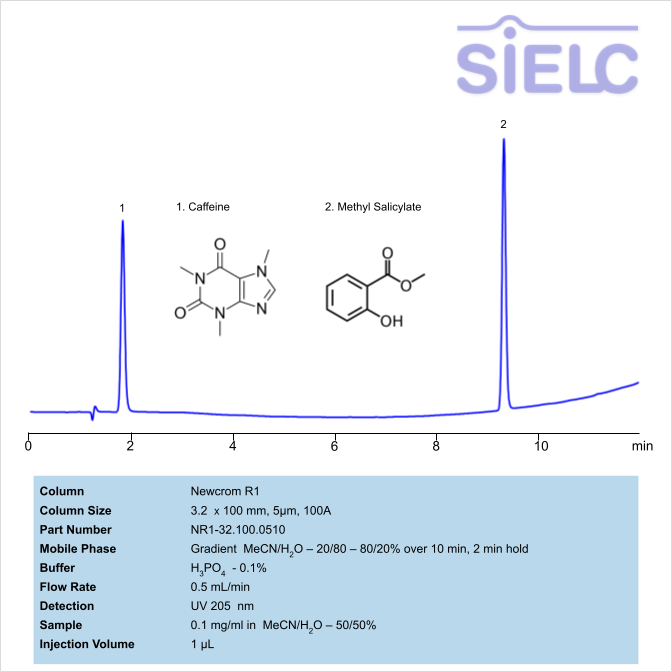
High Performance Liquid Chromatography (HPLC) Method for Analysis of Caffeine, Methyl salicylate.
Caffeine is a natural stimulant and methylxanthine alkaloid. with the molecular formula C6H10N4O2. Caffeine can be found in a variety of plants, including tea, coffea, cocoa, kola nuts, and guarana. Ingestion of it can increase alertness and cognitive function. It can also cause worsening anxiety, heart palpitations, and headaches You can find detailed UV spectra of Caffeine and information about its various lambda maxima by visiting the following link.
Methyl Salicylate, also known as oil of wintergreen and wintergreen oil, is a methyl ester of salicylic acid with the formula C8H8O3. It is used primarily as a flavoring and fragrance in root beer, chewing gum, mints, and more. In medical contexts, it is used as a rubefacient and analgesic in deep heating liniments to treat muscular pain, despite the effects being reported as minimal in double blind studies. You can find detailed UV spectra of Methyl Salicylate and information about its various lambda maxima by visiting the following link.
Caffeine, Methyl salicylate can be retained and analyzed using the Newcrom R1 stationary phase column. The analysis utilizes a gradient method with a simple mobile phase consisting of water and acetonitrile (MeCN) and phosphoric acid. Detection is performed using UV.
Condition
| Column | Newcrom R1, 3.2 x 100 mm, 5 µm, 100 A, dual ended |
| Mobile Phase | Gradient MeCN/H2O |
| Buffer | H2PO4 – 0.1% |
| Flow Rate | 0.5 ml/min |
| Detection | UV 205 nm |
Description
| Class of Compounds | Compounds |
| Analyzing Compounds | Caffeine, Methyl salicylate |
Application Column
Newcrom R1
Column Diameter: 3.2 mm
Column Length: 100 mm
Particle Size: 5 µm
Pore Size: 100 A
Column options: dual ended
Methyl salicylate