
| CAS Number | 119-36-8 |
|---|---|
| Molecular Formula | C8H8O3 |
| Molecular Weight | 152.149 |
| InChI Key | OSWPMRLSEDHDFF-UHFFFAOYSA-N |
| LogP | 2.55 |
| Synonyms |
|
Applications:
HPLC Method for Analysis of Carminic acid Extracted from Pepto Bismol Chewable Tablets on Primesep 100 Column
November 24, 2026
HPLC Method for Carminic acid on Primesep 100 by SIELC Technologies
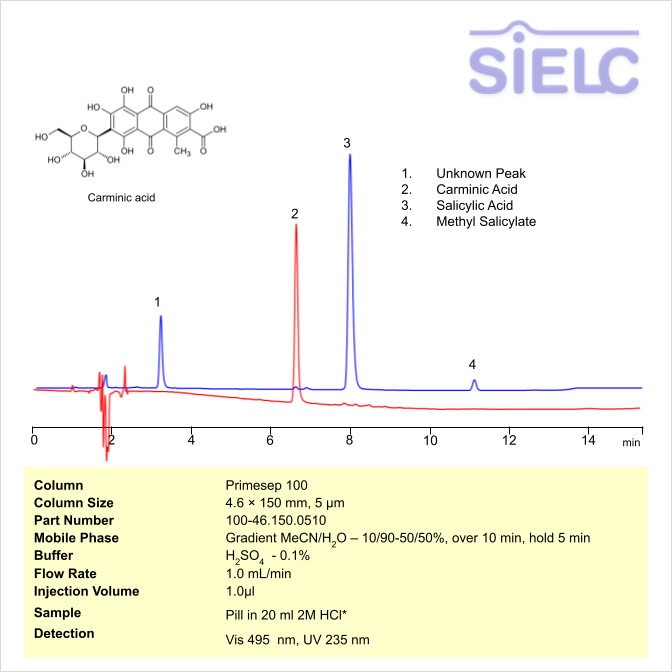
Carminic acid is a glucosidal hydroxyanthrapurin with the formula C22H20O13. It is found primarily in scale insects, especially varieties of cochineal. It is produced as a deterrent for predators. It is also the coloring agent in carmine, which has been used as a dye in Peru since 700 CE.
Salicylic acid (SA) is an o-hydroxybenzoic acid, synthesized by both plants and microorganisms. SA acts as a critical plant hormone regulating various processes, including growth and development, flowering, thermogenesis, ion uptake, stomatal movement, photosynthesis, and plant immunity. Medically, Salicylic acid is used as a topical treatment for a wide variety of skin conditions. It has the chemical formula C7H6O3. You can find detailed UV spectra of Salicylic acid and information about its various lambda maxima by visiting the following link.
Methyl Salicylate, also known as oil of wintergreen and wintergreen oil, is a methyl ester of salicylic acid with the formula C8H8O3. It is used primarily as a flavoring and fragrance in root beer, chewing gum, mints, and more. In medical contexts, it is used as a rubefacient and analgesic in deep heating liniments to treat muscular pain, despite the effects being reported as minimal in double blind studies. You can find detailed UV spectra of Methyl Salicylate and information about its various lambda maxima by visiting the following link.
*Sample was made by dissolving the outer layer of the chewable pill in 20mL of 2M HCl/H2O by using an ultrasonic bath for 15 minutes at 50oC.
Carminic acid, Salicylic acid, Methyl salicylate can be retained, and analyzed using a Primesep 100 mixed-mode stationary phase column. The analysis utilizes a gradient method with a simple mobile phase consisting of water, acetonitrile (MeCN), and sulfuric acid as a buffer. Detection is carried out using Vis.
| Column | Primesep 100, 4.6 x 150 mm, 5 µm, 100 A, dual ended |
| Mobile Phase | Gradient MeCN/H2O – 10/90-50/50%, over 10 min, hold 5 min |
| Buffer | H2SO4 – 0.1% |
| Flow Rate | 1.0 ml/min |
| Detection | Vis 495 nm, UV 235 nm |
| Class of Compounds | Acid |
| Analyzing Compounds | Carminic acid, Salicylic acid, Methyl salicylate |
Application Column
Primesep 100
Column Diameter: 4.6 mm
Column Length: 150 mm
Particle Size: 5 µm
Pore Size: 100 A
Column options: dual ended
Methyl salicylate
Salicylic acid
Vis Detection

HPLC Method for Analysis of Caffeine and Methyl Salicylate on Newcrom R1 Column
October 2, 2026
HPLC Method for Analysis of Caffeine, Methyl salicylate on Newcrom R1 Column by SIELC Technologies
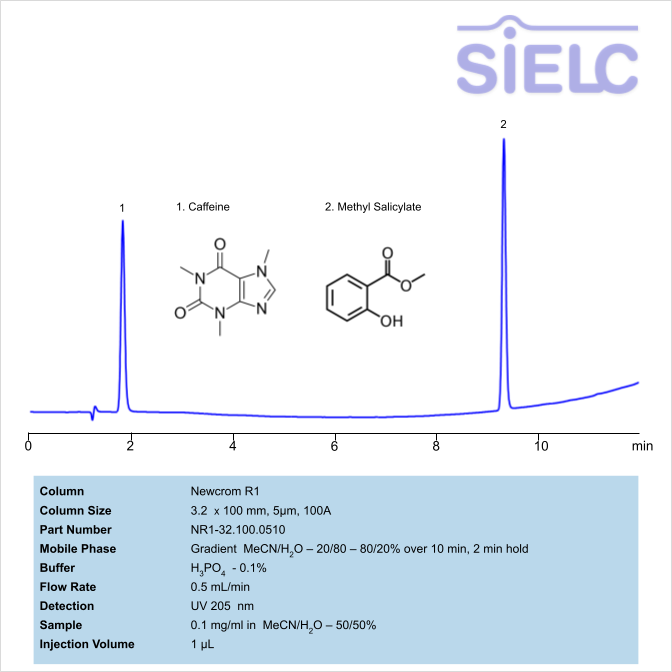
High Performance Liquid Chromatography (HPLC) Method for Analysis of Caffeine, Methyl salicylate.
Caffeine is a natural stimulant and methylxanthine alkaloid. with the molecular formula C6H10N4O2. Caffeine can be found in a variety of plants, including tea, coffea, cocoa, kola nuts, and guarana. Ingestion of it can increase alertness and cognitive function. It can also cause worsening anxiety, heart palpitations, and headaches You can find detailed UV spectra of Caffeine and information about its various lambda maxima by visiting the following link.
Methyl Salicylate, also known as oil of wintergreen and wintergreen oil, is a methyl ester of salicylic acid with the formula C8H8O3. It is used primarily as a flavoring and fragrance in root beer, chewing gum, mints, and more. In medical contexts, it is used as a rubefacient and analgesic in deep heating liniments to treat muscular pain, despite the effects being reported as minimal in double blind studies. You can find detailed UV spectra of Methyl Salicylate and information about its various lambda maxima by visiting the following link.
Caffeine, Methyl salicylate can be retained and analyzed using the Newcrom R1 stationary phase column. The analysis utilizes a gradient method with a simple mobile phase consisting of water and acetonitrile (MeCN) and phosphoric acid. Detection is performed using UV.
Condition
| Column | Newcrom R1, 3.2 x 100 mm, 5 µm, 100 A, dual ended |
| Mobile Phase | Gradient MeCN/H2O |
| Buffer | H2PO4 – 0.1% |
| Flow Rate | 0.5 ml/min |
| Detection | UV 205 nm |
Description
| Class of Compounds | Compounds |
| Analyzing Compounds | Caffeine, Methyl salicylate |
Application Column
Newcrom R1
Column Diameter: 3.2 mm
Column Length: 100 mm
Particle Size: 5 µm
Pore Size: 100 A
Column options: dual ended
Methyl salicylate
Uv-Vis Spectrum of Methyl Salicylate
February 20, 2026
Access the UV-Vis Spectrum SIELC Library
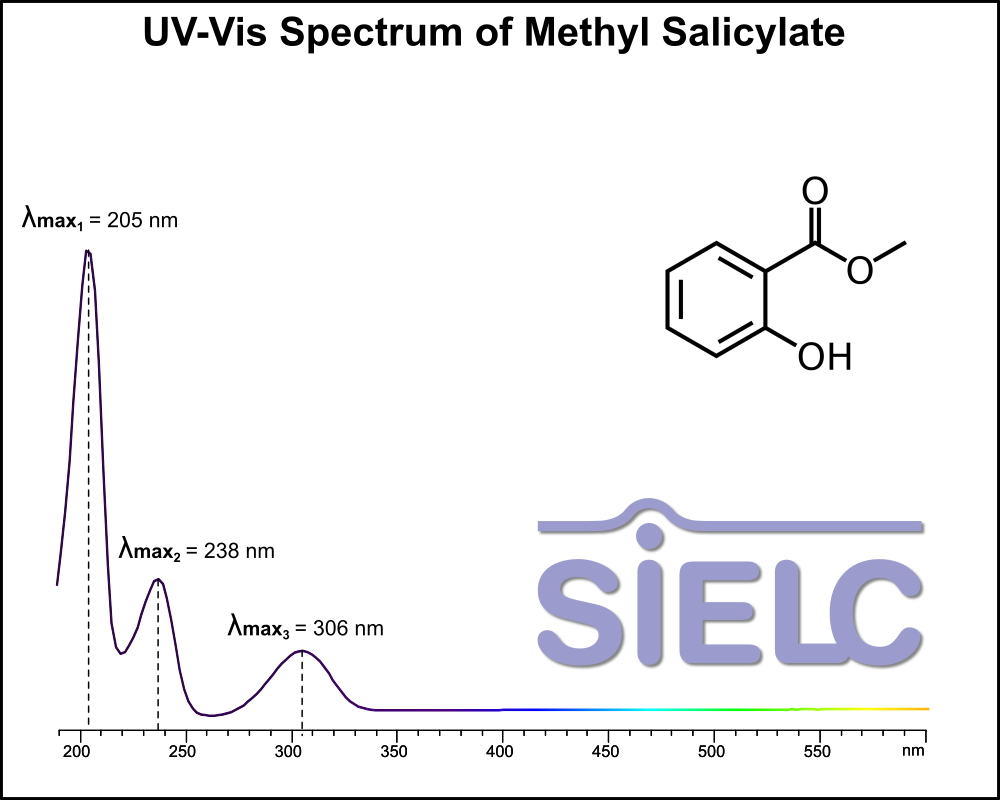
If you are looking for optimized HPLC method to analyze Methyl salicylate check our HPLC Applications library
For optimal results in HPLC analysis, it is recommended to measure absorbance at a wavelength that matches the absorption maximum of the compound(s) being analyzed. The UV spectrum shown can assist in selecting an appropriate wavelength for your analysis. Please note that certain mobile phases and buffers may block wavelengths below 230 nm, rendering absorbance measurement at these wavelengths ineffective. If detection below 230 nm is required, it is recommended to use acetonitrile and water as low UV-transparent mobile phases, with phosphoric acid and its salts, sulfuric acid, and TFA as buffers.
For some compounds, the UV-Vis Spectrum is affected by the pH of the mobile phase. The spectra presented here are measured with an acidic mobile phase that has a pH of 3 or lower.
Separation of Methyl salicylate on Newcrom R1 HPLC column
February 16, 2018

Methyl salicylate can be analyzed by this reverse phase (RP) HPLC method with simple conditions. The mobile phase contains an acetonitrile (MeCN), water, and phosphoric acid. For Mass-Spec (MS) compatible applications the phosphoric acid needs to be replaced with formic acid. Smaller 3 µm particles columns available for fast UPLC applications. This liquid chromatography method is scalable and can be used for isolation impurities in preparative separation. It also suitable for pharmacokinetics.
Application Column
Newcrom R1
The Newcrom columns are a family of reverse-phase-based columns. Newcrom A, AH, B, and BH are all mixed-mode columns with either positive or negative ion-pairing groups attached to either short (25 Å) or long (100 Å) ligand chains. Newcrom R1 is a special reverse-phase column with low silanol activity.
Select options