HPLC Method for Analysis of Berberine on Primesep B by SIELC Technologies
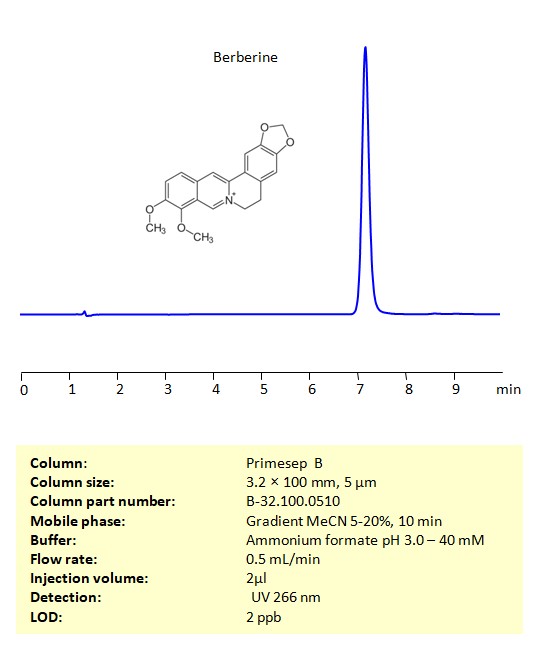
Berberine is a naturally occurring alkaloid with the chemical formula C20H18NO4. It is found in several plants, including the roots, rhizomes, and stem bark of plants such as Berberis species (barberry), Coptis chinensis (goldthread), and Hydrastis canadensis (goldenseal). Berberine has been used in traditional medicine for its various medicinal properties, including antimicrobial, anti-inflammatory, and antioxidant effects. Some studies suggest that berberine may help regulate blood sugar levels and improve insulin sensitivity, making it of interest in diabetes research. It has been investigated for potential benefits in managing cholesterol levels. Berberine has also shown promise in preclinical studies for its potential anticancer properties. In traditional medicine, berberine-containing plants have been used for treating various conditions.
Berberine can be retained, and analyzed using a Primesep B mixed-mode stationary phase column. The analysis utilizes an isocratic method with a simple mobile phase consisting of water, acetonitrile (MeCN), and sulfuric acid as a buffer. Detection is achieved using UV at 266 nm
| Column | Primesep B, 3.2 x 100 mm, 5 µm, 100 A, dual ended |
| Mobile Phase | Gradient MeCN – 5-20%, 10 min |
| Buffer | Ammonium formate pH 3.0 – 40 mM |
| Flow Rate | 0.5 ml/min |
| Detection | λmax230, 266, 348, 431 nm |
| Samples | 0.1 mg/mL in MeCN/H2O – 50/50% |
| Injection volume | 1 µl |
| LOD* | 2 ppb |
| Class of Compounds | Alkaloid, Quaternary ammonium |
| Analyzing Compounds | Berberine |
Application Column
Primesep B
Column Diameter: 3.2 mm
Column Length: 100 mm
Particle Size: 5 µm
Pore Size: 100 A
Column options: dual ended