High Performance Liquid Chromatography (HPLC) Method for Analysis of Benzonatate on Primesep 100 by SIELC Technologies
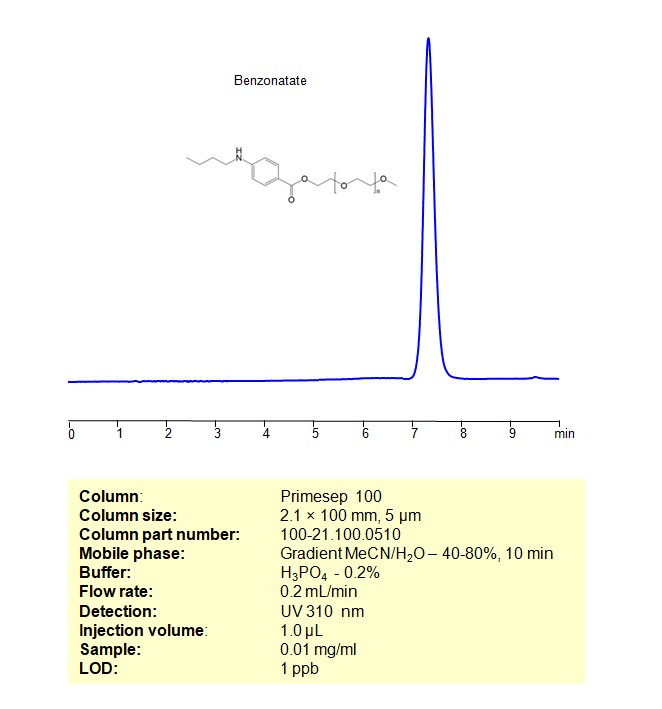
Benzonatate is a medication with the chemical formula C30H53NO11. Antitussives are substances that suppress or relieve coughing. Benzonatate works by numbing the throat and lungs, reducing the cough reflex. Benzonatate is primarily used to relieve cough caused by conditions such as respiratory infections or irritation of the airways. It works by anesthetizing the stretch receptors in the respiratory passages, lungs, and pleura. This helps reduce the urge to cough. Typically, it is taken orally in the form of capsules. It’s important not to chew or break the capsules, as this can lead to a numbing sensation in the mouth and throat. Common side effects may include dizziness, headache, constipation, and upset stomach. Serious allergic reactions are rare but possible.
Benzonatate be retained and analyzed using a Primesep 100 mixed-mode stationary phase column. The analysis employs an isocratic method with a simple mobile phase comprising water, acetonitrile (MeCN), and phosphoric acid as a buffer. This method allows for detection using UV at 310 nm
| Column | Primesep 100, 4.6 x 150 mm, 5 µm, 100 A, dual ended |
| Mobile Phase | Gradient MeCN 40-80%, 10 min |
| Buffer | H3PO4 -0.2% |
| Flow Rate | 0.2ml/min |
| Detection | UV 310 nm |
| Samples | 0.01 mg/mL |
| Injection volume | 5 µl |
| LOD* | 1 ppb |
| Class of Compounds | Antitussives |
| Analyzing Compounds | Benzonatate |
Application Column
Primesep 100
Column Diameter: 4.6 mm
Column Length: 150 mm
Particle Size: 5 µm
Pore Size: 100 A
Column options: dual ended