High Performance Liquid Chromatography (HPLC) Method for Analysis of Ketamine on Primesep B by SIELC Technologies
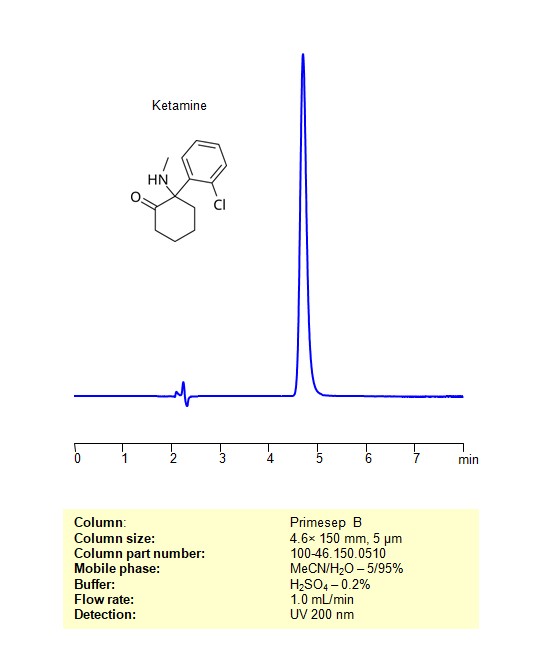
Ketamine, also known as (RS)-2-(2-chlorophenyl)-2-(methylamino)cyclohexanone, is a medication with the chemical formula C13H16ClNO. It is primarily used for induction and maintenance of anesthesia n both humans and animals. It is classified as an arylcyclohexylamine. It has a unique mechanism of action, acting primarily as an antagonist of the N-methyl-D-aspartate (NMDA) receptor, which is involved in pain transmission and synaptic plasticity. Beyond its primary anesthetic use, ketamine has also been investigated for its rapid-acting antidepressant effects and is used in certain treatment-resistant cases of depression. Due to its potential for misuse and the hallucinogenic effects it can produce at sub-anesthetic doses, ketamine is also classified as a controlled substance in many countries. You can find detailed UV spectra of Ketamine and information about its various lambda maxima by visiting the following link.
Ketamine can be retained, and analyzed on a Primesep B mixed-mode stationary phase column using an isocratic analytical method with a simple mobile phase of water, Acetonitrile (MeCN), and a sulfuric acid as a buffer. This analysis method can be detected using UV at 200 nm.
Condition
| Column | Primesep B, 4.6 x 150 mm, 5 µm, 100 A, dual ended |
| Mobile Phase | MeCN/H2O – 5/95% |
| Buffer | H2SO4 – 0.2% |
| Flow Rate | 1.0 ml/min |
| Detection | UV 200 nm |
| Peak Retention Time | 5.56 min |
| LOD * | 200 ppb |
*LOD was determined for this combination of instrument, method, and analyte, and it can vary from one laboratory to another even when the same general type of analysis is being performed.
Description
| Class of Compounds | Drug, arylcyclohexylamine |
| Analyzing Compounds | Ketamine |
Application Column
Primesep B
Column Diameter: 4.6 mm
Column Length: 150 mm
Particle Size: 5 µm
Pore Size: 100 A
Column options: dual ended