HPLC Method for Analysis of Guaiacol on Primesep 100 by SIELC Technologies
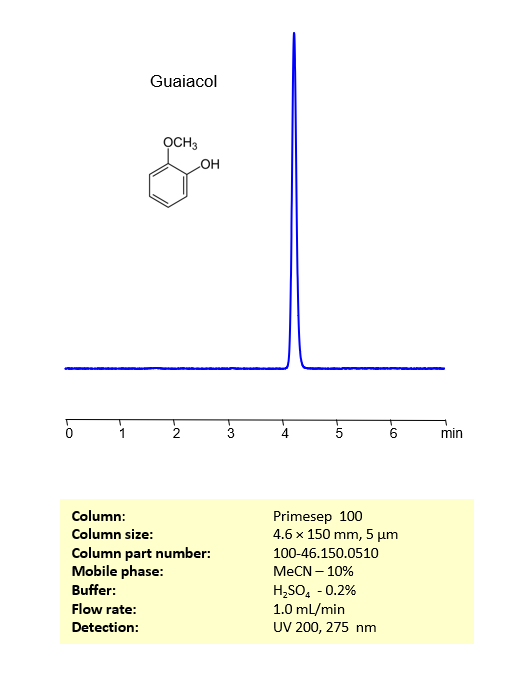
Guaiacol is an organic compound with the chemical formula C7H8O2. It is a naturally occurring substance derived from guaiacum or wood creosote and it is known for its characteristic smoky odor. It can be naturally found in guaiacum wood, creosote, and certain plants or produced synthetically through the methylation of catechol or other methods. Guaiacol appears as a colorless to pale yellow aromatic oil. It is used in various foods as a smoky flavoring. Medically, it has been used in expectorants and antiseptics. Guaiacol derivatives are also used in the pharmaceutical industry. It also serves as a precursor for the synthesis of other chemicals, such as vanillin. It is a phenolic compound, specifically a methoxyphenol. It has a molecular structure consisting of a benzene ring with methoxy (-OCH3) and hydroxyl (-OH) groups attached. UV spectra of Guaiacol and information about its various lambda maxima by visiting the following link.
Guaiacol can be retained and analyzed using a Primesep 100 mixed-mode stationary phase column. The analysis employs an isocratic method with a simple mobile phase comprising water, acetonitrile (MeCN), and sulfuric acid as a buffer. This method allows for detection using UV at 210 nm
Condition
| Column | Primesep 100, 4.6 x 150 mm, 5 µm, 100 A, dual ended |
| Mobile Phase | MeCN/H2O – 10/90% |
| Buffer | H2SO4 – 0.2% |
| Flow Rate | 1.0 ml/min |
| Detection | UV 200, 275 nm |
| Peak Retention Time | 4.21 min |
Description
| Class of Compounds | Phenols |
| Analyzing Compounds | Guaiacol |
Application Column
Primesep 100
Column Diameter: 4.6 mm
Column Length: 150 mm
Particle Size: 5 µm
Pore Size: 100 A
Column options: dual ended