HPLC Chiral Method for Analysis of Ketoprofen Enantiomers on Cyralis AM Column by SIELC Technologies
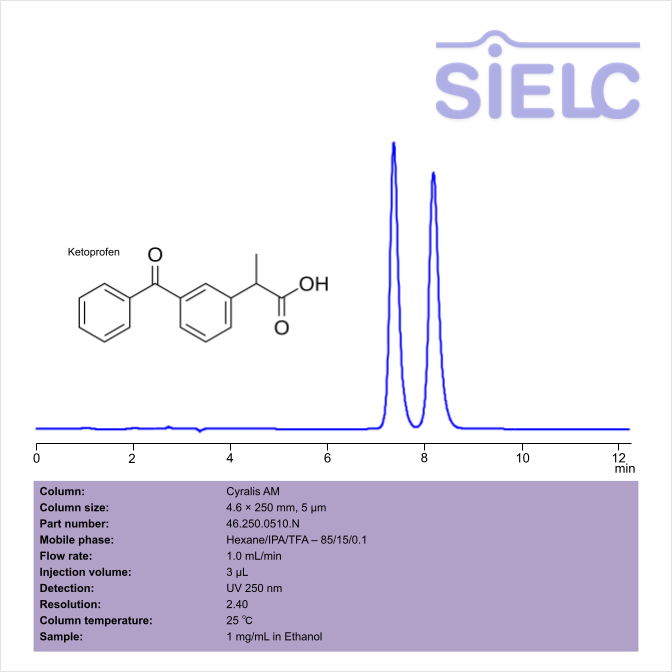
High Performance Liquid Chromatography (HPLC) Method for Analysis of Ketoprofen.
Ketoprofen is a prescription anti-inflammatory drug (NSAID) that is used to treat pain, inflammation, and fever. It is also used in veterinary medicine. It works through inhibiting cyclooxygenase enzymes, which prevents the synthesis of prostaglandins. It can be administered through capsules, topical gel, injections, and patches. It has the chemical formula C16H14O3. You can find detailed UV spectra of Ketoprofen and information about its various lambda maxima by visiting the following link.
This application describes a normal-phase chiral HPLC method for the separation of Ketoprofen enantiomers using SIELC’s Cyralis AM chiral column. Cyralis AM is an amylose-based chiral stationary phase (CSP) designed for enantiomeric separations, optical purity testing, chiral impurity analysis, and stereoisomer characterization in pharmaceutical, chemical, agrochemical, and fine chemical applications.
Ketoprofen can be retained and analyzed using the Cyralis AM stationary phase column. The analysis utilizes an isocratic method with a mobile phase consisting of Hexane, IPA, and TFA. Detection is performed using UV.
Condition
| Column | Cyralis AM, 4.6 x 250 mm, 5 µm, 100 A, normal phase |
| Mobile Phase | Hexane/IPA/Ethanolamine |
| Flow Rate | 1.0 mL/min |
| Detection | UV 250 nm |
| Resolution | 2.40 |
Description
| Class of Compounds | Drug |
| Analyzing Compounds | Ketoprofen |
Application Column
Cyralis AM
Column Diameter: 4.6 mm
Column Length: 250 mm
Particle Size: 5 µm
Pore Size: 100 A
Column options: normal phase