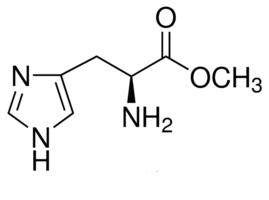
| CAS Number | 1499-46-3 |
|---|---|
| Molecular Formula | C7H11N3O2 |
| Molecular Weight | 169.18 |
| InChI Key | BXRMEWOQUXOLDH-LURJTMIESA-N |
| LogP | -0.6 |
| Synonyms |
|
Applications:
HPLC Method for Separation of Histidine, Histidine Methyl Ester and Histidine lauryl Ester on BIST B+ Column
March 23, 2023
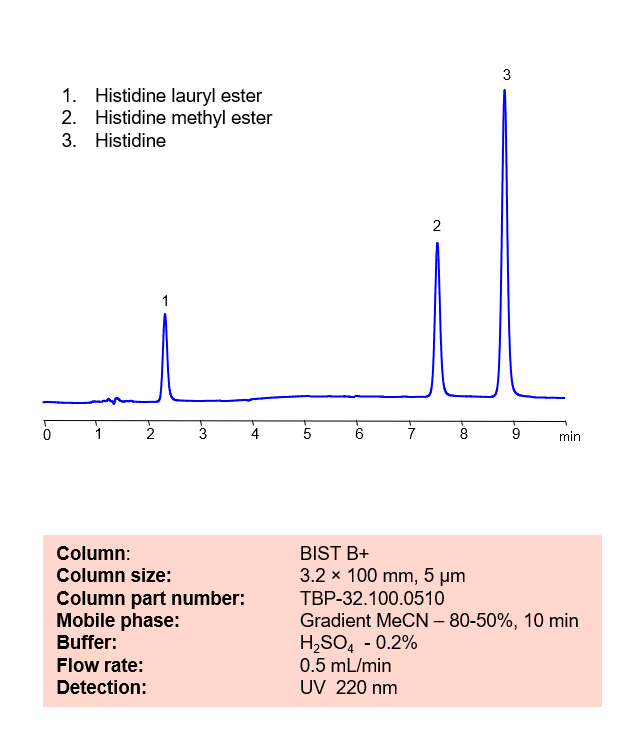
HPLC Method for Separation of Histidine, Histidine Methyl Ester, and Histidine Lauryl Ester on BIST B+ by SIELC Technologies
Histidine is an essential amino acid with the chemical formula C9H9N3O2. It cannot be produced within the body and must be obtained through consuming it. It s fundamental for repair of damaged tissue, growth of muscles, and making of blood cells through biosynthesis of protein. Outside of protein, it also has the unique property of being able to act as a buffer to help maintain stable pH levels in the body. Sources of it include meat, fish, dairy products, beans, and nuts. Histidine, is also typtically found in meat, poultry, and also cereal grains (like rice, wheat, and rye). You can find detailed UV spectra of Histidine and information about its various lambda maxima by visiting the following link.
Histidine Methyl Ester, also written as HME, is a histidine decarboxylase inhibitor with the chemical formula with the chemical formula C7H11N3O2. It can be used to synthesize other biological compounds.
Histidine Lauryl Ester is another derivative of Histidine.
Using SIELC’s newly introduced BIST™ method, Histidine methyl ester, Histidine can be retained and separated on a positively charged, anion-exchange BIST B+ column. There are two keys to this retention method: 1) a multi-charged, negative buffer, such as Sulfuric acid (H2SO4), which acts as a bridge, linking the positively charged dipeptide to the positively charged column surface and 2) a mobile phase consisting mostly of organic solvent (such as MeCN) to minimize the formation of a solvation layer around the charged analytes. Using this new and unique analysis method, Histidine and its derivatives can be UV detected at 220 nm.
Condition
| Column | BIST B+, 3.2 x 100 mm, 5 µm, 100 A, dual ended |
| Mobile Phase | Gradient MeCN – 80 – 50%, 10 min |
| Buffer | H2SO4 – 0.2% |
| Flow Rate | 0.5 ml/min |
| Detection | UV 220 nm |
| Peak Retention Time | 2.2 min, 7.5 min, 8.9 min |
Description
| Class of Compounds | Amino acid |
| Analyzing Compounds | Histidine methyl ester, Histidine |
Application Column
BIST B+
Column Diameter: 3.2 mm
Column Length: 100 mm
Particle Size: 5 µm
Pore Size: 100 A
Column options: dual ended
Histidine methyl ester

HPLC Method For Analysis Of Histidine and Histidine Methyl Ester Dihydrochloride on Primesep 100 Column
January 27, 2022
HPLC Method for L-Histidine hydrochloride monohydrate, Histidine, Histidine methyl ester on Primesep 100 by SIELC Technologies
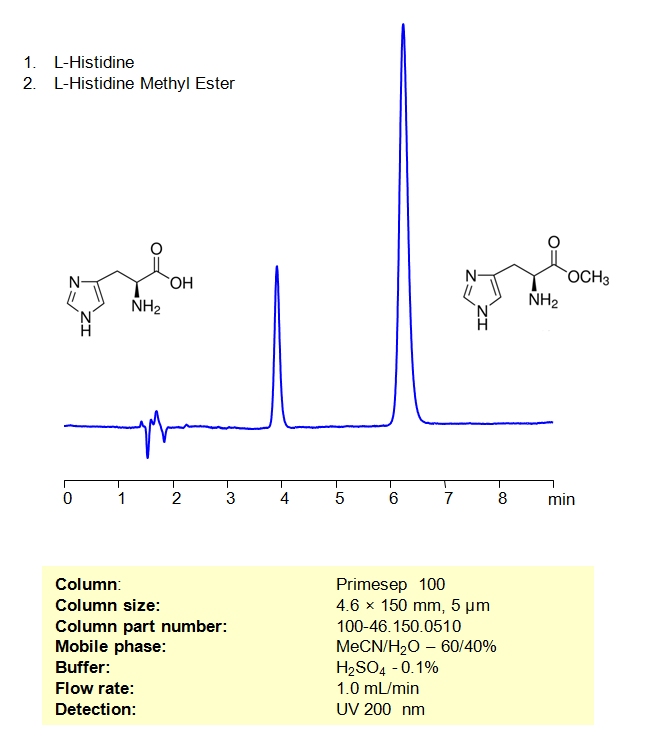
High Performance Liquid Chromatography (HPLC) Method for Analysis of L-Histidine hydrochloride monohydrate, Histidine, Histidine methyl ester.
L-Histidine is an essential amino acid with the chemical formula C9H11N3O2. It cannot be produced within the body and must be obtained through consuming it. It s fundamental for repair of damaged tissue, growth of muscles, and making of blood cells. Outside of protein, it also has the unique property of being able to act as a buffer to help maintain stable pH levels in the body. Sources of it include meat, fish, dairy products, beans, and nuts. You can find detailed UV spectra of Histidine and information about its various lambda maxima by visiting the following link.
Histidine Methyl Ester, also written is HME, is an irreversible histidine decarboxylase inhibitor with the chemical formula C7H11N3O2.
L-Histidine hydrochloride monohydrate, Histidine, Histidine methyl ester can be retained and analyzed using the Primesep 100 stationary phase column. The analysis utilizes an isocratic method with a simple mobile phase consisting of water and acetonitrile (MeCN) with a Sulfuric Acid buffer. Detection is performed using UV.
| Column | Primesep 100, 4.6 x 150 mm, 5 µm, 100 A, dual ended |
| Mobile Phase | MeCN/H2O – 60/40% |
| Buffer | H2SO4 – 0.1% |
| Flow Rate | 1.0 ml/min |
| Detection | UV, 200 nm |
| Class of Compounds |
Amino acid |
| Analyzing Compounds | L-Histidine hydrochloride monohydrate, Histidine, Histidine methyl ester |
Application Column
Primesep 100
Column Diameter: 4.6 mm
Column Length: 150 mm
Particle Size: 5 µm
Pore Size: 100 A
Column options: dual ended
Histidine methyl ester
L-Histidine hydrochloride monohydrate
