
| CAS Number | 305-84-0 |
|---|---|
| Molecular Formula | C9H14N4O3 |
| Molecular Weight | 226.23 |
| InChI Key | CQOVPNPJLQNMDC-ZETCQYMHSA-N |
| LogP | -3.3 |
| Synonyms |
|
Applications:
HPLC Method for Analysis of Carnosine (beta-alanyl-L-histidine) on Primesep 100 Column
February 15, 2023
HPLC Method for Analysis of Carnosine (beta-alanyl-L-histidine) on Primesep 100 by SIELC Technologies
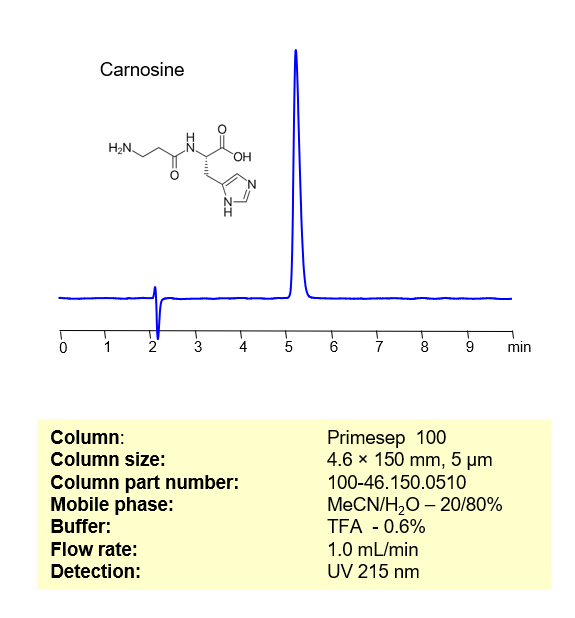
Carnosine is a dipeptide molecule with the chemical formula C9H14N4O3. It is synthesized from beta-alanine and histidine. It is a naturally occurring pH buffer. It is found in muscles and brain tissue, but is produced in the liver. Some use it as a nutritional supplement, but it can be used in topical applications to reduce wrinkles.
Carnosine (beta-alanyl-L-histidine) can be retained and analyzed on a mixed-mode Primesep 100 column with a mobile phase consisting of water, Acetonitrile (MeCN), and Trifluoroacetic acid (TFA). This analytical method can be UV detected at 215 nm with high resolution and peak symmetry.
Condition
| Column | Primesep 100, 4.6 x 150 mm, 5 µm, 100 A, dual ended |
| Mobile Phase | MeCN/H2O – 20/80% |
| Buffer | TFA – 0.6% |
| Flow Rate | 1.0 ml/min |
| Detection | UV 215 nm |
| Peak Retention Time | 5.21 min |
Description
| Class of Compounds | Phenols |
| Analyzing Compounds | Carnosine (beta-alanyl-L-histidine) |
Application Column
Primesep 100
Column Diameter: 4.6 mm
Column Length: 150 mm
Particle Size: 5 µm
Pore Size: 100 A
Column options: dual ended

HPLC Method for Analysis of Carnosine (beta-alanyl-L-histidine) on BIST B+ Column
January 18, 2023
HPLC Method for Carnosine (beta-alanyl-L-histidine) on BIST B+ by SIELC Technologies
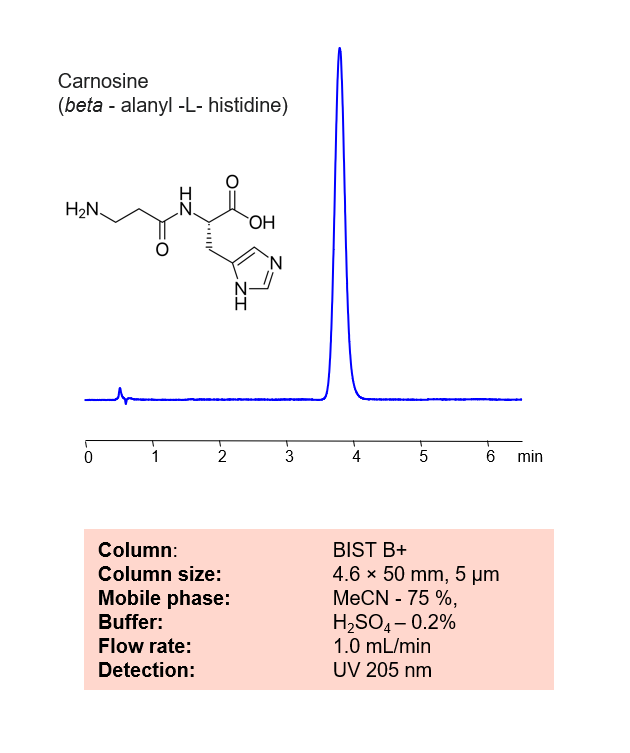
Carnosine is a dipeptide molecule with the chemical formula C9H14N4O3. It is synthesized from beta-alanine and histidine. It is a naturally occurring pH buffer. It is found in muscles and brain tissue, but is produced in the liver. Some use it as a nutritional supplement, but it can be used in topical applications to reduce wrinkles.
Using SIELC’s newly introduced BIST™ method, Carnosine (beta-alanyl-L-histidine) can be retained on a positively charged, antion-exchange BIST B+ column. There are two keys to this retention method: 1) a multi-charged, negative buffer, such as Sulfuric acid (H2SO4), which acts as a bridge, linking the positively charged peptide to the positively charged column surface and 2) a mobile phase consisting mostly of organic solvent (such as MeCN) to minimize the formation of a solvation layer around the charged analytes. Using this new and unique analysis method, Carnosine can be separated, retained, and UV detected at 205 nm.
Condition
| Column | BIST B+, 4.6 x 50 mm, 5 µm, 100 A, dual ended |
| Mobile Phase | MeCN – 75% |
| Buffer | H2SO4 – 0.2% |
| Flow Rate | 1.0 ml/min |
| Detection | UV 205 nm |
| Peak Retention Time | 3.71 min |
Description
| Class of Compounds | Dipeptide |
| Analyzing Compounds | Carnosine (beta-alanyl-L-histidine) |
Application Column
BIST B+
Column Diameter: 4.6 mm
Column Length: 50 mm
Particle Size: 5 µm
Pore Size: 100 A
Column options: dual ended
