
| CAS Number | 1260-17-9 |
|---|---|
| Molecular Formula | C22H20O13 |
| Molecular Weight | 492.390 |
| InChI Key | DGQLVPJVXFOQEV-JNVSTXMASA-N |
| LogP | 2.10 |
| Synonyms |
|
Applications:
HPLC Method for Analysis of Carminic acid Extracted from Pepto Bismol Chewable Tablets on Primesep 100 Column
November 24, 2026
HPLC Method for Carminic acid on Primesep 100 by SIELC Technologies
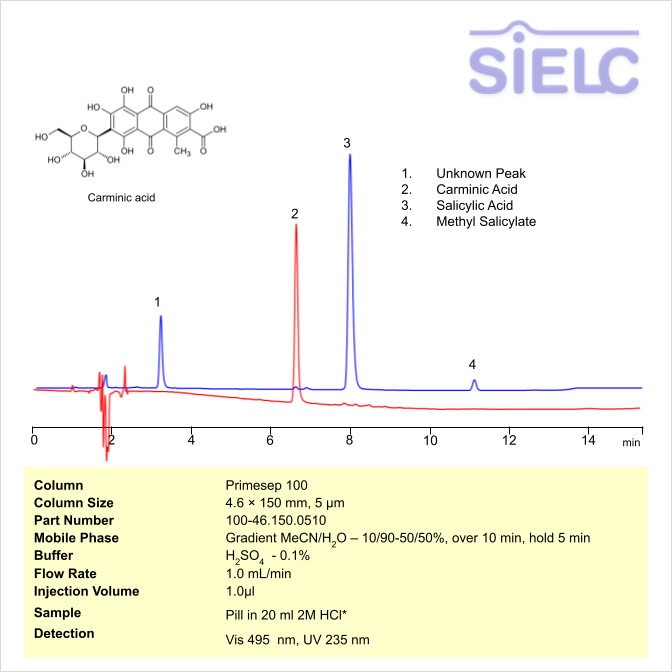
Carminic acid is a glucosidal hydroxyanthrapurin with the formula C22H20O13. It is found primarily in scale insects, especially varieties of cochineal. It is produced as a deterrent for predators. It is also the coloring agent in carmine, which has been used as a dye in Peru since 700 CE.
Salicylic acid (SA) is an o-hydroxybenzoic acid, synthesized by both plants and microorganisms. SA acts as a critical plant hormone regulating various processes, including growth and development, flowering, thermogenesis, ion uptake, stomatal movement, photosynthesis, and plant immunity. Medically, Salicylic acid is used as a topical treatment for a wide variety of skin conditions. It has the chemical formula C7H6O3. You can find detailed UV spectra of Salicylic acid and information about its various lambda maxima by visiting the following link.
Methyl Salicylate, also known as oil of wintergreen and wintergreen oil, is a methyl ester of salicylic acid with the formula C8H8O3. It is used primarily as a flavoring and fragrance in root beer, chewing gum, mints, and more. In medical contexts, it is used as a rubefacient and analgesic in deep heating liniments to treat muscular pain, despite the effects being reported as minimal in double blind studies. You can find detailed UV spectra of Methyl Salicylate and information about its various lambda maxima by visiting the following link.
*Sample was made by dissolving the outer layer of the chewable pill in 20mL of 2M HCl/H2O by using an ultrasonic bath for 15 minutes at 50oC.
Carminic acid, Salicylic acid, Methyl salicylate can be retained, and analyzed using a Primesep 100 mixed-mode stationary phase column. The analysis utilizes a gradient method with a simple mobile phase consisting of water, acetonitrile (MeCN), and sulfuric acid as a buffer. Detection is carried out using Vis.
| Column | Primesep 100, 4.6 x 150 mm, 5 µm, 100 A, dual ended |
| Mobile Phase | Gradient MeCN/H2O – 10/90-50/50%, over 10 min, hold 5 min |
| Buffer | H2SO4 – 0.1% |
| Flow Rate | 1.0 ml/min |
| Detection | Vis 495 nm, UV 235 nm |
| Class of Compounds | Acid |
| Analyzing Compounds | Carminic acid, Salicylic acid, Methyl salicylate |
Application Column
Primesep 100
Column Diameter: 4.6 mm
Column Length: 150 mm
Particle Size: 5 µm
Pore Size: 100 A
Column options: dual ended
Methyl salicylate
Salicylic acid
Vis Detection

HPLC Method for Analysis of Carminic acid Extracted from Carmine on Primesep 100 Column
November 24, 2026
HPLC Method for Carminic acid on (Column not found) by SIELC Technologies
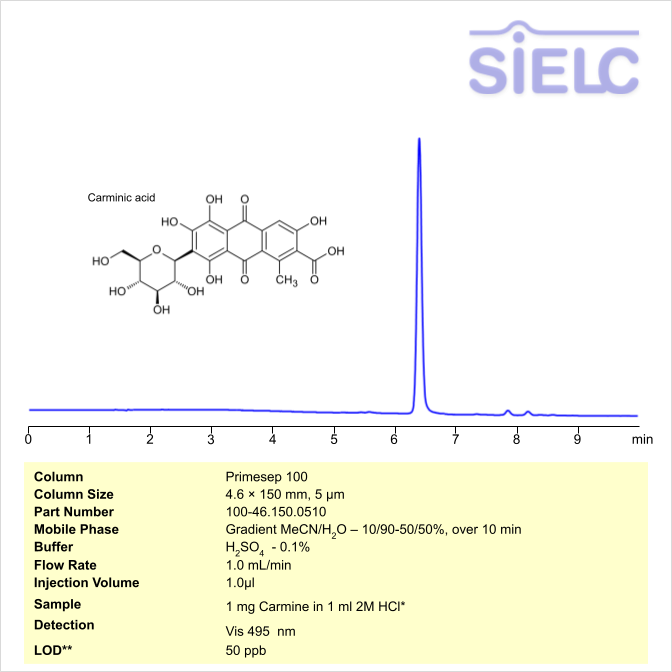
Carminic acid is a glucosidal hydroxyanthrapurin with the formula C22H20O13. It is found primarily in scale insects, especially varieties of cochineal. It is produced as a deterrent for predators. It is also the coloring agent in carmine, which has been used as a dye in Peru since 700 CE.
*Sample was made by dissolving Carmine in 2M HCl/H2O by using an ultrasonic bath for 15 minutes at 50oC.
Carminic acid can be retained, and analyzed using a (Column not found) mixed-mode stationary phase column. The analysis utilizes a gradient method with a simple mobile phase consisting of water, acetonitrile (MeCN), and sulfuric acid as a buffer. Detection is carried out using Vis.
| Column | (Column variation not found) |
| Mobile Phase | Gradient MeCN/H2O – 10/90-50/50%, over 10 min |
| Buffer | H2SO4 – 0.1% |
| Flow Rate | 1.0 ml/min |
| Detection | Vis 495 nm |
| LOD** | 50 ppb |
| Class of Compounds | Acid |
| Analyzing Compounds | Carminic acid |
Separation of Carminic acid on Newcrom R1 HPLC column
May 16, 2018
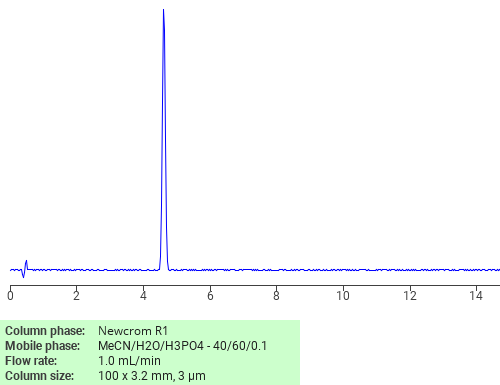
Carminic acid can be analyzed by this reverse phase (RP) HPLC method with simple conditions. The mobile phase contains an acetonitrile (MeCN), water, and phosphoric acid. For Mass-Spec (MS) compatible applications the phosphoric acid needs to be replaced with formic acid. Smaller 3 µm particles columns available for fast UPLC applications. This liquid chromatography method is scalable and can be used for isolation impurities in preparative separation. It also suitable for pharmacokinetics.
Application Column
Newcrom R1
The Newcrom columns are a family of reverse-phase-based columns. Newcrom A, AH, B, and BH are all mixed-mode columns with either positive or negative ion-pairing groups attached to either short (25 Å) or long (100 Å) ligand chains. Newcrom R1 is a special reverse-phase column with low silanol activity.
Select options