Bisphenol A diglycidyl ether

Bisphenol A diglycidyl ether structural formula

CAS Number1675-54-3
Molecular FormulaC21H24O4
Molecular Weight340.420
InChI KeyLCFVJGUPQDGYKZ-UHFFFAOYSA-N
LogP3.47
Synonyms
  • Bisphenol A diglycidyl ether
  • 2,2'-{Propane-2,2-diylbis[(4,1-phenylene)oxymethylene]}bis(oxirane)
  • Oxirane, 2,2'-[(1-methylethylidene)bis(4,1-phenyleneoxymethylene)]bis-
  • 1675-54-3
  • Oxirane, 2,2'-[(1-methylethylidene)bis(4,1-phenyleneoxymethylene)]bis-
  • 2,2'-[(1-Methylethyliden)bis(4,1-phenylenoxymethylen)]bisoxiran
  • 2,2'-[(1-Methylethylidene)bis(4,1-phenyleneoxymethylene)]bisoxirane
  • 2,2'-[(1-methylethylidene)bis(4,1-phenyleneoxymethylene)]bisoxiranne
  • 2,2'-[(1-metiletiliden)bis(4,1-fenilenoximetilen)]bisoxirano
  • 2,2-bis(4-(2,3-epoxypropoxy)phenyl) propane
  • 2,2-Bis(4'-glycidoxyphenyl)propane
  • 2,2-Bis(4'-glycidyloxyphenyl)propane
  • 2,2-Bis(4-hydroxyphenyl)propane diglycidyl ether
  • 2,2-Bis(p-glycidyloxyphenyl)propane
  • 2,2-Bis(p-hydroxyphenyl)propane diglycidyl ether
  • 2,2-Bis[4-(2,3-epoxypropoxy)phenyl]propane
  • 2,2-Bis[4-(2,3-epoxypropyloxy)phenyl]propane
  • 2,2-Bis[p-(2,3-epoxypropoxy)phenyl]propane
  • 2,2-Di(4-glycidyloxyphenyl)propane
  • 4,4'-Bis(2,3-epoxypropoxy)diphenyldimethylmethane
  • 4,4'-Isopropylidenebis[1-(2,3-epoxypropoxy)benzene]
  • 4,4'-Isopropylidenediphenol diglycidyl ether
  • Bis(4-hydroxyphenyl)dimethylmethane diglycidyl ether
  • BISOXIRANE, 2,2'-[(1-METHYLETHYLIDENE)BIS(4,1- PHENYLENEOXYMETHYLENE)]-
  • Bisphenol A bisglycidyl ether
  • BISPHENOL A-DIGLYCIDYLAETHER
  • Dian diglycidyl ether
  • Diglycidyl bisphenol A ether
  • Diglycidyl diphenylolpropane ether
  • Diglycidylbisphenol A
  • Dimethylmethane diglycidyl ether
  • Diomethane diglycidyl ether
  • NSC 5022
  • Propane, 2,2-bis[p-(2,3-epoxypropoxy)phenyl]-
  • 2,2-Bis(p-(2,3-epoxypropoxy)phenyl)propane
  • 2,2-Bis(4-(2,3-epoxypropyloxy)phenyl)propane
  • Bis(4-glycidyloxyphenyl)dimethylmethane
  • 2,2-Bis(p-hydroxyphenyl)propane, diglycidyl ether
  • 2,2-Bis(4-hydroxyphenyl)propane, diglycidyl ether
  • Diglycidyl bisphenol A
  • Diglycidyl ether of 2,2-bis(p-hydroxyphenyl)propane
  • Diglycidyl ether of 2,2-bis(4-hydroxyphenyl)propane
  • Diglycidyl ether of bisphenol A
  • Diglycidyl ether of 4,4'-isopropylidenediphenol
  • p,p'-Dihydroxydiphenyldimethylmethane diglycidyl ether
  • 4,4'-Dihydroxydiphenyldimethylmethane diglycidyl ether
  • EINECS 216-823-5
  • Epoxide A
  • 4,4'-Isopropylidenebis(1-(2,3-epoxypropoxy)benzene)
  • Oligomer 340
  • Propane, 2,2-bis(4-(2,3-epoxypropoxy)phenyl)-
  • Dian-bis-glycidylether
  • UNII-F3XRM1NX4H
  • 2,2-Bis(4-glycidyloxyphenyl)propane
  • 1018476-17-9
  • 116161-20-7
  • 1226906-55-3
  • 170962-54-6
  • 220756-60-5
  • 47424-12-4
  • 64339-51-1
  • 85101-00-4

Applications:

HPLC Chiral Separation of Bisphenol A diglycidyl ether Enantiomers on Cyralis AM Column

July 29, 2026

HPLC Chiral Method for Analysis of Bisphenol A diglycidyl ether Enantiomers on Cyralis AM Column by SIELC Technologies
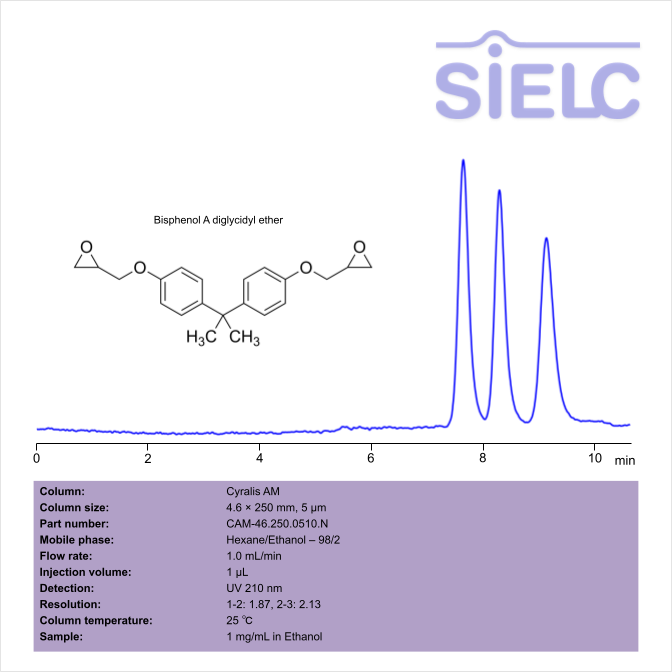
High Performance Liquid Chromatography (HPLC) Method for Analysis of Bisphenol A diglycidyl ether.

Bisphenol A diglycidyl ether (BADGE or DGRBA) is a liquid epoxy resin with the chemical formula C21H24O4. It is a key component of commercially available resins as well as other formulations. It reacts with a variety of compounds to create various resins. For example, if BADGE reacts with acrylic acid, it will produce vinyl ester resin.

This application describes a normal-phase chiral HPLC method for the separation of Bisphenol A diglycidyl ether enantiomers using SIELC’s Cyralis AM chiral column. Cyralis AM is an amylose-based chiral stationary phase (CSP) designed for enantiomeric separations, optical purity testing, chiral impurity analysis, and stereoisomer characterization in pharmaceutical, chemical, agrochemical, and fine chemical applications.

Bisphenol A diglycidyl ether can be retained and analyzed using the Cyralis AM stationary phase column. The analysis utilizes an isocratic method with a mobile phase consisting of Hexane and Ethanol. Detection is performed using UV.

Condition

ColumnCyralis AM, 4.6 x 250 mm, 5 µm, 100 A, normal phase
Mobile PhaseHexane/Ethanol
Flow Rate1.0 mL/min
DetectionUV 210 nm
Resolution1-2: 1.87, 2-3: 2.13

Description

Class of CompoundsResin
Analyzing CompoundsBisphenol A diglycidyl ether

Application Column

Cyralis AM

Column Diameter: 4.6 mm
Column Length: 250 mm
Particle Size: 5 µm
Pore Size: 100 A
Column options: normal phase

Add to cart
Application Analytes:
Bisphenol A diglycidyl ether

Application Detection:
UV Detection
SIELC Technologies usually develops more than one method for each compound. Therefore, this particular method may not be the best available method from our portfolio for your specific application. Before you decide to implement this method in your research, please send us an email to research@sielc.com so we can ensure you get optimal results for your compound/s of interest.

Separation of Bisphenol A diglycidyl ether on Newcrom R1 HPLC column

February 16, 2018
Separation of Bisphenol A diglycidyl ether on Newcrom C18 HPLC column

Bisphenol A diglycidyl ether can be analyzed by this reverse phase (RP) HPLC method with simple conditions. The mobile phase contains an acetonitrile (MeCN), water, and phosphoric acid. For Mass-Spec (MS) compatible applications the phosphoric acid needs to be replaced with formic acid. Smaller 3 µm particles columns available for fast UPLC applications. This liquid chromatography method is scalable and can be used for isolation impurities in preparative separation. It also suitable for pharmacokinetics.

Application Column
Newcrom R1

The Newcrom columns are a family of reverse-phase-based columns. Newcrom A, AH, B, and BH are all mixed-mode columns with either positive or negative ion-pairing groups attached to either short (25 Å) or long (100 Å) ligand chains. Newcrom R1 is a special reverse-phase column with low silanol activity.

Select options
Application Analytes:
Bisphenol A diglycidyl ether
The result was obtained by a proprietary SIELC algorithm. It may deviate from the actual experimental data. The experimental data are available upon request. Contact us before ordering the column as there may be a more suitable column alternative by either e-mail: support@sielc.com or by phone: 847-229-2629.