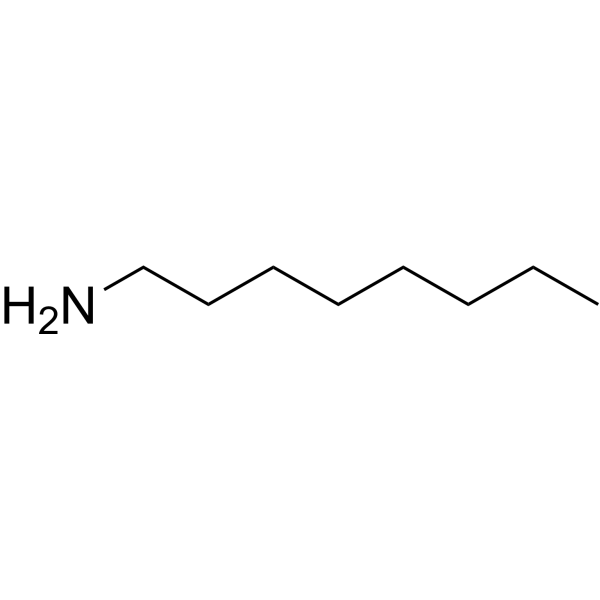
Octylamine

CAS Number111-86-4
Molecular FormulaC8H19N
Molecular Weight129.24
InChI KeyIOQPZZOEVPZRBK-UHFFFAOYSA-N
LogP3.1
Synonyms
  • Octylamine
  • octan-1-amine
  • N-OCTYLAMINE
  • 111-86-4
  • 1-Aminooctane
  • 1-Octanamine
  • 1-Octylamine
  • Caprylamine
  • Caprylylamine
  • Octanamine
  • Armeen 8
  • Armeen 8D
  • Monoctylamine
  • SF0V8U4T67
  • DTXSID8021939
  • GENAMIN 8R
  • NSC-9824
  • CHEBI:7728
  • DTXCID401939
  • RefChem:167904
  • 203-916-0
  • n-Octylamine, mono-
  • Monooctylamine
  • MFCD00008247
  • NSC 9824
  • 149698-79-3
  • EINECS 203-916-0
  • BRN 1679227
  • UNII-SF0V8U4T67
  • octyl amine
  • octyl-amine
  • AI3-11522
  • n-octyl-amine
  • N-Octyl amine
  • 1-octyl amine
  • Amine 8D
  • octane, 1-amino-
  • Octylamine, 99%
  • EC 203-916-0
  • Octylamine, >=99.5%
  • SCHEMBL25545
  • SCHEMBL49773
  • n-C8H17NH2
  • WLN: Z8
  • 4-04-00-00751 (Beilstein Handbook Reference)
  • MLS002222344
  • SCHEMBL233652
  • SCHEMBL236570
  • SCHEMBL268590
  • Octylamine, analytical standard
  • orb3022093
  • SCHEMBL1369586
  • SCHEMBL1403811
  • SCHEMBL1535267
  • SCHEMBL2248611
  • SCHEMBL2973479
  • SCHEMBL3861194
  • SCHEMBL4738004
  • SCHEMBL9602166
  • CHEMBL1160509
  • SCHEMBL17889059
  • NSC9824
  • STR03145
  • Tox21_200052
  • SBB059986
  • STL484288
  • AKOS009075839
  • EBC-446066
  • NCGC00090924-01
  • NCGC00090924-02
  • NCGC00257606-01
  • Octylamine, puriss., >=99.0% (GC)
  • BP-21015
  • BP-31176
  • CAS-111-86-4
  • SMR001253809
  • CS-0076038
  • NS00008237
  • O0045
  • ST45027490
  • EN300-22061
  • C01740
  • F099074
  • Q2013954
  • F2190-0498
  • 6E6D539B-16BC-4721-9F9E-13E1C44995DE
  • InChI=1/C8H19N/c1-2-3-4-5-6-7-8-9/h2-9H2,1H
  • FKZ

Applications:

Uv-Vis Spectrum of Octylamine

April 1, 2026

Access the UV-Vis Spectrum SIELC Library
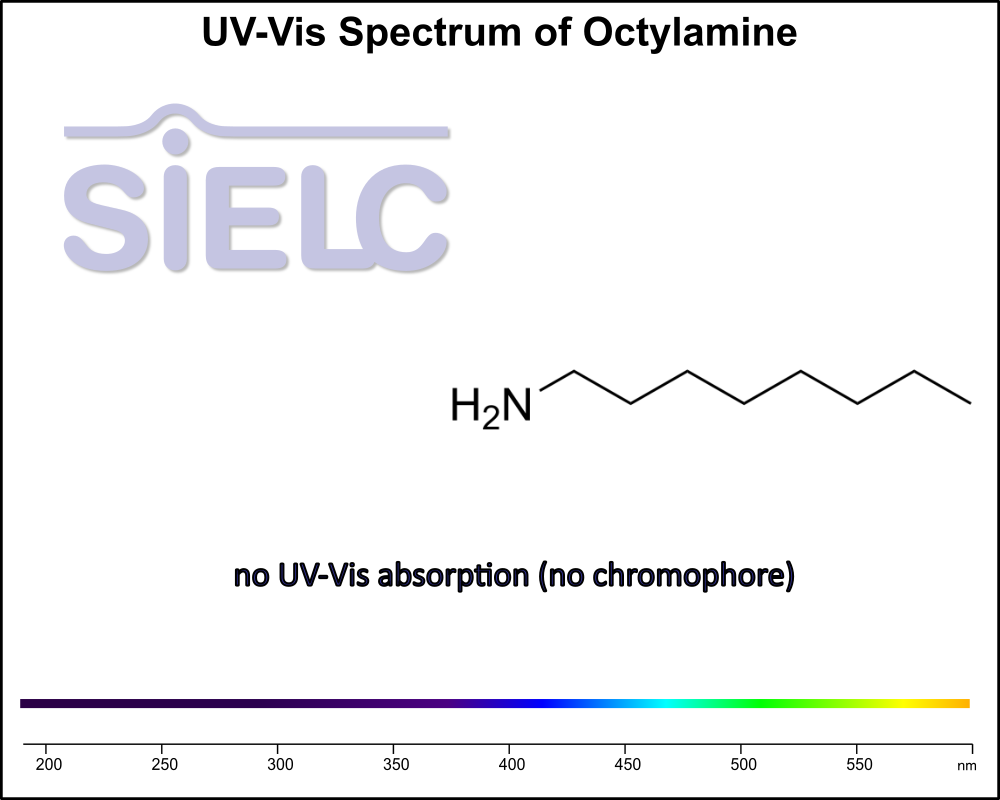
If you are looking for optimized HPLC method to analyze Octylamine check our HPLC Applications library

For optimal results in HPLC analysis, it is recommended to measure absorbance at a wavelength that matches the absorption maximum of the compound(s) being analyzed. The UV spectrum shown can assist in selecting an appropriate wavelength for your analysis. Please note that certain mobile phases and buffers may block wavelengths below 230 nm, rendering absorbance measurement at these wavelengths ineffective. If detection below 230 nm is required, it is recommended to use acetonitrile and water as low UV-transparent mobile phases, with phosphoric acid and its salts, sulfuric acid, and TFA as buffers.
For some compounds, the UV-Vis Spectrum is affected by the pH of the mobile phase. This analysis was done with the mobile phase made of 20% acetonitrile and 80% water.

Application Analytes:
Octylamine
SIELC Technologies usually develops more than one method for each compound. Therefore, this particular method may not be the best available method from our portfolio for your specific application. Before you decide to implement this method in your research, please send us an email to research@sielc.com so we can ensure you get optimal results for your compound/s of interest.