HPLC Method for Melanotan-I, Melanotan-II on Chromni by SIELC Technologies
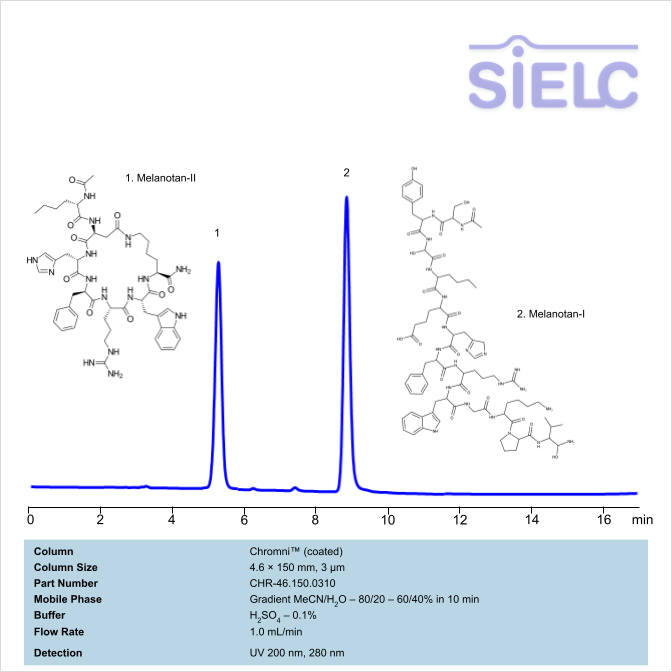
High Performance Liquid Chromatography (HPLC) Method for Analysis of Melanotan-I, Melanotan-II
Melanotan-I is a synthetic analogue of a-melanocyte-stimulating hormone (a-MSH) with the chemical formula C78H111N21O19. It is used primarily to provide photoprotection against UV radiation as well as for patients with erythropoietic protoporphyria to increase pain-free light exposure. It is used “off-label” as a synthetic tanner, for which it is not FDA approved.
Melanotan-II is a synthetic analogue of peptide hormone a-a-melanocyte-stimulating hormone (a-MSH) with the chemical formula C50H69N15O9. It is approved by the FDA to treat sun sensitivity, but unlicense Melanotan II is sold as a tanning agent, though health agencies advise against it due to reports of it being a health risk. It works as a non-selective agonist of the melanocortin receptors.
Melanotan-I, Melanotan-II can be retained and analyzed using the Chromni stationary phase column. The analysis utilizes a gradient method with a simple mobile phase consisting of water and acetonitrile (MeCN) with an sulfuric acid as a buffer. Detection is performed using UV.
| Column | Chromni, 4.6 x 150 mm, 3 µm, 100 A, surface coated |
| Mobile Phase | Gradient MeCN – 80 – 60%, 10 min |
| Buffer | H2SO4 – 0.1% |
| Flow Rate | 1.0 ml/min |
| Detection | UV 200 nm, 280 nm |
| Class of Compounds | Analogue |
| Analyzing Compounds | Melanotan-I, Melanotan-II |
Application Column
Chromni
Column Diameter: 4.6 mm
Column Length: 150 mm
Particle Size: 3 µm
Pore Size: 100 A
Column options: surface coated
Melanotan-II