HPLC Method for Separation of Thiourea, Urea on Primesep S Column by SIELC Technologies
Urea is a white crystalline solid with the chemical formula CO(NH2)2. It has a wide variety of uses including but not limited to as fertilizer, due to its high nitrogen content, In the production of plastics, resins, and adhesives, in the manufacturing of animal feed, and as a raw material in the production of many industrial chemicals. In addition, it is also used as a component in certain skin creams and cosmetics due to its moisturizing properties. You can find detailed UV spectra of Urea and information about its various lambda maxima by visiting the following link.
Thiourea is a versatile chemical compound with the formula (NH2)2CS. It is structurally similar to urea, except that the oxygen atom is replaced by a sulfur atom. It is a white crystalline solid when pure. Thiourea is used in a variety of applications. It is a reagent in organic synthesis, often used in the toning of silver-gelatin photography prints, as a component of hair preparations and bleaches, and as a radioprotective agent in cancer therapy. In agriculture, thiourea is used as a soil treatment agent to promote germination and stimulate flowering and fruiting. You can find detailed UV spectra of Thiourea and information about its various lambda maxima by visiting the following link.
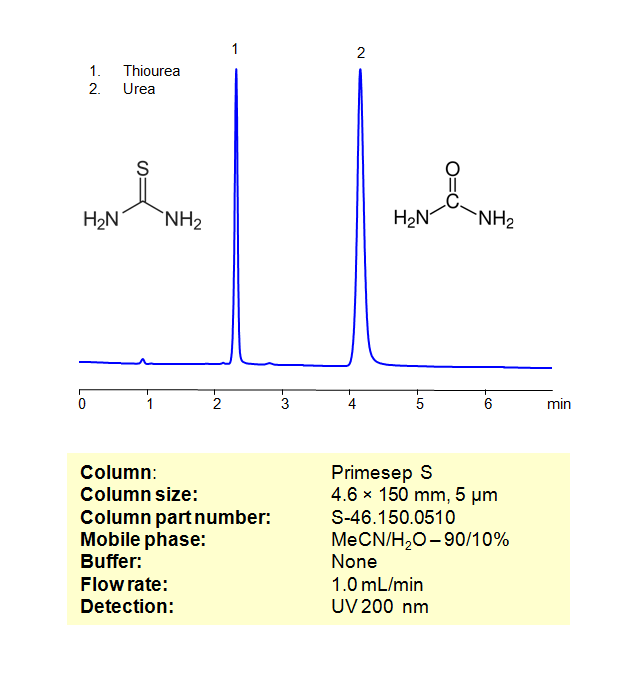
Using a Primesep S normal-phase column and a mobile phase consisting of water and Acetonitrile (MeCN) with no buffer, Thiourea, Urea can be retained, separated, and analyzed. This analysis method can be UV detected at 200 nm.
Condition
| Column | Primesep S, 4.6 x 150 mm, 5 µm, 100 A, dual ended |
| Mobile Phase | MeCN -90% |
| Buffer | No |
| Flow Rate | 1.0 ml/min |
| Detection | UV 200 nm |
Description
Application Column
Primesep S
Column Diameter: 4.6 mm
Column Length: 150 mm
Particle Size: 5 µm
Pore Size: 100 A
Column options: dual ended
Urea