HPLC Method for Trimellitic anhydride, Trimellitic Acid on Newcrom B by SIELC Technologies
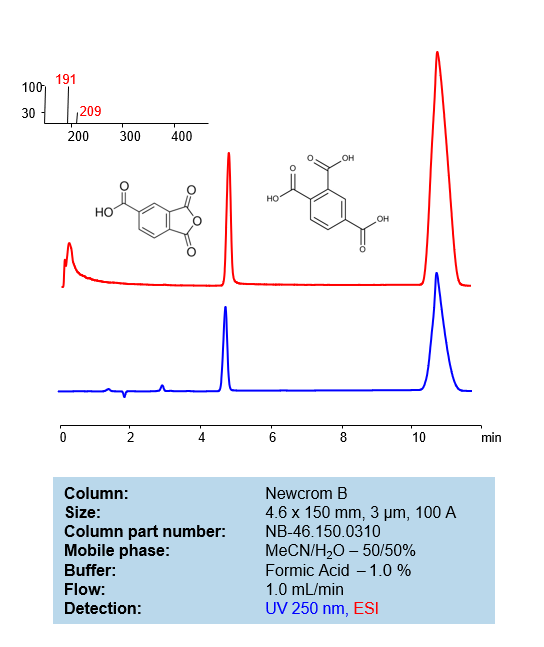
High Performance Liquid Chromatography (HPLC) Method for Analysis of Trimellitic anhydride, Trimellitic Acid.
Trimellitic anhydride is a trifunctional, highly reactive aromatic anhydride with the chemical formula C9H4O5. It is used as a curing agent for epoxy and other resins; in vinyl plasticizers, paints, coatings, dyes, pigments and a wide variety of other manufactured products. It is a common precursor to plasticizers for polyvinyl chloride (PVC). In acidic water, Trimellitic Anhydride will ‘open up’ back into Trimellitic Acid.
Trimellitic Acid is an isomer of benzenetricarboxylic acid with the chemical formula C9H6O6. It is primarily used as carboxylate ligand in the synthesis of a wide range of metal-organic frameworks (MOFs).
Trimellitic anhydride, Trimellitic Acid can be separated, retained, and analyzed on a mixed-mode Newcrom B column with a mobile phase consisting of water, Acetonitrile (MeCN), and Formic acid (FA). This analytical method can be UV detected at 250 nm or via negatively-charged Electrospray Ionization (ESI-) with high resolution and peak symmetry.
| Column | Newcrom B, 4.6 x 150 mm, 3 µm, 100 A, dual ended |
| Mobile Phase | MeCN/H2O -50/50% |
| Buffer | Formic Acid- 1.0% |
| Flow Rate | 1.0 ml/min |
| Detection | UV 250 nm, ESI |
| Class of Compounds | Acid, Hydrophilic |
| Analyzing Compounds | Trimellitic anhydride, Trimellitic Acid |
Application Column
Newcrom B
Column Diameter: 4.6 mm
Column Length: 150 mm
Particle Size: 3 µm
Pore Size: 100 A
Column options: dual ended
Trimellitic anhydride