HPLC Method for Analysis of Selenious Acid on Chromni Column by SIELC Technologies
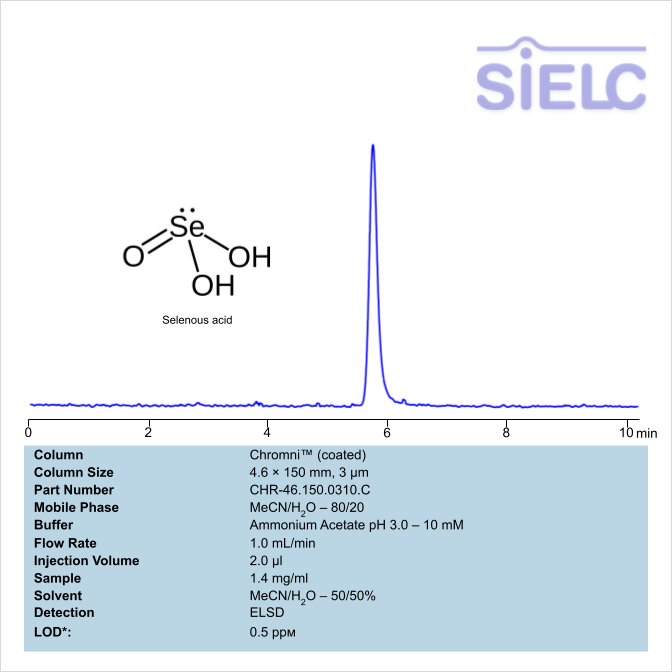
High Performance Liquid Chromatography (HPLC) Method for Analysis of Selenious Acid.
Selenous Acid, also known as selenious acid, is a compound with the formula H2SeO3. It is used primarily to change the color of steel when used in a process with copper (II) nitrate and nitric acid. The process, known as cold-bluing, causes steel to change from a grey to blue-grey or even black. It can be used to darken other metals as well. You can find detailed UV spectra of Selenious Acid and information about its various lambda maxima by visiting the following link.
Selenious Acid can be retained and analyzed using the Chromni stationary phase column. The analysis utilizes an isocratic method with a simple mobile phase consisting of water and acetonitrile (MeCN). Detection is performed using ELSD.
Condition
| Column | Chromni, 4.6 x 150 mm, 3 µm, 100 A, surface coated |
| Mobile Phase | MeCN/H2O – 80/20 |
| Buffer | AmAc pH 3.0 – 10 mM |
| Flow Rate | 1.0 ml/min |
| Detection | ELSD, the nebulizer and evaporator temperatures 50°C with a gas flow rate of 1.6 Standard Liters per Minute (SLM) |
| LOD* | 0.5 ppm |
Description
| Class of Compounds | Acid |
| Analyzing Compounds | Selenious Acid |
Application Column
Chromni
Column Diameter: 4.6 mm
Column Length: 150 mm
Particle Size: 3 µm
Pore Size: 100 A
Column options: surface coated