HPLC Method for Analysis of Glutathione, Glutathione oxidized (GSSG) on Chromni Column by SIELC Technologies
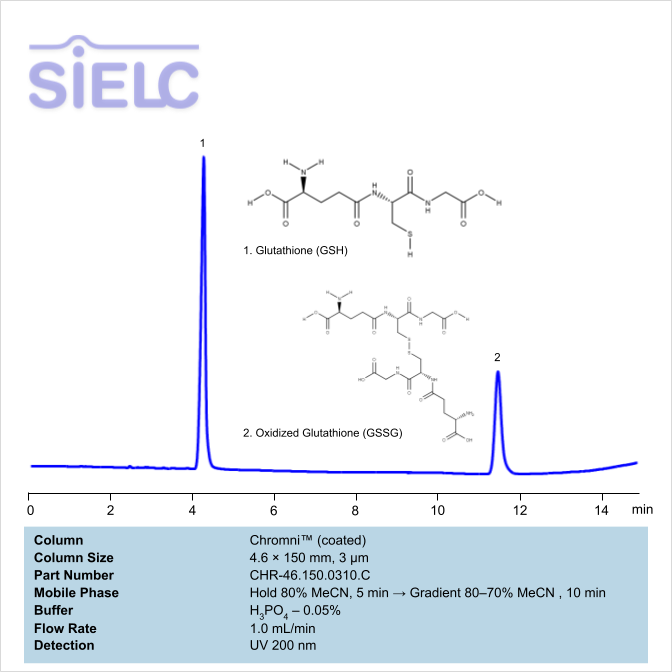
High Performance Liquid Chromatography (HPLC) Method for Analysis of Glutathione, Glutathione oxidized (GSSG).
following link.
Glutathione, reduced (GSH) is a tripeptide (small protein) consisting of the amino acids glutamic acid, cysteine, and glycine. It has the chemical formula C10H17N3O6S. GSH serves as an antioxidant, helping to prevent damage to cellular components caused by reactive oxygen species such as free radicals and peroxides. In fact, it is the most prevalent endogenous antioxidant, protecting cells from damage by neutralizing harmful free radicals and reactive oxygen species. It also regenerates other antioxidants, like vitamins C and E, from their oxidized forms. It contributes to the neutralization of many different types of harmful substances, such as pollutants, heavy metals, and some drugs, thereby aiding in the detoxification process. Not only that, it plays a crucial role in the proper function of white blood cells, including T cell lymphocytes—the foundation of adaptive immunity. Low levels of glutathione have been linked to several diseases, including cancer, neurodegenerative disorders such as Parkinson’s disease, cardiovascular diseases, and HIV/AIDS. Additionally, glutathione levels typically decrease with age, which can contribute to the aging process. Glutathione is primarily synthesized in the liver and then distributed to other tissues in the body. It can also be obtained from some foods, especially fruits, vegetables, and meats. You can find detailed UV spectra of Glutathione and information about its various lambda maxima by visiting the following link.
Oxidized glutathione, or glutathione disulfide (GSSG), is a form of the antioxidant molecule glutathione with the chemical formula C20H32N6O12S2. Glutathione exists in two forms: the reduced form (GSH), which is the active antioxidant, and the oxidized form (GSSG). When glutathione neutralizes a free radical or a reactive oxygen species, it becomes oxidized and forms GSSG. The ratio of GSH to GSSG within cells is often used as a measure of cellular oxidative stress. The body can convert GSSG back into the active GSH form using an enzyme called glutathione reductase, provided there are adequate levels of NADPH, a compound integral to many cellular processes, including the antioxidant response.
Glutathione, Glutathione oxidized (GSSG) can be retained and analyzed using the Chromni stationary phase column. The analysis utilizes a gradient method with a simple mobile phase consisting of water and acetonitrile (MeCN) and phosphoric acid. Detection is performed using UV.
Condition
| Column | Chromni, 4.6 x 150 mm, 3 µm, 100 A, surface coated |
| Mobile Phase | MeCN/H2O |
| Buffer | H3PO4 – 0.05% |
| Flow Rate | 1.0 ml/min |
| Detection | UV 200 nm |
Description
| Class of Compounds | Amino Acids |
| Analyzing Compounds | Glutathione, Glutathione oxidized (GSSG) |
Application Column
Chromni
Column Diameter: 4.6 mm
Column Length: 150 mm
Particle Size: 3 µm
Pore Size: 100 A
Column options: surface coated
Glutathione oxidized (GSSG)