HPLC Method for 2-Phosphonobutane-1,2,4-tricarboxylic acid on Newcrom BH by SIELC Technologies
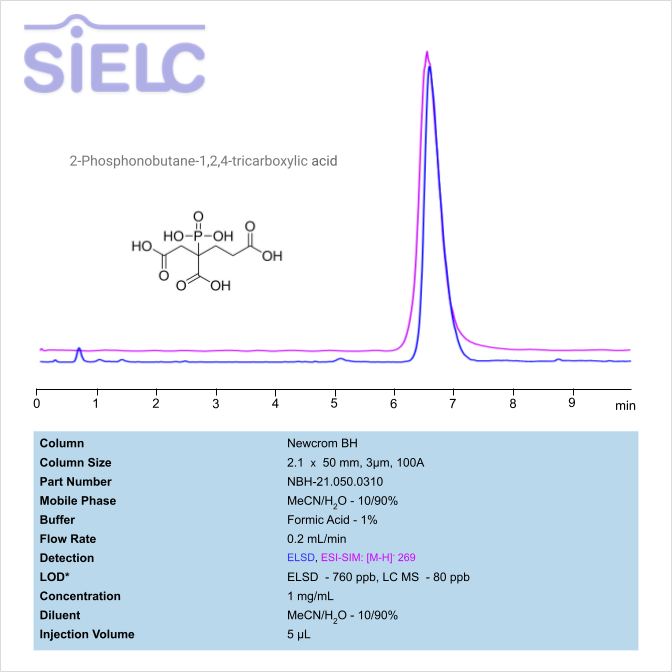
High Performance Liquid Chromatography (HPLC) Method for Analysis of 2-Phosphonobutane-1,2,4-tricarboxylic acid.
PBTC (2-phosphonobutane-1,2,4-tricarboxylic acid) is one of the most widely used scale inhibitors in the cooling water treatment industry. It works through binding with metal ions, therefore preventing them from forming scale. It is widely used especially due to performing well under harsh conditions like high temperatures and high alkalinity.
Using a mixed-mode column and a mobile phase consisting of acetonitrile (ACN) and water containing formic acid as a buffer, 2-phosphonobutane-1,2,4-tricarboxylic acid can be effectively retained and detected by LC–MS and ELSD.
| Column | Newcrom BH, 2.1 x 50 mm, 3 µm, 100 A, dual ended |
| Mobile Phase | MeCN/H2O – 20/80% |
| Buffer | Formic acid- 1.0% |
| Flow Rate | 0.2 mL/min |
| Detection | ELSD, ESI-SIM: [M-H]1- 269 |
| Class of Compounds | Acid, Hydrophilic, Ionizable |
| Analyzing Compounds | 2-Phosphonobutane-1,2,4-tricarboxylic acid |
*LOD was determined for this combination of instrument, method, and analyte, and it can vary from one laboratory to another even when the same general type of analysis is being performed.
Application Column
Newcrom BH
Column Diameter: 2.1 mm
Column Length: 50 mm
Particle Size: 3 µm
Pore Size: 100 A
Column options: dual ended
LC MS Detection