HPLC Method for Myelin Basic Protein Peptide Antagonist on Chromni by SIELC Technologies
High Performance Liquid Chromatography (HPLC) Method for Analysis of Myelin Basic Protein Peptide Antagonist
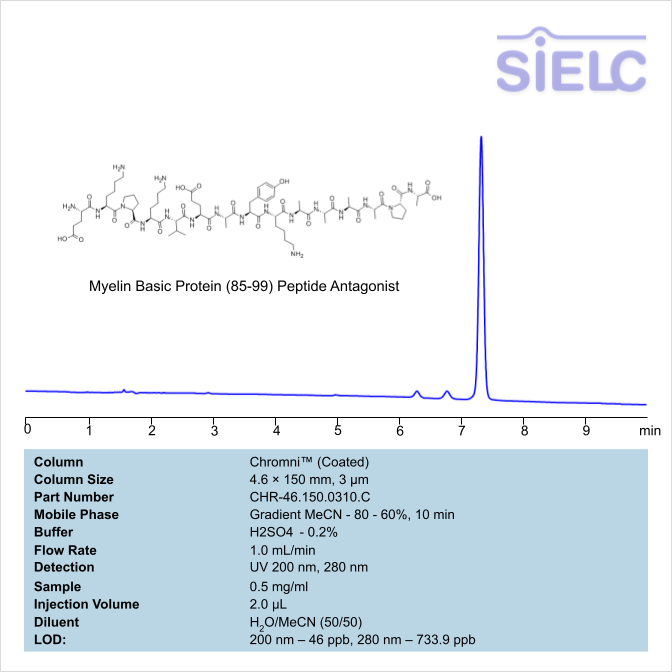
Myelin Basic Protein Peptide Antagonist is a synthetic peptide antagonist with the molecular formula C70H114N18O21 • XCF3COOH. When expressing an MBP (85-99), it inhibits the production of IL-2 in T cell hybridoma cells. MBP peptide antagonist also delays MBP (85-99)-induced experimental autoimmune encephalomyelitis and reduces symptom severity. You can find detailed UV spectra of Myelin Basic Protein Peptide Antagonist and information about its various lambda maxima by visiting the following link.
Myelin Basic Protein Peptide Antagonist is analyzed using a Chromni stationary phase column under gradient conditions with a mobile phase composed of acetonitrile (MeCN) and water. Detection is performed by UV absorbance detection.
| Column | Chromni, 4.6 x 150 mm, 3 µm, 100 A, surface coated |
| Mobile Phase | MeCN/H2O- 80/20 – 60/40%, 10 min |
| Buffer | H2SO4 – 0.2% |
| Flow Rate | 1.0 mL/min |
| Detection | UV 200 nm, UV 280 nm |
| Limit of Detection* | 200 nm – 46 ppb, 280 nm – 733.9 ppb |
| Class of Compounds | Peptide |
| Analyzing Compounds | Myelin Basic Protein Peptide Antagonist |
Application Column
Chromni
Column Diameter: 4.6 mm
Column Length: 150 mm
Particle Size: 3 µm
Pore Size: 100 A
Column options: surface coated