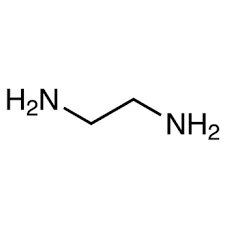
| CAS Number | 107-15-3 |
|---|---|
| Molecular Formula | C2H8N2 |
| Molecular Weight | 60.1 |
| InChI Key | PIICEJLVQHRZGT-UHFFFAOYSA-N |
| LogP | -1 |
| Synonyms |
|
Applications:
Uv-Vis Spectrum of Ethylenediamine
January 26, 2026
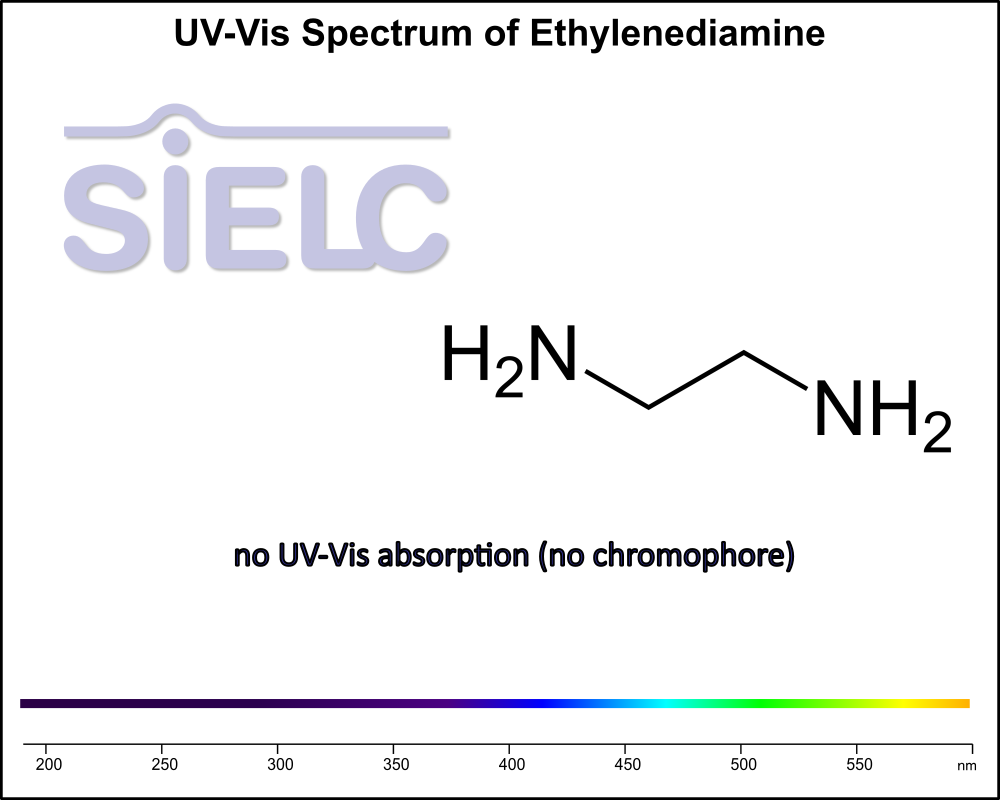
If you are looking for optimized HPLC method to analyze Ethylenediamine check our HPLC Applications library
For optimal results in HPLC analysis, it is recommended to measure absorbance at a wavelength that matches the absorption maximum of the compound(s) being analyzed. The UV spectrum shown can assist in selecting an appropriate wavelength for your analysis. Please note that certain mobile phases and buffers may block wavelengths below 230 nm, rendering absorbance measurement at these wavelengths ineffective. If detection below 230 nm is required, it is recommended to use acetonitrile and water as low UV-transparent mobile phases, with phosphoric acid and its salts, sulfuric acid, and TFA as buffers.
For some compounds, the UV-Vis Spectrum is affected by the pH of the mobile phase. The spectra presented here are measured with an acidic mobile phase that has a pH of 3 or lower.

HPLC Separation of Polyamines on Primesep 500 Column
June 26, 2020
HPLC Method for N-(3-Aminopropyl)-1,3-propanediamine (Norspermidine), Tetraethylenepentamine, Pentaethylenehexamine, N,N'-Bis(3-aminopropyl)-1,3-propanediamine, Ethylenediamine, Polyamines on Primesep 500 by SIELC Technologies

High Performance Liquid Chromatography (HPLC) Method for Analysis of N-(3-Aminopropyl)-1,3-propanediamine (Norspermidine), Tetraethylenepentamine, Pentaethylenehexamine, N,N'-Bis(3-aminopropyl)-1,3-propanediamine, Ethylenediamine, Polyamines.
Polyamines are both naturally occurring and synthetic. The naturally occurring polyamines have a variety of functions including ion channel modulation and biosynthesis of cells. The synthetic polyamines are used in motor oil and epoxy resins. Because of their strong ionic characteristics, they are not retained on reverse-phase columns and strongly retained on anion-exchange columns. In order to separate polyamines with varying numbers of ionic groups, we used a Primesep 500 HPLC mixed-mode column with embedded carboxylic groups of pKa around 5. By lowering the pH of the mobile phase, we can suppress the carboxylic groups on the column making it less retentive to polyamines. We separate the double and triple charged polyamines at one pH, then do a step gradient to lower pH to reduce the retention time and separate higher charged polyamines. The detection can be achieved with CAD or MS.
| Column | Primesep 500, 4.6 x 150 mm, 5 µm, 100 A, dual ended |
| Mobile Phase | H2O |
| Buffer | AmFm pH 3.0 – 20 mM, AmFm pH 3.5 – 20 mM |
| Flow Rate | 1.0 ml/min |
| Detection | CAD |
| Class of Compounds | Hydrophilic, Amines |
| Analyzing Compounds | N-(3-Aminopropyl)-1,3-propanediamine (Norspermidine), Tetraethylenepentamine, Pentaethylenehexamine, N,N'-Bis(3-aminopropyl)-1,3-propanediamine, Ethylenediamine, Polyamines |
Application Column
Primesep 500
Column Diameter: 4.6 mm
Column Length: 150 mm
Particle Size: 5 µm
Pore Size: 100 A
Column options: dual ended
N,N’-Bis(3-aminopropyl)-1,3-propanediamine
N-(3-Aminopropyl)-1,3-propanediamine (Norspermidine)
Pentaethylenehexamine
Polyamines
Tetraethylenepentamine
